


This is Part 2 of a 3-part series breaking down Formula 1: the sport, the business, and the culture behind the fastest show on earth. Read Part 1 here. Whether you're brand new or just filling in the gaps, start here. If you're interested in Formula 1 and how the money works in motorsport, please subscribe.
Part 2: The Business
In 2017, Liberty Media acquired Formula 1 for $4.4 billion. By 2024, the enterprise value had climbed to $22 billion. In 2025, F1 posted $3.87 billion in revenue, up 14% year over year, with operating income rising 28% to $632 million. More than double what the sport generated annually when Liberty took over.
These numbers explain the grid. They explain why certain drivers have seats and others don’t, why Cadillac paid $450 million just to be allowed in the door, and why Apple committed $140 million a year to stream races in the US. Every decision in Formula 1, from who drives the car to who builds it to where the races happen, runs through money.
The Dealmakers
Formula 1’s commercial transformation has a short list of architects.
Stefano Domenicali, the CEO since January 2021, just extended his contract through 2029. Under his leadership, annual revenue has nearly doubled (from $2.1 billion in 2021 to $3.87 billion in 2025), the race calendar has grown to 24 events, and the fanbase has expanded into demographics the sport had never seriously pursued. His stated ambition is to make F1 a cultural event, something that lives beyond the racetrack and enters the broader conversation. The Apple deal, the LVMH partnership, and the push into new markets are all extensions of that thinking.
Behind him sits Liberty Media and its chairman, John C. Malone. Their playbook was straightforward: F1’s fundamentals were strong, but its commercial infrastructure was outdated, and its audience was underleveraged. They invested in digital, leaned into content (Netflix’s Drive to Survive drove US viewership up 67% after its debut), and treated the sport like a media property with a racing problem to solve, rather than the other way around.
At the team level, the business operators matter just as much. Toto Wolff built Mercedes into a three-way ownership split between Mercedes-Benz, INEOS, and himself, each holding a third. Lawrence Stroll sank $235 million into Aston Martin’s infrastructure. Zak Brown turned McLaren from a team posting $75 million losses into one valued at $4.73 billion. These are executives running billion-dollar operations that happen to compete on Sundays.
Revenue: Where It Comes From
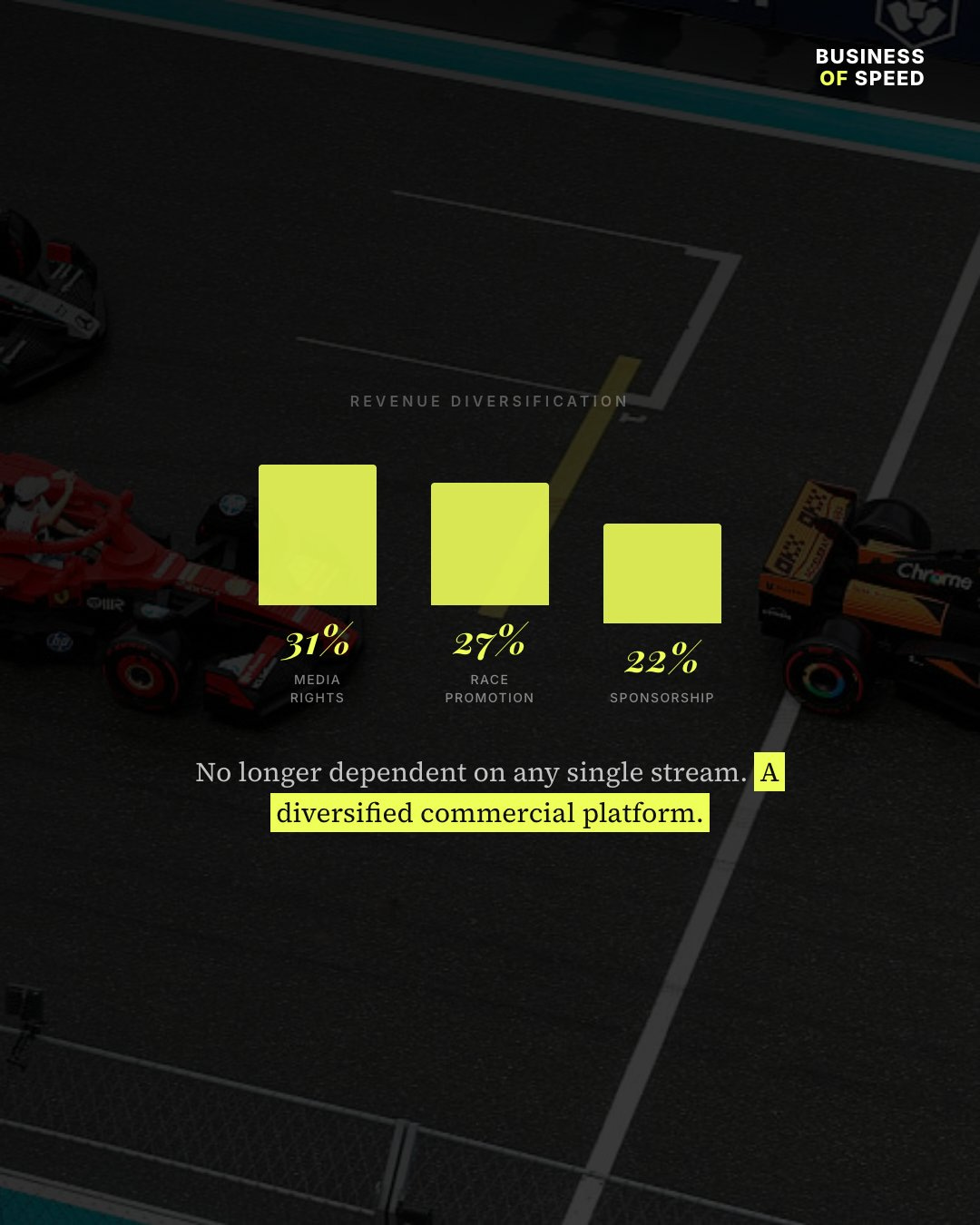
F1’s $3.87 billion breaks down across four streams:
Media rights: 31%. The broadcast money. Apple, Sky Sports, and dozens of regional partners.
Race promotion fees: 27%. Governments and promoters pay between $20 million and $60 million annually for the right to host a Grand Prix. Those fees escalate year over year through contractual clauses, which is part of why the calendar keeps expanding and why cities compete for a slot.
Sponsorship: 22%. F1’s global partner roster has nearly tripled since 2020, from 12 to 31. LVMH signed a 10-year global partnership integrating Louis Vuitton, TAG Heuer, and Moet. LEGO, American Express, Sony, and Santander have all entered.
Everything else: 20%. Hospitality, licensing, F1 TV, merchandise.
No single stream dominates. That balance matters. It means F1 can absorb a downturn in one area without the model breaking.
Revenue: Where It Goes
Liberty Media distributes approximately 45% of annual revenue back to the teams through the Concorde Agreement, the binding commercial contract that governs the sport’s financial structure. In 2025, the prize pool sat around $1.25 billion.
How it gets divided is where the politics live.
Championship position determines the largest share. The Constructors’ Champion receives roughly 14% of the pot. The team finishing tenth gets around 6%. But finishing position alone doesn’t determine the payout.
Ferrari receives a guaranteed 5% of the entire prize fund regardless of where they finish. Written into the Concorde Agreement as recognition of their unbroken presence since 1950. This is why Ferrari topped the 2025 prize money table at $277.7 million despite McLaren winning both championships.


Then there are legacy performance bonuses. Mercedes, because of their dominance during the hybrid era (2014 through 2021), earned roughly $112 million in historical success payments on top of their standard share.
The system rewards sustained excellence, not a single strong year. With Cadillac joining in 2026, the pool now splits eleven ways instead of ten. Their $450 million anti-dilution fee was paid to each existing team as a $45 million lump sum to offset dilution.
The Cost Cap
Before 2021, spending was essentially uncapped. Mercedes, Ferrari, and Red Bull routinely poured over $200 million per season into car development alone, creating a financial moat that made it nearly impossible for smaller teams to compete on merit.
The budget cap changed the math. Initially set at $135 million, it forced top teams to make choices they’d never faced before. Where do you allocate? What do you sacrifice? Which development path gets funded and which gets shelved?
For 2026, the cap sits at $215 million, a 30% increase to account for new regulations and the engineering demands of active aerodynamics and redesigned power units. The principle still holds. You can’t outspend your way to a championship. You have to outthink.
The downstream effects have been real. McLaren reversed a $75 million loss into a $16.7 million profit in 2023. Smaller operations like Haas have become more competitive. The performance gap between the front and back of the grid has narrowed in ways that would have seemed unlikely a decade ago.
Technology as Competitive Advantage
The cost cap created a secondary economy inside F1: technology partnerships that function as performance multipliers without counting against the spending limit.
Oracle’s partnership with Red Bull goes well beyond the logo on the car. Their cloud infrastructure allows Red Bull to run up to four billion race-day simulations, modeling tire wear, weather scenarios, and competitor tactics in real time. Ansys simulation technology, used by the team since 2008, began with aerodynamics and now covers cooling, materials management, and driver safety. Oracle’s own data show that the partnership improved race simulations by 25% and reduced technical faults by 50%.
McLaren’s approach runs through Google. Engineers from the partnership work in the pit lane during race weekends to optimize data.
Dell developed a CFD wind tunnel for McLaren, freeing up budget for other R&D areas under the cap. DP World handles global freight logistics. Dropbox manages content transfer between the factory and the circuit. The head of human performance films pit stops on Android tablets and shares annotated footage with the crew between sessions.
Ferrari chose Amazon Web Services for their CFD simulations, enabling faster and more efficient aerodynamic development cycles.

These arrangements have shifted what a “sponsor” actually means in modern F1. The smartest teams distinguish between companies that buy visibility and companies that contribute operational capability. The latter generates competitive leverage that shows up in lap times.
Team Valuations
In 2019, the average F1 team was valued at roughly $500 million. By late 2025, that number had climbed to $3.6 billion. Every team on the grid is now valued at above $1.5 billion. Four years ago, only four had cleared that threshold.
The top five:
Ferrari: $6.4 billion. The most valuable team for the third consecutive year.
Mercedes: $5.88 billion.
McLaren: $4.73 billion. Valuation up 203% in two years, the largest jump on the grid. Bahrain’s Mumtalakat and Abu Dhabi’s CYVN Holdings completed a takeover at a record $5 billion figure.
Red Bull: $4.32 billion.
Aston Martin: $3 billion.
These valuations are backed by real revenue and a cost structure that the budget cap has made more predictable. The investor profile of F1 has shifted accordingly. Private equity firms like Arctos Partners and HPS Partners have entered the space. Qatar’s sovereign wealth fund took a minority stake in Sauber (now Audi). What was once a playground for wealthy enthusiasts is now attracting institutional capital.
Sponsorship
F1 teams collectively generated $2.04 billion in sponsorship revenue in 2024. The average deal sits at $6.01 million annually, nearly eight times the average NFL sponsorship agreement.
The tiers are steep. A sidepod logo on a top team costs $5 to $7 million per year. A title partnership with McLaren, Ferrari, Mercedes, or Red Bull runs $30 to $70 million annually. Oracle’s deal with Red Bull is reportedly worth $300 million over five years. McLaren announced Mastercard as their naming partner for 2026, reportedly worth $100 million per year.
Those figures only cover the fee. Activation costs, hospitality, and global travel can easily double the investment. A mid-tier brand pursuing a meaningful F1 presence could be looking at $40 to $140 million all in.
This pricing structure means roughly 95% of potential sponsors are priced out. The concentration keeps the commercial ecosystem exclusive but also narrows the pool of potential partners. F1 sponsorship, at the top tier, is a market for tech companies, luxury houses, and sovereign-adjacent capital.
Circuit Economics
Hosting a Grand Prix is expensive and counterintuitive. The race fee alone runs $20 to $60 million, but total operational costs, including infrastructure, insurance, and staffing, push the real figure to $70 to $150 million per event.
General admission barely moves the needle financially. The revenue engine is hospitality. Paddock Club access runs $6,000 to $16,000 per person. Private suites go higher. Monaco yacht experiences reach six figures. Hospitality margins outpace general ticket revenue by a factor of ten, and F1 captures most of the premium.
The Las Vegas model represents where things are heading. Rather than sharing revenue with a local promoter, F1 operates the Vegas event directly and keeps 100% of the proceeds. The 2024 race generated $934 million in economic impact and $45 million in tax revenue.
But the economic impact extends beyond the race itself. Singapore’s Grand Prix drives tourism spending across the broader Asia-Pacific region, with a quarter of American and Canadian attendees adding trips to Japan and nearly a third of Australians continuing on to Indonesia. Melbourne’s 2026 Australian Grand Prix sold out its Friday, Saturday, and Sunday sessions in record time, with 450,000 expected across the weekend and significant spillover into local hospitality and regional tourism.
Most traditional circuits survive through a combination of luxury real estate development, year-round corporate partnerships, and government subsidies. The racing itself is rarely where the profit sits.
Broadcasting
The media rights story is a growth story.
In 2018, ESPN picked up US broadcast rights for F1 at essentially zero cost. Average viewership: 554,000. By 2025, that number had climbed to 1.32 million, with marquee races clearing 2 million. The US fanbase reached 52 million, up 11% year over year.

Apple saw what was building and committed roughly $140 million per year over five years for exclusive US rights. The path from a free ESPN deal to a $700 million Apple commitment says everything about how F1’s commercial trajectory has changed.
Globally, F1 reached 827 million fans in 2025, a 12% increase that pushed it past the NBA as the largest international sports league by fanbase. The 18-to-34 demographic is the fastest-growing segment. Women now make up 42% of the audience, up from 37% in 2018. The F1 movie grossed $630 million, becoming the highest-grossing sports film ever made.
On social media, F1 has led all sports properties for five consecutive years with 2.3 billion total engagements. TikTok growth is at 91%. YouTube at 53%.
These numbers directly inform the value of broadcast deals, sponsorship pricing, and the overall leverage F1 holds in commercial negotiations. When Apple pays $140 million a year, they’re buying access to a young, global, affluent, digitally native audience.
Driver Salaries
Driver pay sits outside the cost cap. Salaries are funded by the team but don’t count against the $215 million development budget, creating a separate market with its own logic.
Max Verstappen leads the grid at a reported $65 million annual base from Red Bull, with performance bonuses pushing his 2025 total to an estimated $76 million. Lewis Hamilton earns approximately $60 million base from Ferrari, with a 2025 total of $70.5 million. Lando Norris, the reigning champion, takes home $20 million from McLaren.
The gap between Verstappen and Norris is notable given that Norris beat him for the title. Driver salary negotiations reflect market timing and leverage at the point of signing. Verstappen’s contract was set when he was dominant. Norris’s was signed before his championship run. That disparity won’t last.
At the back of the grid, rookies earn between $1 and $3 million. Some bring sponsorship funding that subsidizes their seat. The financial spread between the highest- and lowest-paid drivers on the grid is more than 60x.
Sustainability
F1 has committed to reaching Net Zero carbon emissions by 2030, and the business case is increasingly intertwined with the environmental one.
By the end of 2024, the sport had achieved a 26% reduction in carbon emissions against its 2018 baseline. Without any changes to operations, emissions would have actually increased by 10% over that same period, given the calendar’s expansion from 21 to 24 races and attendance growth from 4 million to 6.75 million.
The most visible change for 2026 is the switch to 100% advanced sustainable fuels, made from carbon capture, municipal waste, and non-food biomass. These fuels are designed as “drop-in” replacements, meaning they could work in standard road cars without modification. F1 is essentially using its platform and R&D capacity to develop sustainable fuel technology at a scale and pace that the broader automotive industry can eventually adopt.
Aviation and logistics represent the largest portion of the sport’s footprint. DHL and Qatar Airways, both global partners, have co-invested in sustainable aviation fuel, reducing related emissions by roughly 8,000 tonnes of CO2 in 2024 alone, an approximate 19% reduction for the air freight charter program. Remote broadcast operations have cut travel emissions by 25% compared to 2018.
The sustainability push also functions as a commercial magnet. Partners increasingly evaluate F1 through an ESG lens, and the sport’s ability to demonstrate measurable progress (not just targets) makes it a more attractive platform for brands that need to justify their sponsorship spend to boards and shareholders.
The Flywheel
Revenue growth attracts investors. Investment drives up team valuations. Higher valuations attract more sophisticated sponsors. Sponsorship revenue, combined with prize money, funds development within the cost cap. Better engineering produces better cars. Better cars produce results. Results generate viewership. Viewership makes broadcast rights more valuable.
Liberty Media’s bet was that this cycle existed but was underperforming. Nine years later, revenue has more than doubled, the fanbase has reached demographics the sport never previously engaged, and the average team is worth seven times what it was when they bought in.
The racing is the product. The business is the infrastructure that keeps it running, funds the engineering, pays the drivers, and determines which teams are positioned to compete. One without the other gives you an incomplete picture.
Next in this series: Part 3: The Culture explores the human side of Formula 1, from the rivalries that define eras to the sport’s complicated relationship with its own growing fame.