


Let me tell you what happened this week, and why it didn’t happen by accident.
Apple’s Formula 1 strategy has three chapters. Chapter one was the movie: the Brad Pitt F1 film, an Apple Original, the kind of tentpole content you make to signal you’re serious about a sport. Chapter two was the rights: a reported $120-150 million a year for exclusive US broadcast rights starting with the 2026 season, replacing ESPN and changing the sport's distribution landscape in America overnight.
Chapter three started this week. And it’s the one that actually tells you what Apple is building.
In the span of 48 hours, Apple and Netflix announced a cross-platform deal that would’ve been career-ending to pitch 18 months ago. Apple Maps became the most detailed F1 circuit guide ever made. Apple Fitness+ launched a series where you walk a Grand Prix track while an F1 driver narrates it in your ears. Liberty Media dropped a financial report that reads like a victory lap. Tim Cook teased “a big week ahead” before Apple announced five new products across three days.
None of this is a coincidence. All of it is connected. Together, it tells you exactly what Apple is building and why F1 is the vehicle.
The Deal Nobody Saw Coming
Apple and Netflix are competitors. That’s what makes this so interesting.
On Thursday, the two companies announced a cross-platform F1 content deal. Starting tomorrow, “Drive to Survive” Season 8 will stream simultaneously on Netflix worldwide and on Apple TV in the United States. This is the first time in Netflix’s history that one of its original docuseries has ever appeared on a competing streaming platform. Not once. Not ever.
And it goes both ways.
On May 22-24, Netflix will carry the Canadian Grand Prix live for US subscribers — Netflix’s first-ever live Formula 1 broadcast. Apple TV, which holds exclusive US rights to every other race on the 2026 calendar, is essentially giving away one of its crown jewels.


So why would Apple hand a race to its biggest streaming rival?
Simple. The Indianapolis 500.
Netflix has 300+ million subscribers. Apple needs viewers that weekend, desperately. So this deal helps them twofold. One, by trying to blunt the pain of FOX and IndyCar’s 8 million viewers, and secondly, you expose millions of Netflix households to live F1, give them a taste, then funnel them toward Apple TV for the remaining 23 races.
Eddy Cue, Apple’s SVP of Services, put it plainly: “Netflix has played a pivotal role in growing F1 since Drive to Survive launched, and we’re thrilled to make F1 content more broadly available to U.S. fans.”
What the Broadcast Actually Looks Like
Apple didn’t buy the rights and pass through the international feed. They rebuilt the experience from scratch.
The first practice session hits Friday, March 6, at 8:30 AM ET. The season opener in Melbourne is March 7. The subscription is $12.99/month or $99/year, bundled into Apple One. But here’s the part most people will miss: practice sessions are free, no subscription required. You can watch the cars roll out of the garage on Friday without spending a dollar. Apple is betting that getting you in front of a live F1 session, even once, is enough to convert you.
Here’s the full feature set for paying subscribers:
Multi-view: up to four simultaneous feeds on screen at once
Podium channels: automatically locks to the onboards of the top three drivers
P1 feed: a dedicated channel that always follows whoever is currently leading
Team channels: the international broadcast plus both on-board cameras for your chosen team, with live team radio piped in
Data channel: live timing, gaps, tyre data
Driver tracker: real-time position on circuit
Sky Sports F1: the full UK broadcast, commentary team, and all, as an alternate option
Multiview is available on Apple TV 4K and iPad. It’s also available on Vision Pro.
Read that last sentence again. Apple’s spatial computing headset, the one critics have spent two years asking, “But what do you actually do with it?”, now has a use case that’s genuinely hard to replicate anywhere else. Four onboard cameras simultaneously in a wraparound spatial environment during a live race. That’s a different category of experience entirely.
Ian Holmes, F1’s chief media rights officer, didn’t sugarcoat it: “For US fans, they won’t have been served the sport in this way ever before.”
He’s right. ESPN’s coverage was a Sky rebroadcast. Apple is treating F1 the way it treated MLS when it acquired those rights, as a blank canvas to redefine what watching a sport can feel like. Several races will also be free on Apple TV, and Tubi will carry select events. And I'm sure it learned a few things along the way as well.
By lowering the barrier to entry, Apple is betting on its ecosystem to do the work.
F1 Across Every Service Apple Runs
The broadcast is the most visible part of the deal. The full picture goes much further.
Apple is threading Formula 1 through every service it operates, and a lot of it is free.
Apple Music has a dedicated F1 hub launching with the season: driver-curated warm-up playlists, DJ mixes, and a “Sounds of the Circuit” editorial playlist built around the culture of each race venue. The real sleeper is Apple Music Radio, free live audio commentary on race day, available in the Radio tab with no subscription required. No Apple TV. No paid tier. You can listen to a Grand Prix like a game on the radio while doing something else entirely.
Apple Podcasts has a dedicated F1 hub surfacing the sport’s best shows in one place.
Apple News gets dedicated Grand Prix pages that update in real time: driver and constructor standings, live scoring, interviews, and highlights. Real-time video previews land later in the season.
Apple Sports gets live leaderboards, Lock Screen Live Activities during races, a quick-launch link to Apple TV, and an F1 standings widget you can pin to your iPhone home screen. For the duration of the season, every time someone picks up their phone, they might see the championship standings. That’s ambient F1 living in the most valuable real estate in consumer technology.
ESPN never had this level of distribution. No broadcaster in the history of the sport has had this distribution.

Apple Maps Goes Trackside
Now here’s where it gets interesting.
Apple Maps now offers a fully immersive 3D experience for Formula 1 circuits, and the level of detail is borderline absurd. At Albert Park in Melbourne, every one of the 14 turns is labeled, numbered, and annotated with car speed statistics at that corner. Grandstands and footbridges are rendered in 3D and labeled. The pit building is a standalone 3D landmark. The latest F1 news is embedded directly in the map display. For fans attending in person, the app shows race entrance gates, restrooms, water stations, first aid, merchandise stands, and step-by-step walking directions to individual grandstands.
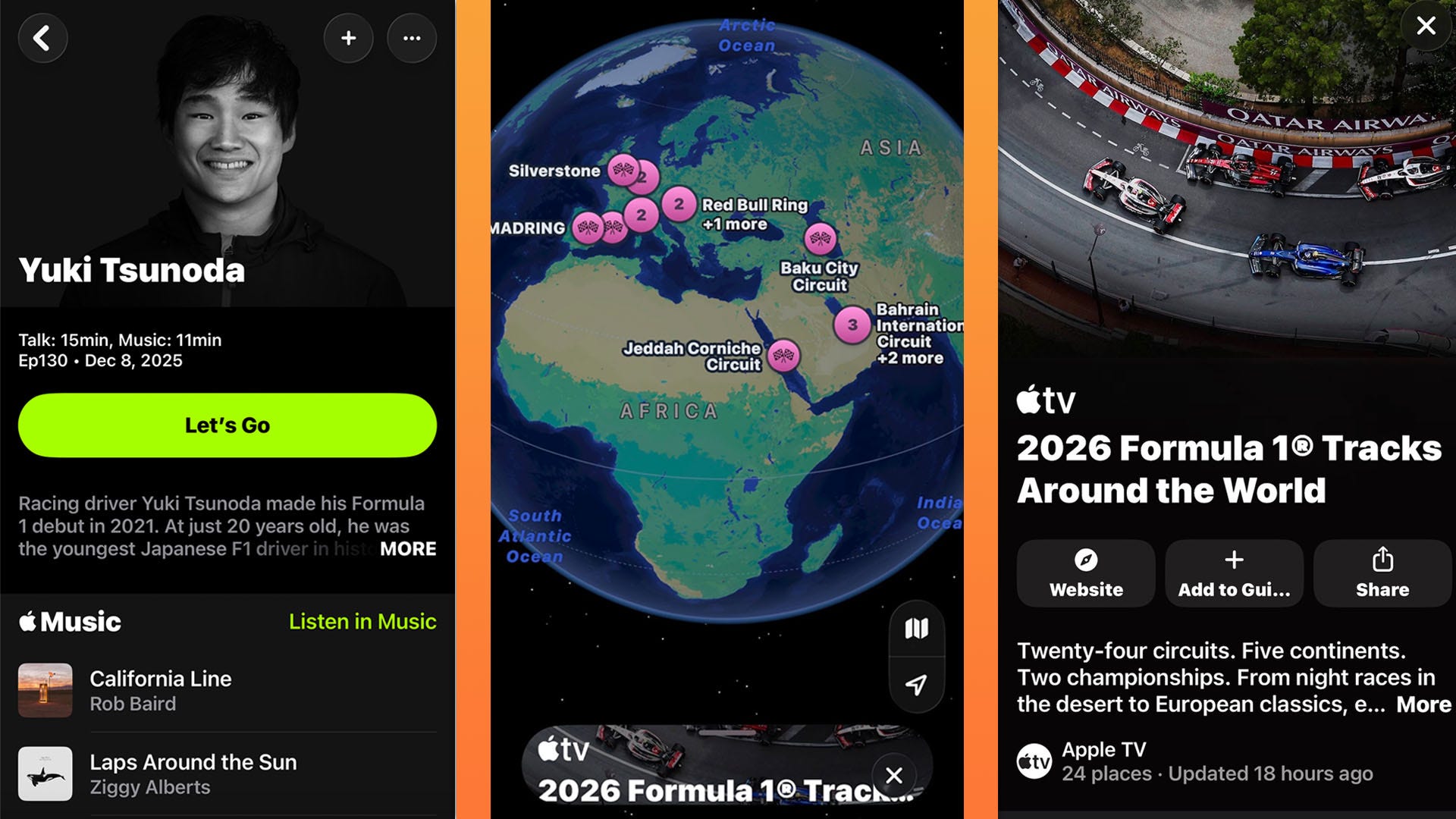
Apple also dropped a “2026 Formula 1 Tracks Around the World” guide inside Maps covering all 24 circuits. Several tracks beyond Melbourne already have upgraded 3D graphics: Circuit Gilles Villeneuve in Montreal, Miami International Autodrome, Monaco, Barcelona-Catalunya, Silverstone, and the Red Bull Ring. More are rolling out as the season progresses.
ESPN never turned a circuit into a navigation tool. No broadcaster in F1 history has done this. Apple Maps shows you the race and walks you to the paddock, the grandstands, the corner where the cars are doing 200 mph. The sport becomes part of your daily digital life in a way that a broadcast window never could.
Apple Fitness+ Sends You to the Track
But wait, there’s more!
Apple Fitness+ just launched a new series called “F1 Walk & Talk,” an extension of the existing “Time to Walk” format where personalities record walking episodes tied to meaningful places. The newest episode features F1 driver Yuki Tsunoda.
The premise: you walk the length of an actual Grand Prix circuit while an F1 driver narrates it in your ears.
Let that land. Apple has connected a sport to your body. Not your screen. Your physical routine. Your morning walk, your lunch break, your 30 minutes of cardio. Apple just made an F1 driver your companion. And because it’s Fitness+, it’s tied to your Apple Watch, your activity rings, your health data.
When did any broadcaster show up in the middle of your workout? They couldn’t. Apple can, and just did.
Liberty Media’s Numbers Validate the Entire Bet
If anyone still needs to justify paying $150 million a year for rights to a sport that barely registered in America a decade ago, Liberty Media’s 2025 annual report is the closing argument.
The headline numbers:
F1 revenue: $3.87 billion, up 14% year-over-year
F1 operating income: $632 million, up 28%
F1 Adjusted OIBDA: $946 million, up 20%
Live viewership: up 21%
Fan attendance: 6.75 million across 24 races, up 4%
Las Vegas GP: 300,000+ weekend attendance, 1.8 billion social impressions
Pull back to the consolidated picture: Liberty posted $4.48 billion in total revenue, up 23%, with consolidated operating income nearly doubling, up 101% to $577 million.
Stefano Domenicali, F1’s President and CEO: “Formula 1 finished another record-breaking season, marking an exceptional 75th anniversary year.”
But the numbers underneath the numbers are even more telling.
Team payments as a percentage of pre-team-payment Adjusted OIBDA actually decreased, from 61.5% to 59.7%. The commercial engine is scaling faster than its obligations to teams. The Concorde Agreement is signed through 2030. New partners are arriving, Standard Chartered called out by name. Portugal returns in 2027-2028. Barcelona is locked through 2032.
Then there’s MotoGP, which Liberty acquired and is already running at scale: $573 million in revenue, up 14%, with operating income surging 86% to $54 million. Fan attendance up 21%. A new Adelaide Grand Prix has been announced for 2027-2032.
Liberty is managing a portfolio of motorsport assets that are compounding in value. Apple didn’t pay $150 million a year for nostalgia. It paid for this trajectory.

Meanwhile, Apple Is Doing Everything Else at the Same Time
Zoom out from F1 for a moment.
On Monday, Apple confirmed Mac mini production is coming to the United States for the first time, with a new factory on its Houston manufacturing campus that will double the site’s footprint. Advanced AI server production at the same facility is already ahead of schedule. A new 20,000-square-foot Advanced Manufacturing Center is opening for workforce training. Tim Cook pegged Apple’s total US investment commitment at $600 billion, citing 20+ billion US-made chips sourced from 24 factories across 12 states.
GlobalWafers’ $4 billion facility in Sherman, Texas, is now producing silicon wafers. Amkor’s $7 billion chip packaging plant in Peoria, Arizona, is under development. TSMC’s Arizona fabs have Apple on track to purchase over 100 million advanced chips in 2026 alone.
And then there’s the product blitz.
Bloomberg’s Mark Gurman reported that Apple plans to introduce at least five products across three days, March 2-4, at “Apple Experience” events in New York, London, and Shanghai. No keynote. Rolling announcements to maximize the news cycle. The expected lineup: a budget MacBook (potentially $599-699), an iPhone 17e, an iPad Air with M4, an entry-level iPad 12, and either a refreshed Mac Studio or Apple Studio Display.
Tim Cook’s tease of “a big week ahead” landed against all of this.
The timing is deliberate. Apple is layering a major product cycle directly on top of its F1 season launch. A new Apple TV subscriber signing up for F1 is also browsing that budget MacBook. Someone headed to Albert Park on March 7 has a new iPhone in their pocket, running the Fitness+ walk they did to prep. The flywheel doesn’t need a memo. It runs itself.
Flywheel?
Here’s what all of this looks like when you stand back and watch it run.
Someone catches the Canadian Grand Prix on Netflix in May. They like what they see. They sign up for Apple TV at $12.99/month for the rest of the season.
But the season already had them in March. They did the Fitness+ “F1 Walk & Talk” with Yuki Tsunoda before the Melbourne opener. The Apple Sports widget showed the standings every time they unlocked their phone. They used Apple Maps to navigate to their grandstand at Albert Park, turn-by-turn, past the corner where the speed stat read 195 mph. Apple Music Radio had live audio commentary during their drive home.
On Vision Pro, they watched four onboard cameras at once.
Their new iPhone 17e, announced the week the season started, is the device running all of it.
Every piece touches every other piece. An operating system for how a sport lives in your life: on your screen, in your ears, in your steps, on your home screen, on your wrist.
ESPN couldn’t build this. Netflix can’t build this. No traditional broadcaster comes close.
The 2026 Formula 1 season hasn’t even started yet. The Australian Grand Prix is on March 7. And in 48 hours, the commercial infrastructure around the sport in the United States was fundamentally restructured.
Apple started with a movie. Then it bought the rights. Now it’s running the ecosystem.


All sounds great, and yet they don't bother to release any of this capability in the home and creator of F1, the UK, so all a bit.... pointless.
Very cool to see what Apple is about to release and integrate across its platforms.
Surprised they couldn’t have done some similar integrations for baseball and MLS to create that same level of stickiness.