


This is Part 1 of a 3-part series breaking down Formula 1: the sport, the business, and the culture behind the fastest show on earth. Whether you’re brand new or just filling in the gaps, start here.
Part 1: The Sport
Formula 1 is the world’s premier open-wheel racing series. Twenty-two drivers, eleven teams, twenty-four races spread across five continents. City streets in Monaco and Singapore. Purpose-built circuits in Silverstone and Suzuka. A global championship that runs from March through December.
Behind each car sits an operation of thousands: aerodynamicists, strategists, data scientists, mechanics, and engineers, all working to shave hundredths of a second off a lap time. The sport rewards precision at every level, from the factory floor to the pit lane to the final corner of the final lap.
Two championships run simultaneously. The Drivers’ Championship crowns the best individual. The Constructors’ Championship determines which team built, strategized, and executed at the highest level across the entire season. The Constructors’ title carries significant prize money, which directly funds next year’s car development. Win both, and you’ve dominated. Lose both, and you’re redesigning the car from the ground up.
The Grid
The 2026 season arrived with the most significant shakeup in years.
Lando Norris enters as the reigning World Champion after edging Max Verstappen by two points in 2025. Two. An entire season decided by a margin that thin.
McLaren took the Constructors’ title alongside him and return with Norris and Oscar Piastri. Ferrari paired Lewis Hamilton (seven-time champion) with Charles Leclerc. Red Bull kept Verstappen and promoted Isack Hadjar from their junior team. Mercedes is running George Russell alongside Kimi Antonelli.
Then there are the new arrivals.
Cadillac became the first new team to enter F1 since Haas in 2016.
Audi took over the former Sauber operation and is racing as a full factory team for the first time. Racing Bulls handed a seat to eighteen-year-old Arvid Lindblad, the only rookie on the grid. And Fernando Alonso, at 44, is still racing for Aston Martin.
The Cars
Every car on the grid is built from scratch. Each season. Teams design, manufacture, and refine their own cars within the FIA’s technical regulations, then continue developing them throughout the year. The car that lines up in Melbourne in March barely resembles the one that crosses the line in Abu Dhabi in December.
A cost cap limits what teams can spend on development. Efficiency in how you allocate that budget matters as much as the budget itself.
For 2026, the cars are running a genuinely new technical package. Active aerodynamics allow front and rear wing elements to adjust their angle based on where the car is on track. Through corners, wings stay shut for maximum downforce, pressing the car into the tarmac. On straights, the flaps open, drag drops, and top speeds push past 320 km/h. This replaces the old DRS system entirely.
The power units are a true 50/50 hybrid: turbocharged internal combustion paired with an electric motor. Half the power comes from electricity. Every car is also running on advanced sustainable fuels for the first time, made from carbon capture and non-food biomass.
The cars themselves are smaller and lighter. Wheelbase reduced by 200mm. Width cut by 100mm. Thirty kilograms were shaved off the minimum weight. More agile. More raceable. That’s the theory, anyway.
How a Race Weekend Works
An F1 weekend is a three-day operation.
Friday brings two free practice sessions, each 60 minutes. Teams experiment with car setup, test tire compounds, and run race simulations. Drivers learn the track.
Saturday starts with a final practice session, then moves into Qualifying. Three rounds. Elimination format.
Q1: all 22 cars on track. The slowest six are cut.
Q2: sixteen remain, another six eliminated.
Q3: the fastest ten fight for pole position.
Sunday is the Grand Prix. Roughly 305 kilometers, or two hours, whichever comes first.
Some weekends run an alternative Sprint format: a condensed qualifying session followed by a 100 km Sprint Race with no mandatory pit stops. Points to the top eight. Short. Aggressive. Very little room for a conservative approach.
Race Day
Five red lights come on, one by one. Then all five go out simultaneously. Twenty-two cars launch toward the first corner at over 300 km/h. More positions change in those opening seconds than in most of the race that follows.
The physical demands on a driver are severe. Forces exceeding 4G under braking and through corners. Around 2G under acceleration. Cockpit temperatures past 50°C. Heart rate between 150 and 170 BPM for nearly 2 hours. Drivers regularly lose 3 kg of body weight in sweat over a single race.
Passing another car at 360 km/h requires three things: opportunity, technology, and nerve.
Slipstreaming means tucking in closely behind the car ahead, using their wake to cut air resistance, then pulling out to make a move.
Overtake Mode lets drivers deploy stored electric energy as a burst of power. Attack into a braking zone. Defend when someone’s coming for you. Being within one second of the car ahead unlocks this advantage under the new regulations.
The technology creates the opening. The driver decides when to take it.
Pit Stops and Tires
Pit strategy is where races are quietly won and lost.
A pit stop involves roughly 20 mechanics executing a rehearsed sequence: all four tires changed in approximately two seconds. Three crew members per wheel. A front jack, a rear jack, and everyone moving in sync. A strong stop gains track position. A mistake (a wheel gun that doesn’t engage, a tire that isn’t seated) can undo an entire afternoon.
Compounds
Teams must use at least two different tire compounds during a dry race:
Softs (red): the fastest compound. Maximum grip, rapid degradation.
Mediums (yellow): balanced performance and durability.
Hards (white): slower, but they last.
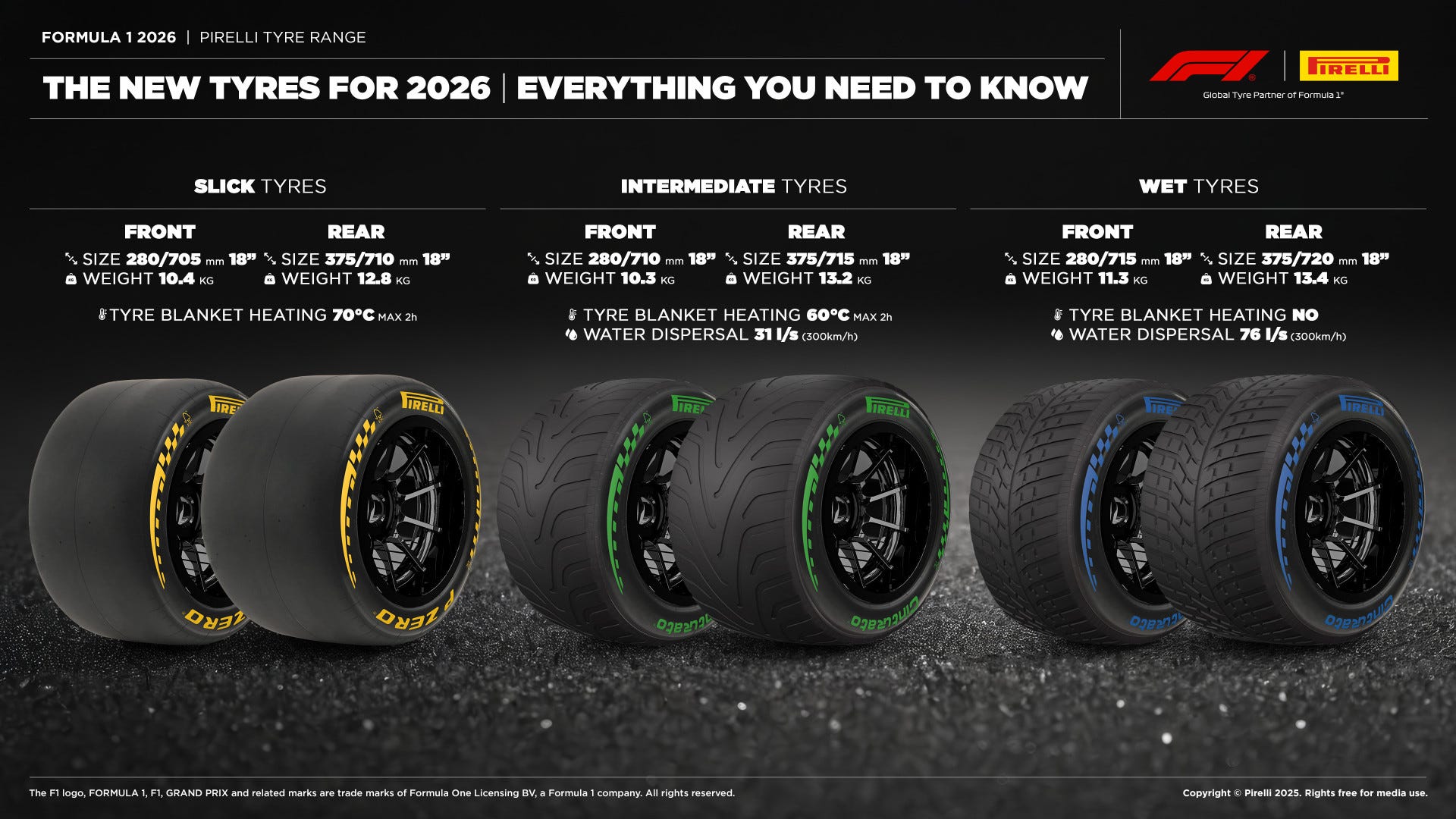
When to switch and how many times to stop are decisions that separate good teams from great ones. A one-stop conserves time in the pits but demands careful tire management over a longer stint. A two-stop is faster on raw pace but burns roughly 20 extra seconds in the pit lane. The math shifts lap by lap depending on wear, conditions, and what your rivals are doing.
When it rains, the equation resets entirely. Intermediates handle both damp and drying surfaces. Full Wets displace standing water. Visibility drops to almost nothing, and driver instinct matters more than car performance. Some of the most memorable results in the sport’s history have come from wet races where the usual order collapsed.
The Pit Wall
Twenty-two drivers get the attention, but this is a team sport staffed by hundreds.
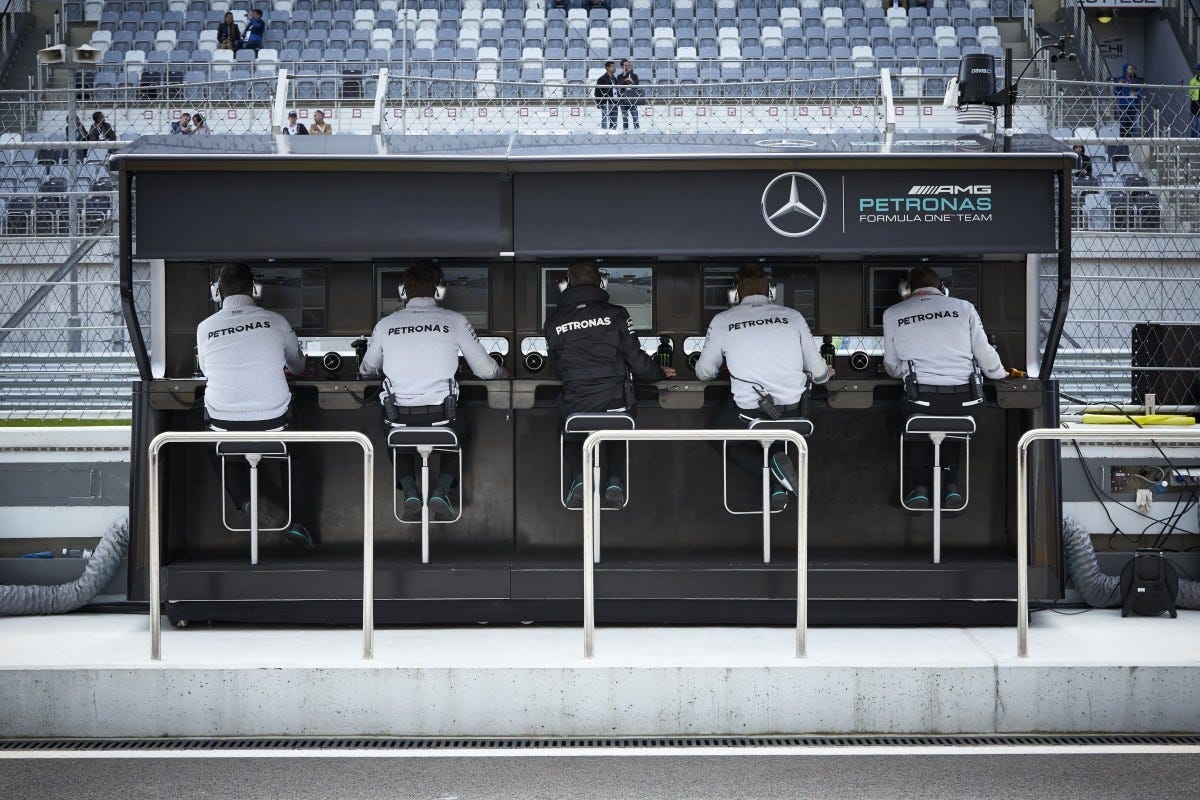
The Pit Wall is the command center. Strategists and data engineers sit alongside the Team Principal, monitoring live telemetry from every sensor on the car: tire temperatures, fuel loads, engine modes, gaps to competitors.
The call to pit (”box, box, box” over team radio) is made under real-time pressure. One lap too early and you’re on cold tires while your rival is pushing. One lap too late, and your rubber is gone.
At the team factory, sometimes on the other side of the world, engineers run real-time simulations and feed strategy updates back to the circuit. What you see on screen is a fraction of the operation running behind it.
Points
Points go to the top ten finishers:
P1 - 25 points
P2 - 18 points
P3 - 15 points
P4 - 12 points
P5 - 10 points
P6 - 8 points
P7 - 6 points
P8 - 4 points
P9 - 2 points
P10 - 1 point
Over 24 races, every point matters. Norris won the 2025 title by two. A single overtake at any point during the season, a different strategy call on any given Sunday, a mechanical failure that didn’t happen or one that did. Any of it could have changed the outcome.
The championship accumulates. Race by race, decision by decision, across eight months and five continents.
Where to Watch
If you’re in the US, Apple TV is now the exclusive home of Formula 1. Every practice, qualifying, sprint, and Grand Prix. A subscription runs $12.99/month or $99/year and includes F1 TV Premium (4K streams, onboard cameras, multi-feed views). Select sessions and a handful of races are available free with an Apple account. There’s a 7-day free trial if you want to test the waters.
The path from ESPN to Apple is worth knowing. In 2018, ESPN picked up the US broadcast rights for essentially nothing. Viewership averaged 554,000. By 2025 that number had climbed to 1.32 million, with some races clearing 2 million. Apple paid roughly $140 million per year to lock it down for five years. Netflix is also broadcasting the 2026 Canadian Grand Prix under a separate licensing agreement.

For the rest of the world:
United Kingdom: Sky Sports F1 carries every session live through 2029. Now TV offers monthly and day passes as a lighter alternative. Channel 4 airs qualifying and race highlights for free and broadcasts the British Grand Prix in full.
Canada: TSN for English, RDS for French. F1 TV is also available with Access, Pro, and Premium tiers.
Europe: Sky holds rights across Germany, Austria, Switzerland, and Italy through 2027. Most other markets run a mix of pay-TV and local free-to-air arrangements.
Australia: Fox Sports handles domestic coverage.
Rest of World: F1 TV continues expanding its direct-to-consumer reach, with recently launched Japanese-language commentary and a fully localized interface.
Formula 1’s official broadcaster page has the full country-by-country directory.
Next in this series: Part 2: The Business explores how the money works, from cost caps and team valuations to sponsorship economics and the financial machinery that keeps the grid running.


