


I love golf.
LOVE.
The time spent on the course is my favorite way to spend 3-4 hours outside. (aside from a racetrack or with my wife and kids)
And I’ve always been into gear. Golf gear has a certain way of hooking you in with new technology to improve your game. Or new ways to approach preparation.
Now, I may not buy the latest and greatest every year, or even a few years, but you bet your ass I’ll be at the pro shop or go out of my way to a Golf Galaxy to swing the new driver that promises huge gains, or the wedges that swear they’ll get you spinning the ball around the greens like Phil.
All this to bring us here today… or yesterday, I suppose, when McLaren announced McLaren Golf, a dedicated golf equipment company.
Not a collaboration.
Not a limited-edition driver with a papaya colorway.
A standalone subsidiary with its own CEO, its own team, and its own Shopify storefront.
The obvious question: why would a Formula 1 team start making golf clubs?
The less obvious answer: because F1 fans and golfers are increasingly the same people.
The Audience Overlap
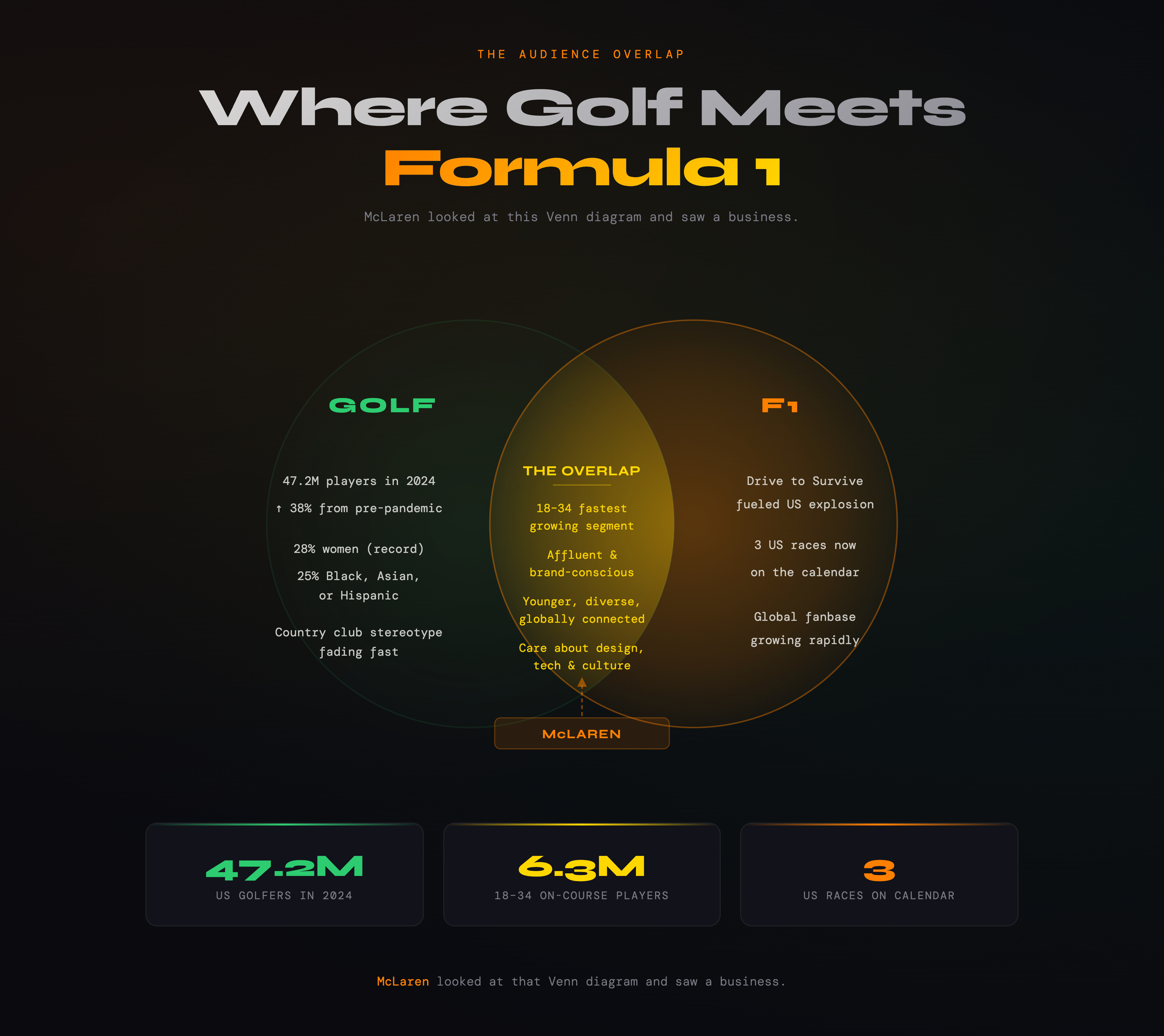
47.2 million Americans played golf in 2024, up 38% from pre-pandemic levels. The fastest-growing segment? The 18-34 age group, now the largest cohort of on-course players at 6.3 million.
That same demographic drove F1’s American explosion over the past five years, fueled by Netflix’s Drive to Survive and a calendar that now includes three US races.
Both sports skew affluent and brand-conscious. Both have undergone dramatic demographic shifts in the same direction: younger, more diverse, more globally connected. Women now represent 28% of on-course golfers, a record. And 25% of golfers identify as Black, Asian, or Hispanic. The old-money country club stereotype is fading fast, replaced by a consumer base that cares about design, technology, and cultural relevance.
McLaren didn’t dream this up in a vacuum. TaylorMade and Oracle Red Bull Racing have been running an F1-golf crossover collaboration since 2023. It started with limited-edition drivers. It has since expanded annually into irons, wedges, putters, and apparel. Each drop sells.
That partnership proved something important: golf consumers will pay a premium for equipment connected to motorsport. The appetite is real and growing. McLaren is taking the same thesis and pushing it further. Instead of co-branding with an existing golf manufacturer, they’re building the whole thing from scratch.
Lando Norris, McLaren’s F1 world champion, played in the Netflix Cup and the BMW PGA Pro-Am. Zak Brown, McLaren Racing’s CEO, is a known golf obsessive. The cultural bridge between the two sports already exists at the top of McLaren’s own organization.
The Market Math
The global golf equipment market is worth roughly $9.2 billion in 2025, growing at a 4.4-5.8% CAGR toward $11.5-12 billion by 2030. The broader golf economy generates $102 billion annually. Premium is where the growth is: premium golf apparel alone is expanding at a 6.77% CAGR, and 51% of US consumers prefer premium brands.
Golfers are spending more and replacing clubs more frequently. The premiumization trend favors exactly the kind of brand McLaren can build. One that is high-end, engineering-forward, design-led.
There’s also a timing advantage. The USGA and R&A finalized new golf ball distance regulations in March 2025, effective in 2028. Every manufacturer on the planet will need to reformulate. When established technological advantages get temporarily leveled, new entrants get their best window to break in.
Why McLaren?
Plenty of car brands have dipped a toe into golf. BMW sponsors tournaments. Mercedes partners with The Masters. Porsche sells branded Titleist balls and leather headcovers. None of them make actual clubs.
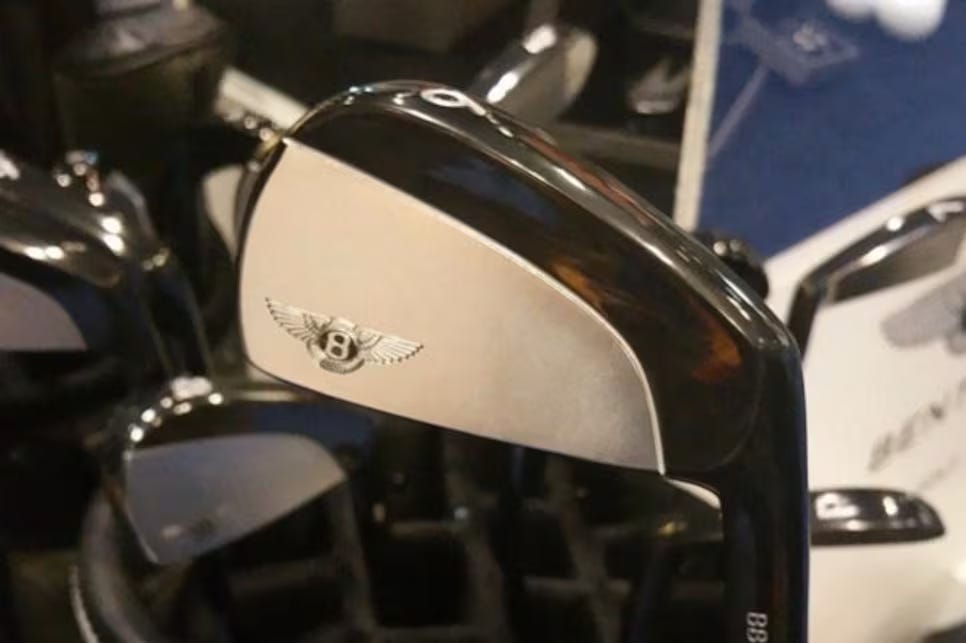
Bentley tried. Launched a full club line in 2016. Sold 100 sets of its Centenary Collection at $16,000 each. But secondary market discounting of 63-70% suggests they never found real traction beyond the novelty buyer. Porsche went further in the late 1990s and 2000s, producing metalwoods and forged irons before quietly exiting the business entirely.
McLaren’s argument for why they’ll fare differently comes down to two things.
First, the engineering transfer is credible. Carbon fiber composites, aerodynamics, computational fluid dynamics, materials science. These are real McLaren capabilities. Whether that translates to measurably better golf equipment remains to be seen. But the brand permission to charge a premium and the R&D pipeline to potentially back it up both exist.
Second, and more practically, they hired real golf people to run it. CEO Neil Howie spent 26 years at Callaway and started his career at TaylorMade. CMO Ryan Lauder came from TaylorMade. Head of Brand Nick Fergus came from Callaway. These are operators who know the golf business from the inside. Previous automotive attempts at golf were run by car people. McLaren hired golf people and gave them a car brand.
Behind all of it sits CYVN Holdings, the Abu Dhabi sovereign wealth entity that acquired McLaren Automotive in April 2025 and created McLaren Group Holdings with an explicit mandate to expand into new categories. Sovereign wealth money is patient money. And patience is the resource most new golf equipment brands run out of first.
So, What’s Coming on 29 April?
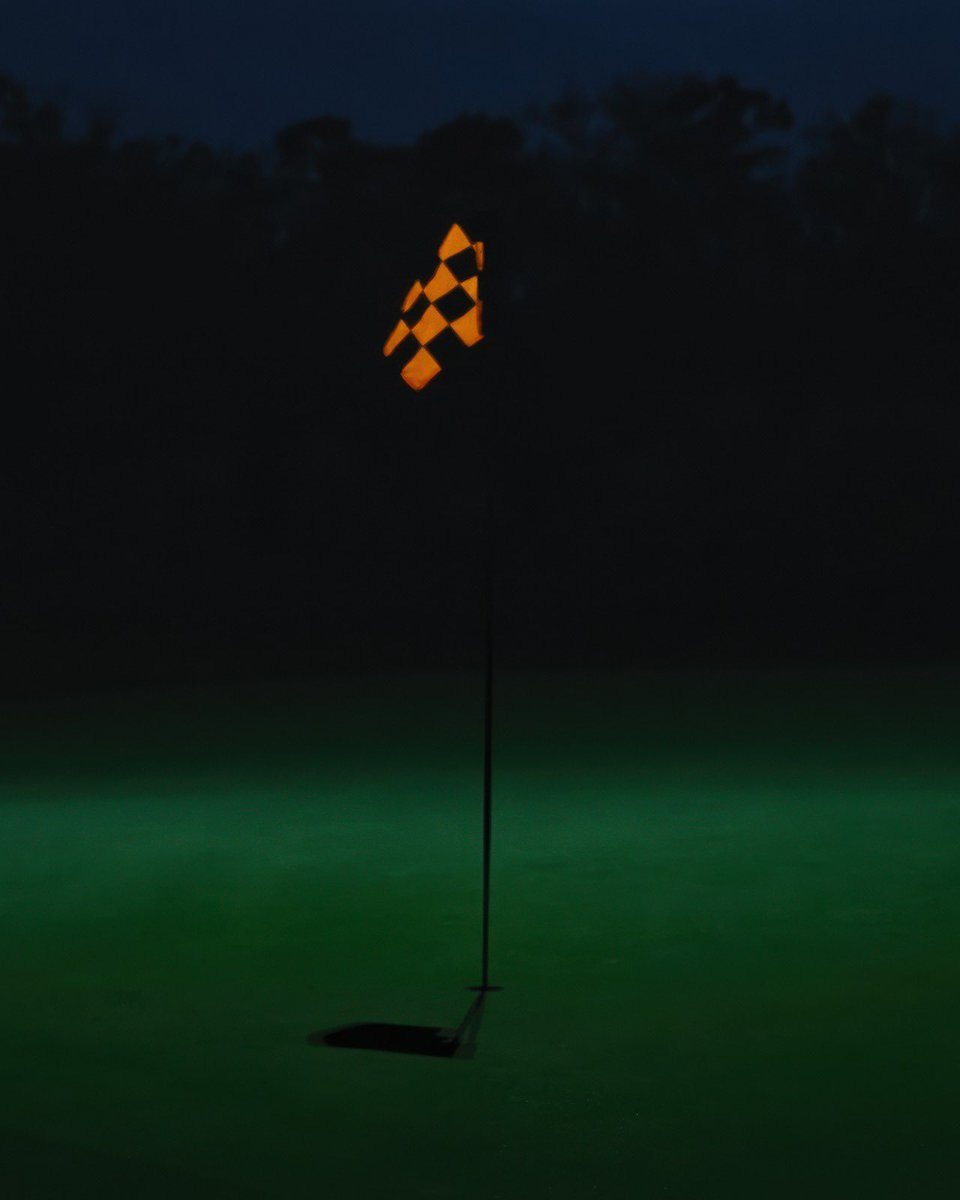
McLaren Golf has promised a product reveal on April 29, 2026. Until then, everything is brand equity and personnel. No clubs. No pricing. No tour endorsements.
The golf industry seems split. Golf Digest drew the Porsche comparison and signed off with “We shall see.” Today’s Golfer compared it to PXG’s launch in 2014, the last time a new brand entered at this scale and actually stuck. On GolfWRX, the enthusiast forum that functions as golf’s town square, engagement was immediate.
The questions that matter:
Will McLaren produce a full bag or start with select categories?
Will pricing land at Bentley-level ultra-premium or PXG-level accessible premium?
Will any tour professionals play the equipment?
Can McLaren’s Shopify-based DTC model compete in a market dominated by fitting studios and pro shop relationships?
The demographics line up. The market is growing. The cultural overlap between F1 and golf is deeper than ever. And McLaren has the engineering credibility, the brand equity, and the financial backing to sustain a long build.
Whether any of that puts a club in a golfer’s bag is a different question.


Red Bull perhaps the more obvious team, given how often it changes drivers.