

Have you considered upgrading to a paid subscription? Support independent creators bringing you business commentary and analysis from the world of F1 and motorsport.
This edition’s partner

Precision timing is crucial in motorsports, where milliseconds can determine the winner. MYLAPS advanced timing solutions ensure the most accurate results.
The Race co-founder Darren Cox got Flavio Briatore at Enstone for what was scheduled as thirty minutes and ran closer to an hour. Cox spent years inside Renault, several rungs below the man across the table, and wrote up his own read of the conversation on August 1. His version is about culture and conviction, and he’s right on both.
I listened to the full podcast to hear what a 76-year-old executive says when nobody in the room has a reason to interrupt him.
Here are some of the things that stood out to me.
He Talked About How He Gets Paid
“Last year, I promised Renault that next year we are in the first six. If we make it, maybe we are in the first five. But surely, the first six from P10 to P6 is already there. It is what I promised. My bonus is in the first six. Anyway, at least I take the bonus.”
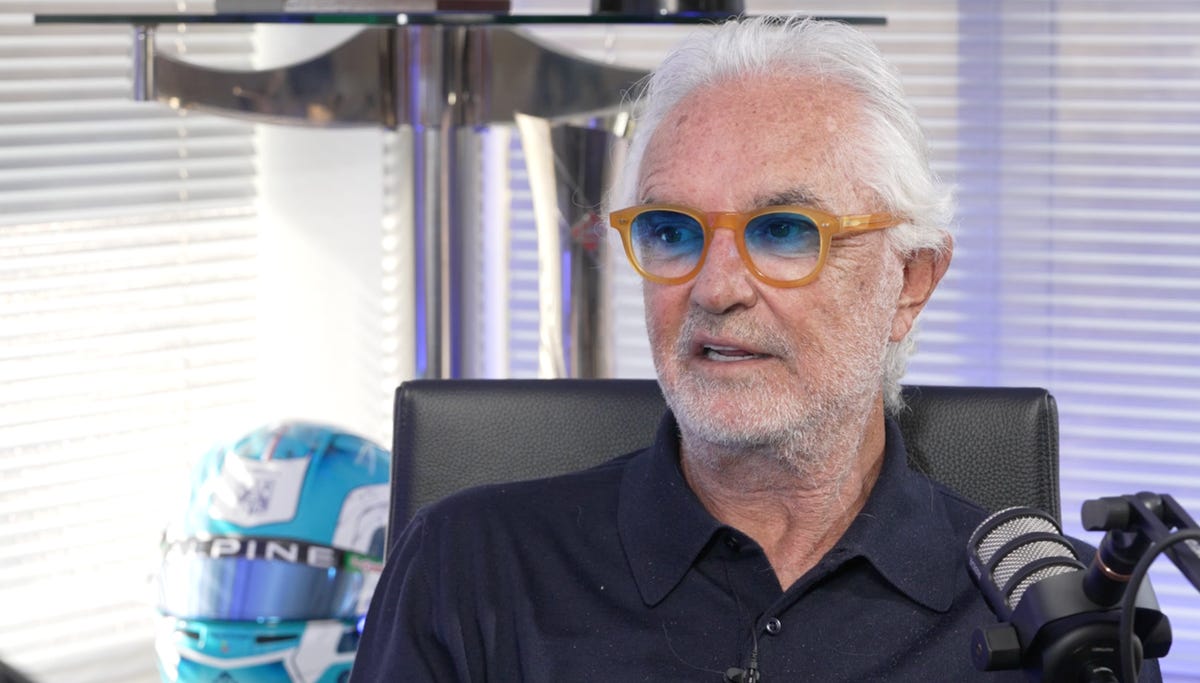
Alpine sits sixth with 61 points, five behind Racing Bulls and forty clear of Haas. The bonus is live, and it is close.
I can’t think of another team boss on this grid who has discussed his compensation on camera. The deal he described pays on where the team finishes, a position he can protect for the rest of the season and still lose on one bad Sunday afternoon.
He Would Sell the Team
Cox asked whether valuations have topped out. “If the team was mine, I’d have sold already!”
Then, asked whether he wished he still owned a piece of one of the three teams he’s held stakes in: “No question, too high.”
The bull case he handed to other people. “The prediction of the people is that the price of the team is still not high, but normal. And the prediction of the people is that in three, four years, the team is worth much more.” The bear case he kept for himself.
He Priced Otro’s Stake
Otro Capital holds 24 percent of Alpine, bought in 2023 for a reported $218 million. Mercedes walked away from acquiring that stake in May over the distance between Otro’s reported ask of around $720 million and what Mercedes thought the whole team was worth.
Cox asked who would make a good incoming investor. Briatore called it Renault’s issue rather than his, then volunteered a number nobody had requested.
“I never see somebody buy, spend 600 million to buy a minority, to be signed as partner, if you don’t agree with the majority.”
Earlier in the same stretch of interview, he had valued Alpine at 3.2, then 3.5 within one answer, never naming a currency. Twenty-four percent of 3.2 billion is 768 million. The figure he chose to say out loud sits below his own arithmetic and below the ask already reported in the paddock. He framed it as a price no buyer would pay, and he said it while Renault is negotiating.
Whether that’s a man rounding or a man talking a price down, I don’t know. My read is the second.
He Changed the Culture…and People Love It
Cox set up his culture question with something he picked up in the lobby on his way in. “I spoke to your receptionist here, as I was coming into the facility. She’s been here many, many years.” Briatore, cutting in: “Longer than me.” Cox again: “She, without me asking, said, it’s great to have Flavio back because he brings a different culture.”
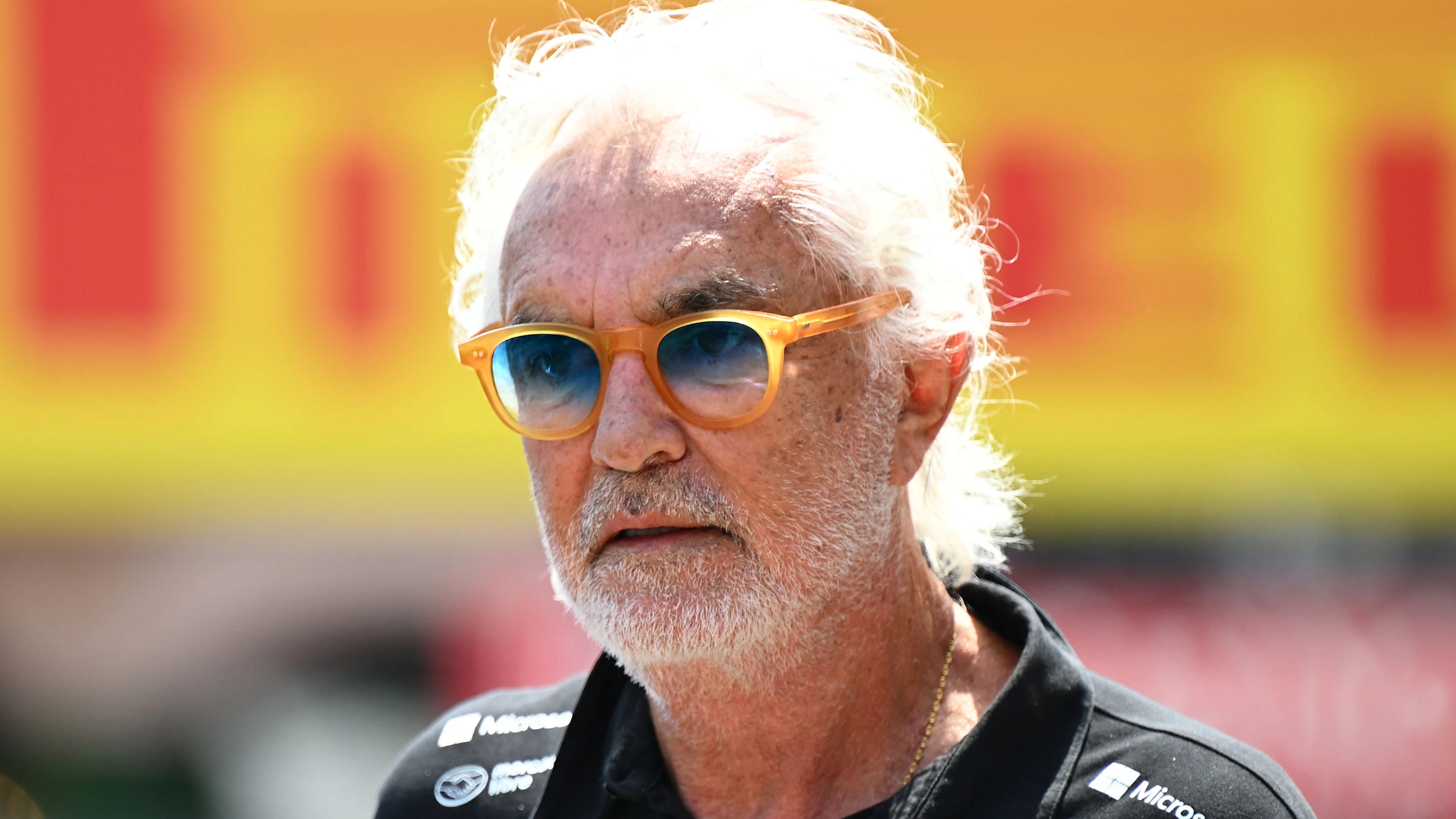
Briatore’s own answer defined the culture by subtraction. “There’s no fucking tourist thing around the world, you know?” The Benetton people who came before him “had no idea about winning. The idea was to be in Formula One, to go around the world, have fun at the barbecue. And I don’t like barbecue, and I don’t like going around the world. I want to win.”
He Doesn’t Watch the Racing
“But if I don’t have the team, I don’t know if I watch Formula One, honestly.”
Asked whether he watched during the years he was out of the sport: “No, sometimes, but never.”
The same distance runs through his restaurants. “For me, the pizza was the excuse to go to Crazy Pizza. The pizza was the DJ, the rumor, the spinning pizza, and the experience. I don’t care about the pizza, if it’s good or bad.”
He put the principle in one line: “For me, our car is our product.” The executive who sold Gucci on Formula 1 has no personal relationship with Formula 1, which is probably why he could look at a race weekend and see inventory.
His Numbers Run High
“And the average of the support of Formula 1 has dropped dramatically; now you talk about 28, 30. And what is incredible is that 60% are women and 40% are men.”
The 2025 Global Fan Survey, 100,000-plus responses across 186 countries, puts the average fan at 32 and women at 42 percent of the audience, up from 37 percent in 2018. He also said Miami draws 500,000; the race reports around 275,000 across its weekend.
Then he gave Silverstone as 560,000 when the circuit published 564,000. The only figure he rounded down was the one that happened to be true.
Cox didn’t correct any of it, and I doubt many interviewers would have. Sixty-forty is the slide a title sponsor’s marketing team wants in the deck, and it will now circulate as a quote from the man who signed Gucci onto a Formula 1 car.
The Driver is Not His Priority
Three separate times, Briatore said the driver is not his priority. “In this moment, the driver is really not our priority.” “Today, my priority is to build a racing team.” “Really, the driver is not my priority.”
Cox then produced this: “In the past, you’ve been great at talent spotting, so I was going to ask you if there’s anyone on the junior ladder that excites you that could be the next Schumacher or Alonso. Unless you have someone’s name, I won’t ask you that question.”
He asked it and withdrew it in the same breath.
Briatore’s reputation in this sport was built on two driver signings: Michael Schumacher, poached from Jordan two weeks after his debut in 1991, and Fernando Alonso, spotted as a teenager in 1999, parked at Minardi, promoted to test driver, and handed the Renault race seat in 2003 on the way to two titles at the same factory Cox was sitting in when he asked the question and pulled it.
The reason he gave for not needing a third is buried in the same answer. “Don’t forget, this team, we arrived in this team with 1,200-1,300 people. Now we drop to 900 people.” That’s roughly 300 people out of a factory he insists can beat McLaren and Ferrari, and the conversation moved straight past it.
6.5/10
Asked whether he has the right people on the engineering side: “from zero to ten, we are about six and a half.”
He then located the problem more precisely than team bosses usually do. “At the back, we are okay with the Mercedes engine, with the gearbox, we are okay.” And: “Now our people are working from the top of the nose to the driver because this is the problem we have.”
Everything Enstone builds itself is the part he’s calling weak. He followed it by aiming at one office without naming the occupant. “Maybe we have very good engineering here, but it’s still on the bench. I think so. Our technical director needs to be really, really looking.”
Somewhere in that building, a technical director heard that sentence at the same time the rest of us did.
The Gucci Deal Closed because François-Henri Pinault had a Nice Weekend in Monaco
The origin story he gave has no strategy in it at all.
He pitched Luca de Meo, who had left Renault for Kering. “In the beginning he told me it was a very bad idea, okay, I never give up, I push him, push him, push him.” De Meo eventually came back with a condition. They would have to convince François-Henri Pinault, who “never followed Formula One, had no idea what was going on.”
So they brought Pinault to Monaco. “He was incredibly enthusiastic, you know, to see all this, plus Monaco, it’s an event, it’s a big event.”
A reported $50 to $60 million a season, escalating past $150 million, for a house working through eleven straight quarters of declining sales at last count, traces back to persistence and one good hosting day on the best weekend of the calendar. Every commercial director priced out of this market should ask which of those two things closed it.
Reheated Soup
Cox built his culture section around returners: Steve Nielsen, back at Enstone for a second spell, and Harry Richards, son of the David Richards who replaced Briatore in 1997.
Briatore, in the same section, on the people who left for Cadillac and Aston Martin and now want to come back: “For the moment, no. I don’t want anybody, the people left, to say a word. I don’t care.” Then, by way of explanation: “We don’t like the minestrone riscaldato.”
He offered reheated soup as a hiring policy in the middle of a conversation built around people who came back.
What I Think Happens
Otro’s 24 percent does not trade this year at anything close to the 768 million Briatore’s own valuation implies. The man running the asset spent an hour telling the market that the price is high, that the majority holder is relaxed about timing, and that a minority stake without Renault’s blessing has no buyer at the ask.
On the parent side, Renault carried a market capitalization of €7.68 billion in mid-June, which pushes Alpine toward the top of its 40-to-50-percent range. That arithmetic keeps getting more extreme.
The other call is sixth place. Racing Bulls are five points up the road. Briatore said his bonus is sixth, said he expects someone else in his chair within two or three years, and said he’d sell if the team were his. Put those three statements together, and he has already described his exit.

