

Every week, we publish a series called CAPITAL MOVES, a look into the off-track investments of individuals involved in the world of racing. Be sure to check out previous editions.
In Discourses on Livy, Niccolò Machiavelli argued that impetuosity and audacity often succeed where deliberation fails. That was five centuries before a mediocre student from a small Italian town in the Piedmontese foothills spent his career proving him right, ruined himself in the process, and then proved him right all over again. It seems Flavio Briatore has never lost a single night’s sleep over the line between audacity and recklessness. By his own account, there just isn’t one.
Verzuolo
Briatore was born on April 12, 1950, in Verzuolo, a small town near Cuneo in the foothills of the Cottian Alps, below Monviso. His parents were both elementary school teachers, but he was held back twice at the public technical institute in Cuneo. He completed his diploma in land surveying as a private student at Fassino di Busca, with the minimum passing grades. Nothing about his childhood suggested fame and fortune. He was just a restless kid in a small town who wanted out.
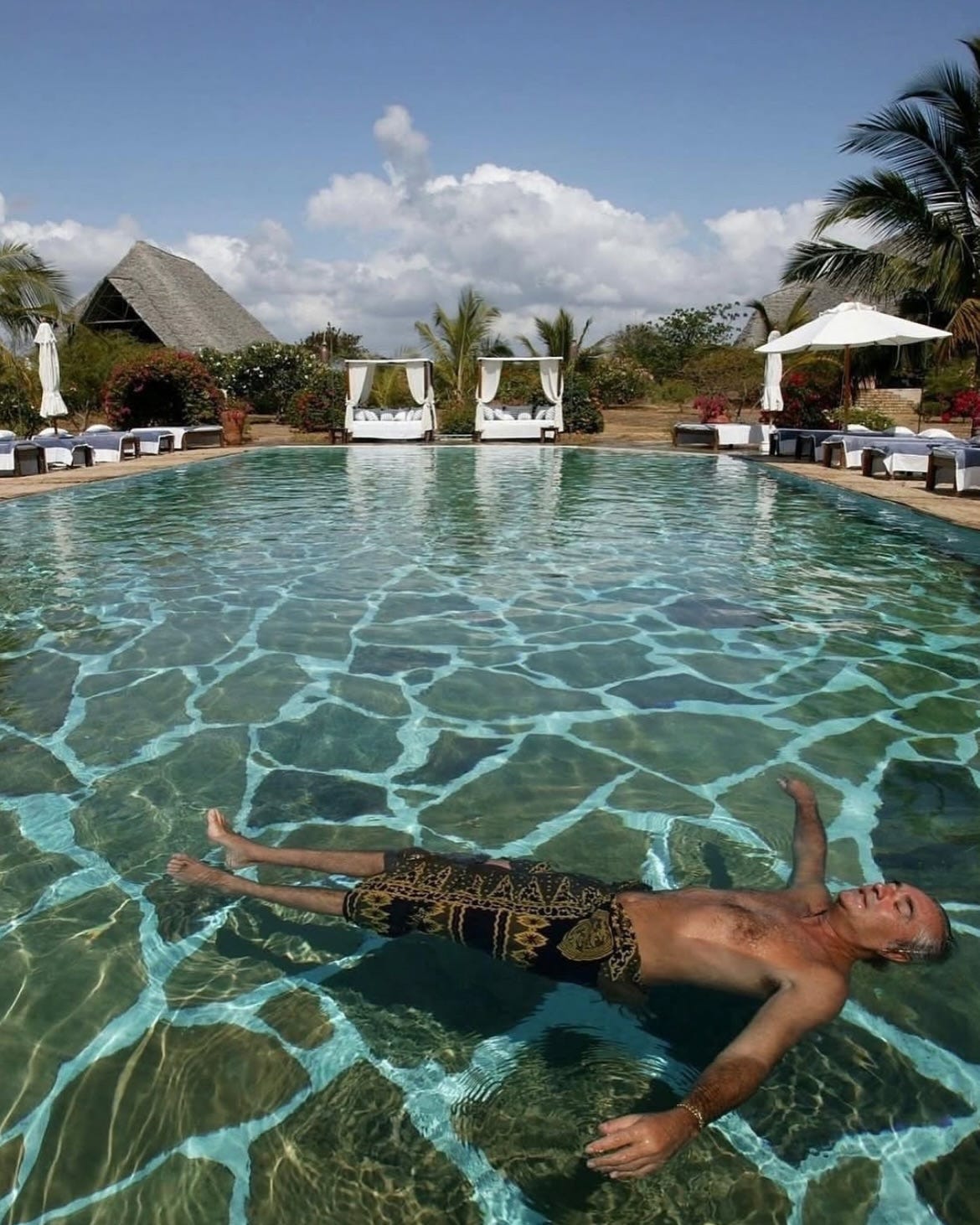
He worked as a ski instructor and ran a few restaurants, including one back in the Cuneo area, which he named Tribùla after his own nickname: a regional word for a restless character who will do almost anything to get what he wants. Foreshadowing at its finest. It failed and closed under a mountain of debt. Next, he sold insurance door-to-door before working his way into Milan’s finance and society circles. Somewhere in the years that followed, he was introduced to Luciano Benetton, a clothing manufacturer from the Veneto region of Italy.
The first serious trouble found him around the same time. Briatore had worked in Cuneo as an assistant to a financier named Attilio Dutto, who owned a paint company called Paramatti Vernici. The business had a dubious past of its own: it had once belonged to a convicted financier named Michele Sindona. Dutto was killed in a car bomb attack in 1979, a crime that was never solved. Briatore resurfaced in Milan afterward, where he schmoozed his way into the orbit of Achille Caproni, heir to the family that had founded the Caproni aircraft company, and was put in charge of one of Caproni’s holding companies, Compagnia Generale Industriale. CGI went on to acquire the same Paramatti Vernici where Briatore had once worked, and the combined group collapsed into bankruptcy, a business disaster that never itself produced a criminal charge. The charge came from somewhere else: a ring of card sharps running rigged games in Milan and Bergamo to fleece wealthy marks, a group that also included a fake marquis, a real count, a lawyer, and television presenter Emilio Fede. In 1984, a Bergamo court convicted Briatore of that ring and sentenced him to 18 months, a sentence that was later reduced on appeal. Two years later, a Milan court convicted him again of the same scheme, sentencing him to three years, which was reduced to 14 months on appeal.
He never served a day of either sentence. To avoid prison, Briatore fled to Saint Thomas in the U.S. Virgin Islands and lived there to evade Italian justice. Both convictions were eventually extinguished by amnesty, and he returned to Italy a free man. The only price he ever paid for those crimes? Roughly six years of self-imposed exile on a stunning Caribbean island.
The Franchise
While he was a fugitive, Briatore never stopped working for Benetton. Benetton had already put him in charge of building out the American franchise network back in 1979, years before his fraud convictions, as the Italian clothing company expanded aggressively into the United States. He simply kept doing the same job from exile. It’s one of the more remarkable facts of his career that his greatest wealth-building act before Formula 1 happened while he was a fugitive from justice, hiding on Saint Thomas.
Exile or not, he was very good at his job. By the end of the decade, Benetton had roughly 800 stores across the United States, up from a handful when he’d started. Briatore took a cut of every franchising agreement he signed. The model was so aggressive that franchisees eventually complained that Benetton had oversaturated markets with its own stores, and the U.S. store count was later cut. But by the time that correction came, Briatore had already made himself genuinely wealthy. He built his first fortune franchising t-shirts and jackets in American malls, without ever racing a car, designing an engine, or working a single day in a racing paddock, all while legally unable to set foot in his own country.
The Team
Luciano Benetton took him to his first Formula 1 race, the 1988 Australian Grand Prix. In 1985, Benetton’s family had bought the underperforming Toleman team and renamed it Benetton Formula. The team had never won a single race in five full seasons on the grid. Bernie Ecclestone later recounted that Luciano Benetton asked him personally to look after the inexperienced young man he was sending over from New York. Briatore had zero technical background in motorsport and, by his own admission, no real interest in it. He was made commercial director of the team in 1989. When he fired the existing management shortly after, he was promoted to managing director and given the team.
He hired celebrated technical director John Barnard to oversee the technical side, but existing chief designer Rory Byrne and engineer Pat Symonds were unhappy working under Barnard and, along with 11 other engineers, quit to join Adrian Reynard’s Formula One project. (This ambitious effort ultimately failed to make it to the grid.) In one of the more underrated pieces of people management in F1 history, Briatore managed to stay on good terms with both Byrne and Symonds during their absence and persuaded them to return at the end of the 1991 season after Barnard left the team.
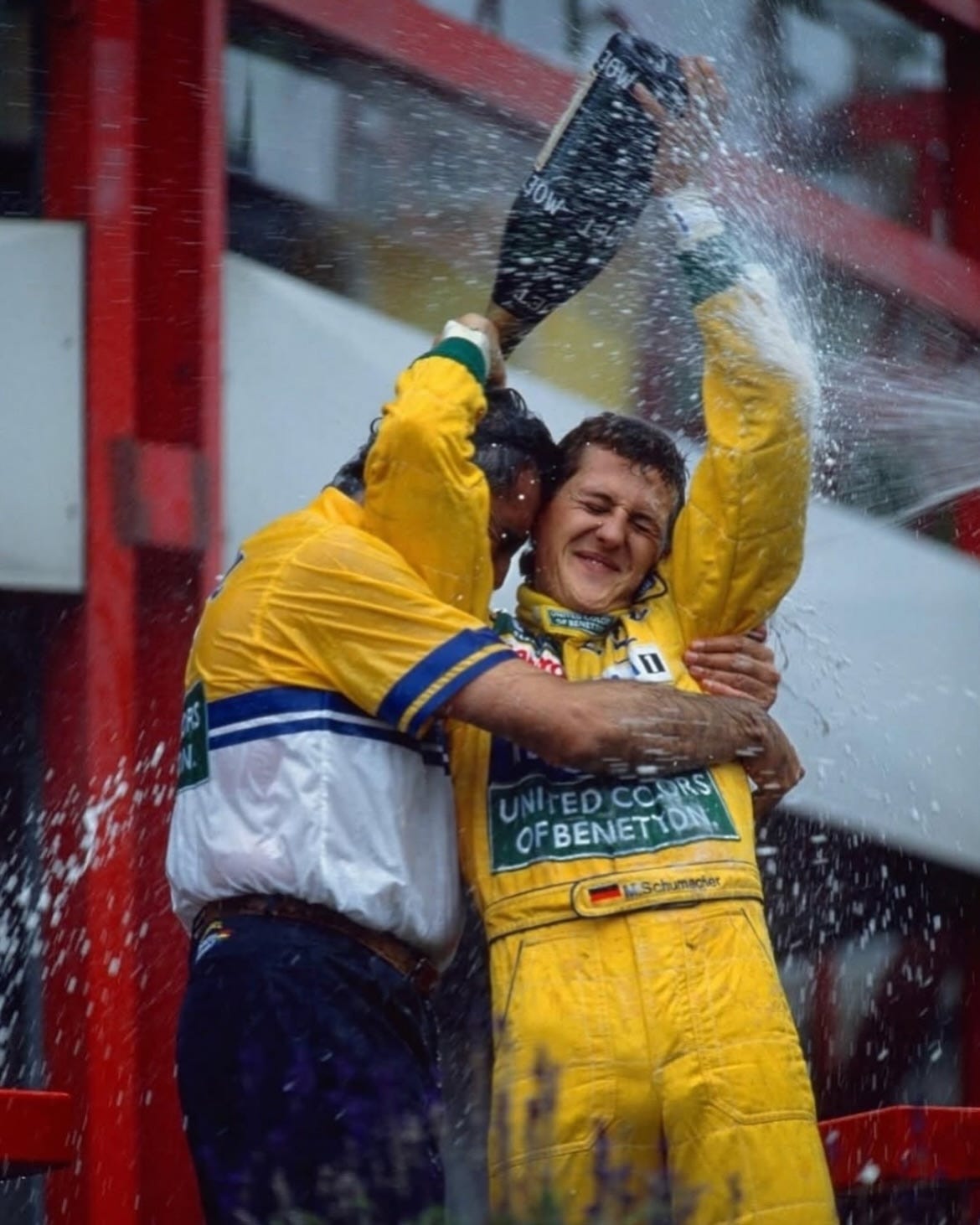
Then came the move that defined his first act in the sport. In August 1991, a young German driver named Michael Schumacher made his Formula 1 debut for Jordan at the Belgian Grand Prix, after Jordan driver Bertrand Gachot was jailed for an unrelated assault charge. Schumacher qualified seventh on a track he had never driven before. By the very next race, Briatore had him in a Benetton. Jordan sought a court injunction, arguing the letter of intent still bound Schumacher, and lost, because no final contract existed. Briatore got his driver. Jordan needled him about the deal for years afterward, and McLaren’s Ron Dennis reportedly told him: “Welcome to the piranha club.” It was the single most consequential signing of Briatore’s career, and he made it within two weeks.
Schumacher won his first championship for Benetton in 1994, a season clouded by controversy on multiple fronts. The FIA investigated Benetton’s engine software after Imola and found hidden “launch control” code, but couldn’t prove it had been used in a race, so no penalty was issued. Separately, after a refueling fire on Jos Verstappen’s car at the German Grand Prix, investigators found Benetton had removed a safety filter from the car’s fuel rig to speed up pit stops. Once again, no penalty was issued: the FIA ruled that the filter had been pulled in good faith and that most of the grid had done the same. The team was issued a $100,000 fine for missing the FIA’s deadline to hand over engine source code, and a $500,000 fine for Benetton plus a two-race ban for Schumacher, for defying a black-flag penalty at Silverstone. Benetton appealed, so Schumacher kept racing while it played out. The ban was upheld a month later, and he served it, sitting out Monza and Estoril.
In 1995, Schumacher repeated as champion and Benetton took the constructors’ title. Briatore had turned a team that had never won a race before his arrival into a back-to-back World Championship operation within five years.
In 1997, with the team sliding after Schumacher left for Ferrari, taking Ross Brawn and Rory Byrne with him, Briatore was pushed out, replaced by David Richards, the former World Rally champion who ran Prodrive. In 2000, Renault bought the Benetton team for a reported $120 million and brought Briatore back as managing director. He was gone for less than three years.
Crashgate
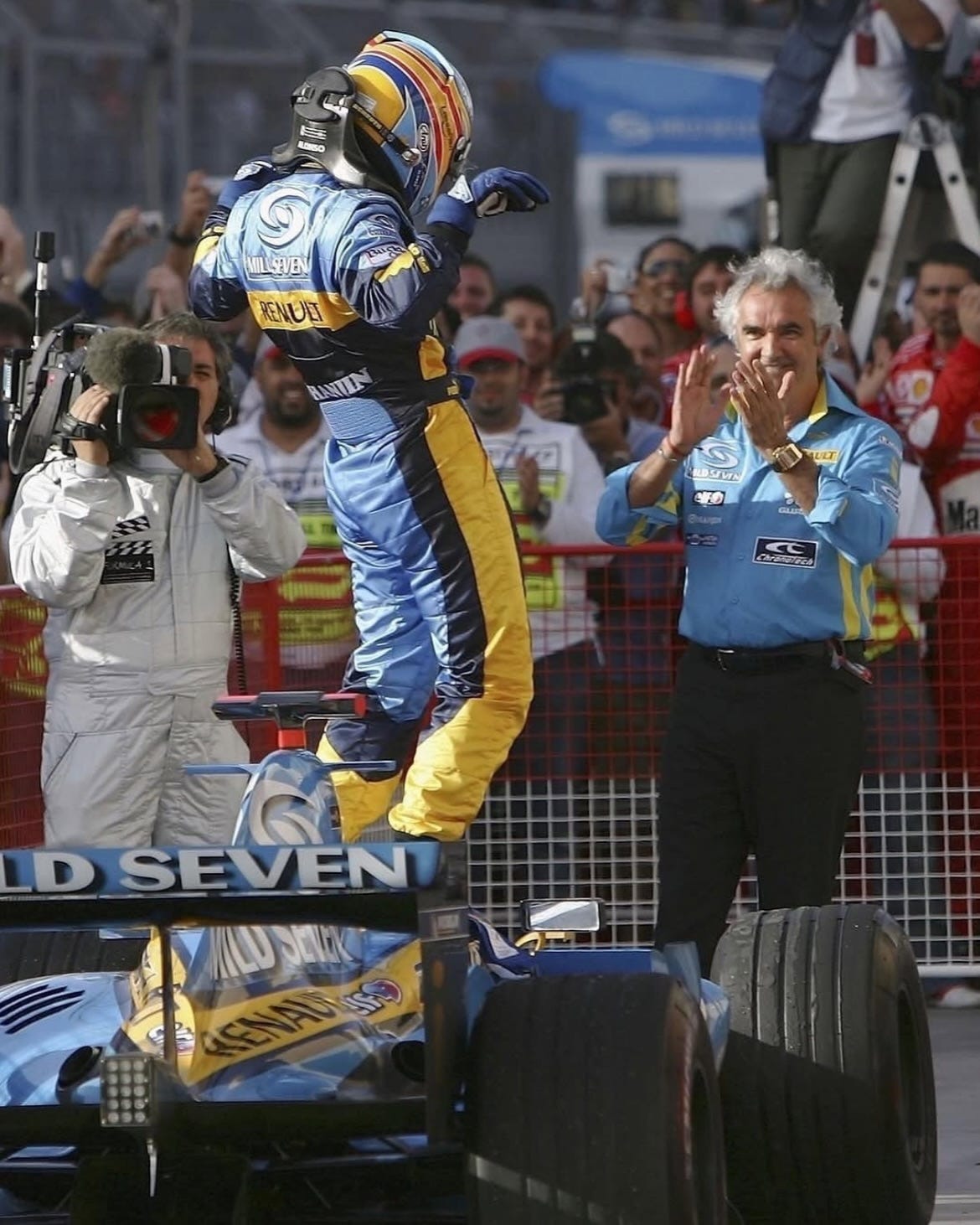
At Renault, Briatore’s signature move was identifying talent early. He met a teenage Spanish driver named Fernando Alonso in 1999 and became his manager. He placed Alonso at Minardi for 2001, promoted him to Renault test driver in 2002, and gave him the race seat in 2003. Alonso won the World Drivers’ Championship in 2005 and 2006, with Renault also taking the Constructors’ Championship in both years. It was Briatore’s second separate championship dynasty, built around his second different driver, fifteen years apart, at the same factory in Enstone, Oxfordshire, under two different team names.
Then came Singapore.
On September 28, 2008, at the first night race in Formula 1 history, Renault driver Nelson Piquet Jr. crashed into the wall at Turn 17 on lap fourteen. The timing of the crash, just after teammate Fernando Alonso had made an unusually early pit stop, meant the resulting safety car period dropped the rest of the field behind Alonso, who went on to win the race. At the time, it was treated as a driver error, and Piquet himself called it a mistake. That held for nearly a year.
Piquet raced his last Grand Prix for Renault at the Hungarian GP on July 26, 2009. Renault dropped him about a week later. Piquet gave the FIA a sworn statement in Paris within days: he said Briatore and Symonds had instructed him to deliberately crash at that exact corner to manufacture a safety car and hand Alonso the win. A month later, in late August, Brazilian television publicly broke the story, and Piquet gave the FIA a fuller statement in September.
His testimony, corroborated by an unnamed Renault employee who became known as “Witness X,” led the FIA to charge Renault with conspiracy and race-fixing. On September 16, 2009, Renault announced it would not contest the charges and that Briatore and Symonds had left the team. Briatore told the Daily Mirror the following day that his departure was an act of responsibility: “I was just trying to save the team. It’s my duty. That’s the reason I’ve finished.”
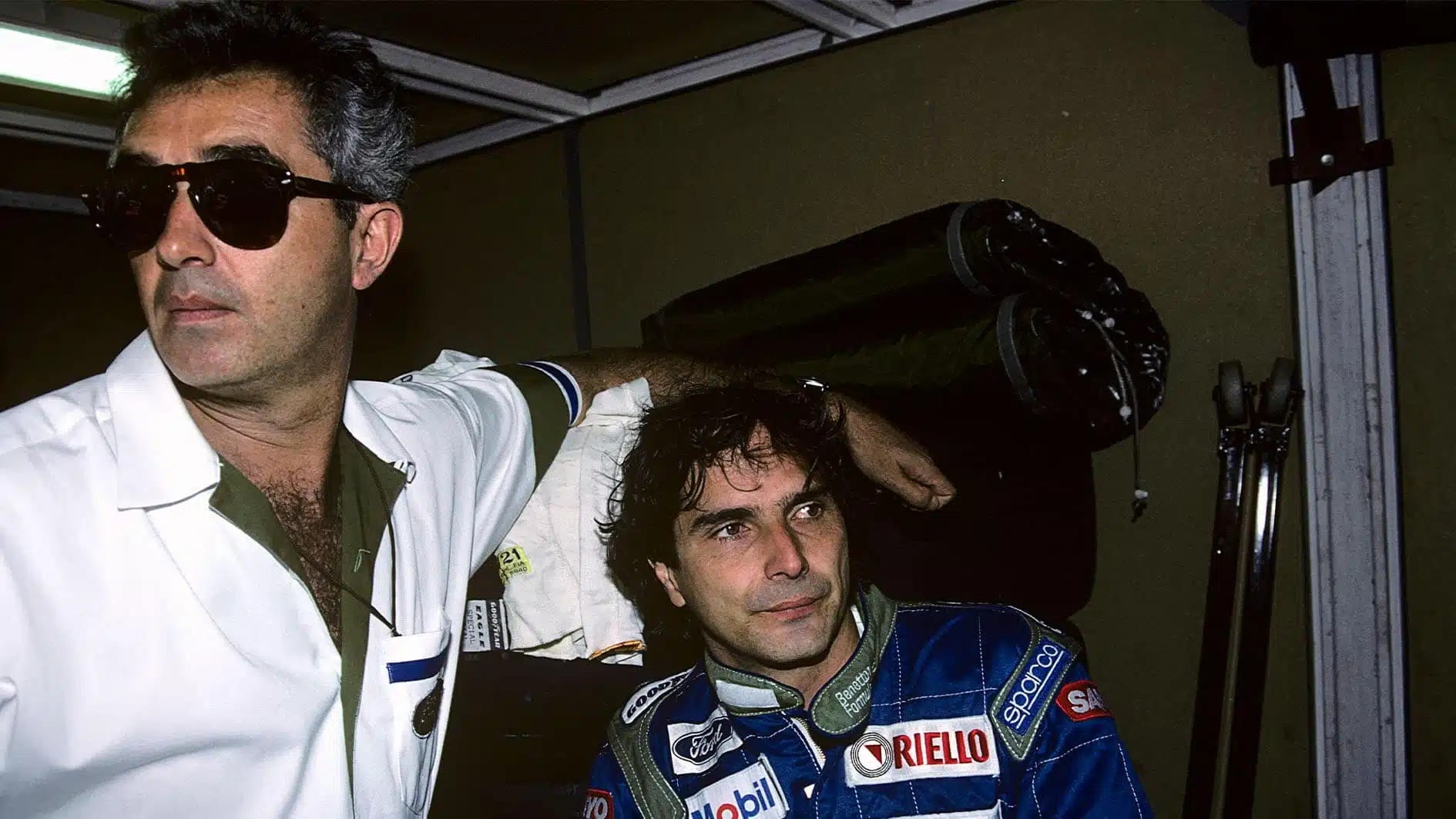
It did not save him from the World Motor Sport Council, which convened in Paris five days later. Renault received a two-year ban suspended on the condition of no repeat offense. Symonds received a five-year ban from FIA-sanctioned events. Briatore received an indefinite ban with no fixed end date and a separate bar from managing any driver holding an FIA Super License. At the time, the Daily Mirror called it the harshest sanction ever imposed on an individual in motorsport history.
Briatore did not accept the ban quietly. He sued. In January 2010, France’s Tribunal de Grande Instance overturned it, ruling that the FIA had no authority to sanction team personnel who don’t hold a competition license, and that the process was tainted by the known animosity between Briatore and WMSC chairman Max Mosley. The court awarded Briatore and Symonds a combined $20,000. The court did not exonerate him of the underlying conduct. It ruled only that the FIA had not followed proper procedure in punishing him. The FIA announced plans to appeal that ruling. The matter was finally settled in April 2010. Briatore and Symonds agreed not to hold any operational role in Formula 1 until January 1, 2013, and not to work in any other FIA-sanctioned championship until the end of 2011. As part of that settlement, both men formally acknowledged their share of responsibility for the crash and apologized to the FIA. Briatore stopped short of admitting personal guilt, and continued for years afterward to describe the safety car that handed Alonso the win as simple “good fortune.”
The Rebuild
The next part of Briatore’s story probably gets the least attention, but it’s the most telling for understanding what kind of person he actually is. He spent the wilderness years building a completely separate fortune, in an entirely different industry, on a foundation he’d actually laid over a decade earlier.
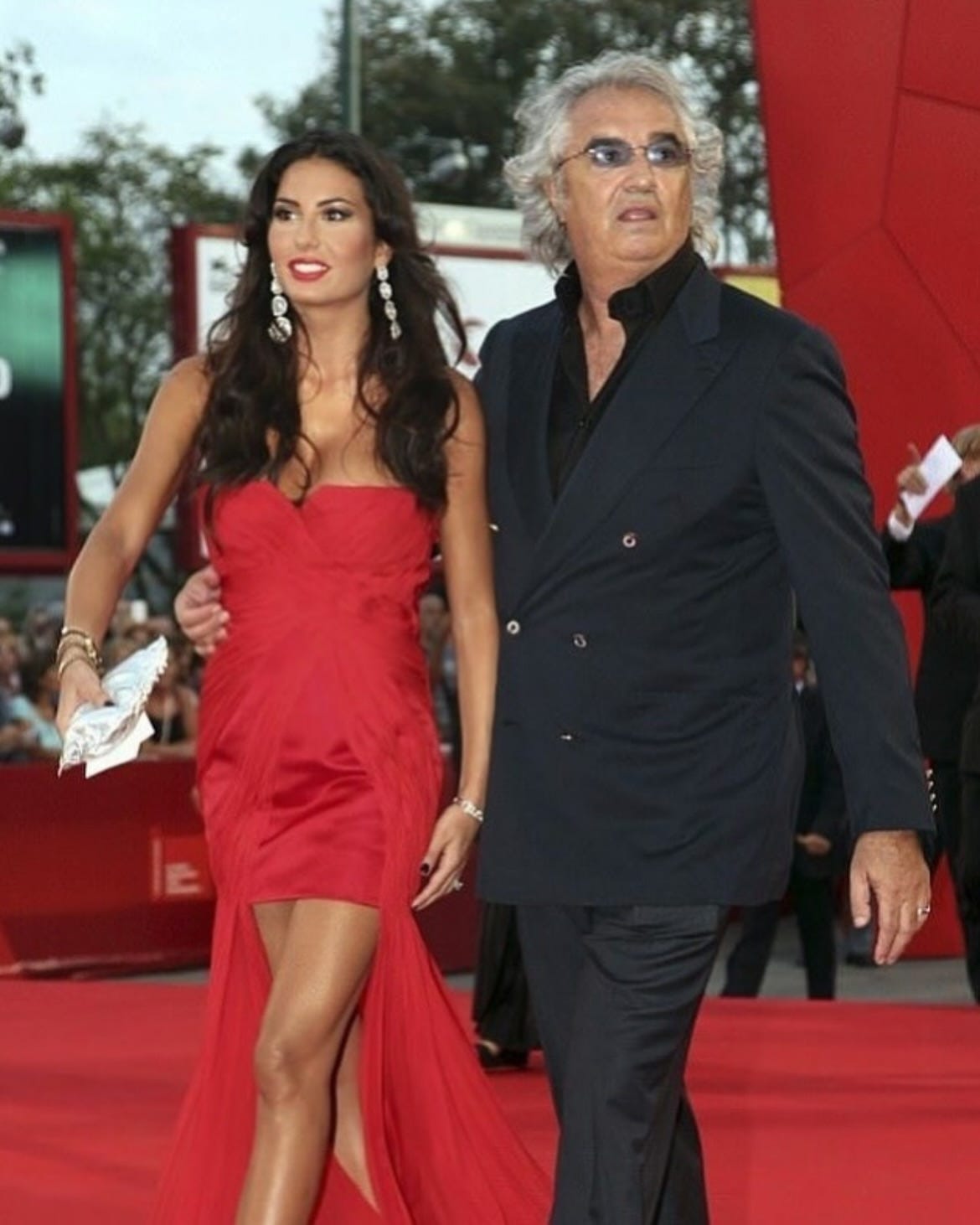
In 1998, while he was still running Benetton, Briatore had co-founded a nightclub brand with DJ Max Correnti called Billionaire. They opened the original location in Porto Cervo, Sardinia. In 2001, he followed it up with a beach club called Twiga in Forte dei Marmi, in Versilia on the Tuscan coast, taking over the concession alongside a small group of partners, among them Daniela Santanchè, now an Italian government minister. After Crashgate took his F1 career away, these ventures went from side interest to full-time occupation.
The numbers for these two clubs were incredible in this category. According to a 2019 investigation by Corriere della Sera, the Twiga location generated roughly $4.5 million in annual revenue while paying annual concession rent of just under $20,000. He expanded the portfolio aggressively: Twiga locations in Monte Carlo and at Baia Beniamin in Liguria; a Billionaire haute couture menswear line, launched solo in 2005 with the Percassi Group joining as a partner two years later, generating roughly $27.7 million a year by 2014 across 30 stores in more than 20 countries (he and Percassi sold a 51 percent stake to designer Philipp Plein in 2016 for an undisclosed sum); a luxury resort in Malindi, Kenya; a Cipriani restaurant partnership in London and Monte Carlo; new Billionaire locations in Dubai, Riyadh and Mykonos through the 2010s and early 2020s; and eventually, a pizza chain called Crazy Pizza with locations in London, Monte Carlo and Porto Cervo.
He restructured the holding company as Majestas Group in 2013, in a fifty-fifty partnership with entrepreneur Francesco Costa. According to Corriere della Sera, the group closed 2022 with roughly $83 million in total revenue: $26.2 million from Billionaire, $24.8 million from Twiga, and the remaining $32 million from brand licensing, including the Cipriani and Cova Montenapoleone names. Geographically, Europe and the UK accounted for about $52 million, with the Middle East contributing roughly $31 million. Briatore and Costa publicly targeted €100 million, roughly $108 million, in revenue for 2023, though subsequent reporting has not confirmed whether the group reached that figure.
In December 2024, now nearing his 75th birthday and with his attention shifting back to Formula 1, Briatore sold the entire Twiga brand outright, along with the original Billionaire venue in Porto Cervo, to Leonardo Maria Del Vecchio, son of the late Luxottica founder. The deal was finalized in early 2025 for an undisclosed sum and folded those four venues into Del Vecchio’s hospitality group. Majestas kept the Billionaire nightclub brand and Crazy Pizza.
The Return
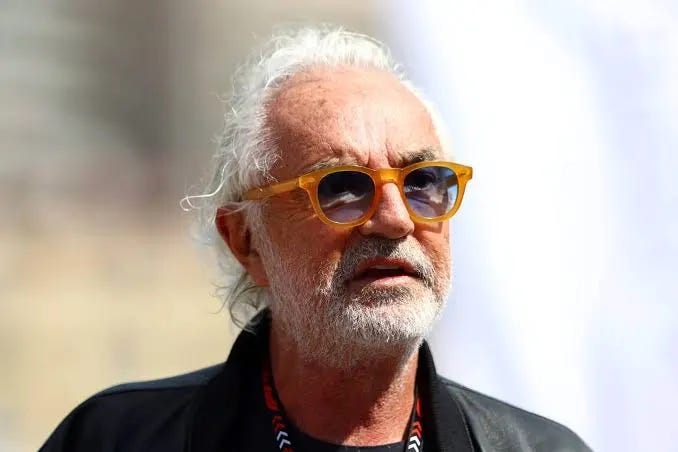
Briatore came back to Formula 1 first as an ambassador for the sport in 2022, and then more substantially in June 2024, when Renault Group CEO Luca de Meo brought him in as Executive Advisor to Alpine, the team that had been Benetton once upon a time, then Renault, now racing under a third name at the same factory in Enstone.
When de Meo first approached him about a return, Briatore told him there was no Plan B: Alpine would have to abandon its own struggling Renault power unit and switch to buying engines from Mercedes for the new 2026 technical rules, or he was not interested. “I wanted a Mercedes-Benz engine completely,” he said. “There was only one way to come back.”
It was a purely commercial demand masquerading as a technical one, exactly the kind of move that built his reputation in the first place. He didn’t care whose name was on the factory gates if the alternative made the car faster. Renault agreed and shut down its own engine program at Viry-Châtillon. The decision did not go over well and triggered employee protests. Ultimately, Briatore got his way, and Alpine switched to Mercedes power for 2026.
In May 2025, after just six races, Alpine team principal Oliver Oakes resigned. Briatore, officially still only an advisor, became the team’s de facto boss.
It seems the power unit switch was indeed the correct call. Alpine is putting in a solid 2026 campaign and sits 5th overall in the Constructors’ Championship, best of the rest behind Mercedes, Ferrari, McLaren and Red Bull. Briatore himself credited the Mercedes switch with meaningfully improving Alpine’s competitiveness heading into 2026, telling the Beyond the Grid podcast that the partnership had “changed our performance a lot” and given “more motivation to everybody” within the team.
The Stake
Which brings this story to where we are now, the middle of 2026.
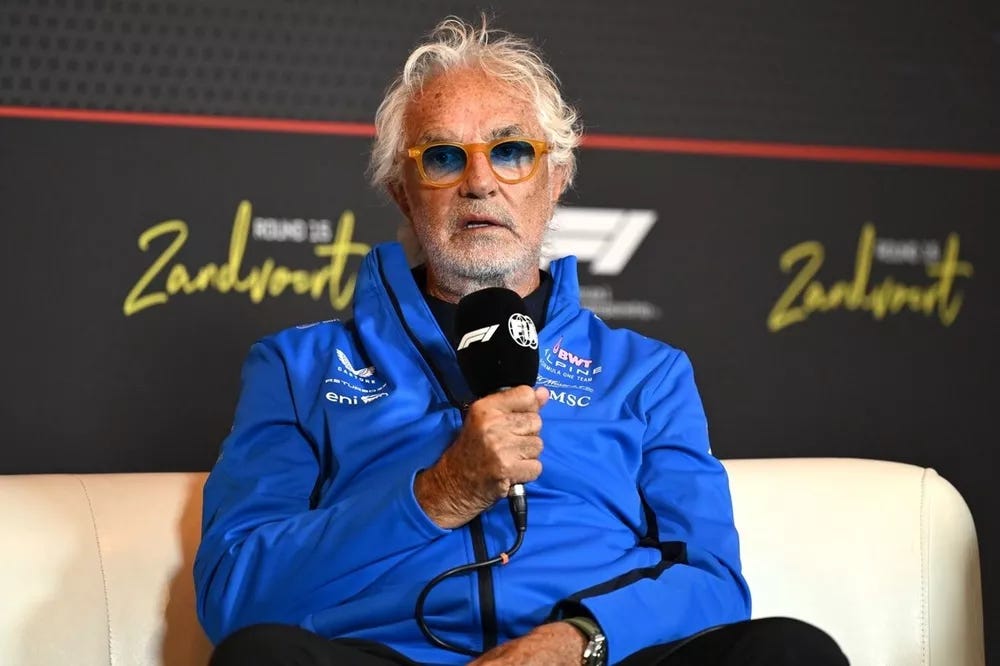
A private equity-adjacent group called Otro Capital, whose investors include actors Ryan Reynolds and Rob McElhenney and golfer Rory McIlroy, bought a 24 percent stake in Alpine in 2023 for a reported $218 million. By late 2025, with Formula 1 franchise valuations climbing across the grid, Otro began exploring a sale of that stake. Mercedes, already supplying Alpine’s engines, opened talks to buy it. During the Chinese Grand Prix weekend in March 2026, Briatore acknowledged that discussions were taking place at an implied valuation of roughly $3 billion. That’s more than triple what the team was worth when Otro bought into it in 2023, when the same 24 percent stake valued Alpine at around $900 million.
The deal fell through toward the end of May. According to multiple paddock reports (rather than any official Alpine, Mercedes or FIA statement), the crux of the issue was that Otro reportedly wanted $720 million for its stake, with reports that Mercedes valued the team closer to $2.3 billion overall and decided to walk away from the gap. Briatore was characteristically blunt about who he thought was at fault, telling reporters the price had simply gotten too high and that Toto Wolff and Mercedes had been treated unfairly in the negotiation: “Toto was very fair. I believe it. I don’t think the Otro people are fair.”
Asked directly and repeatedly whether he was tempted to buy the stake himself, Briatore gave the same answer every time: No. “I’m just looking (at) what’s going on and just watching what’s going on,” he said. “If somebody buys the share, we are very happy.”
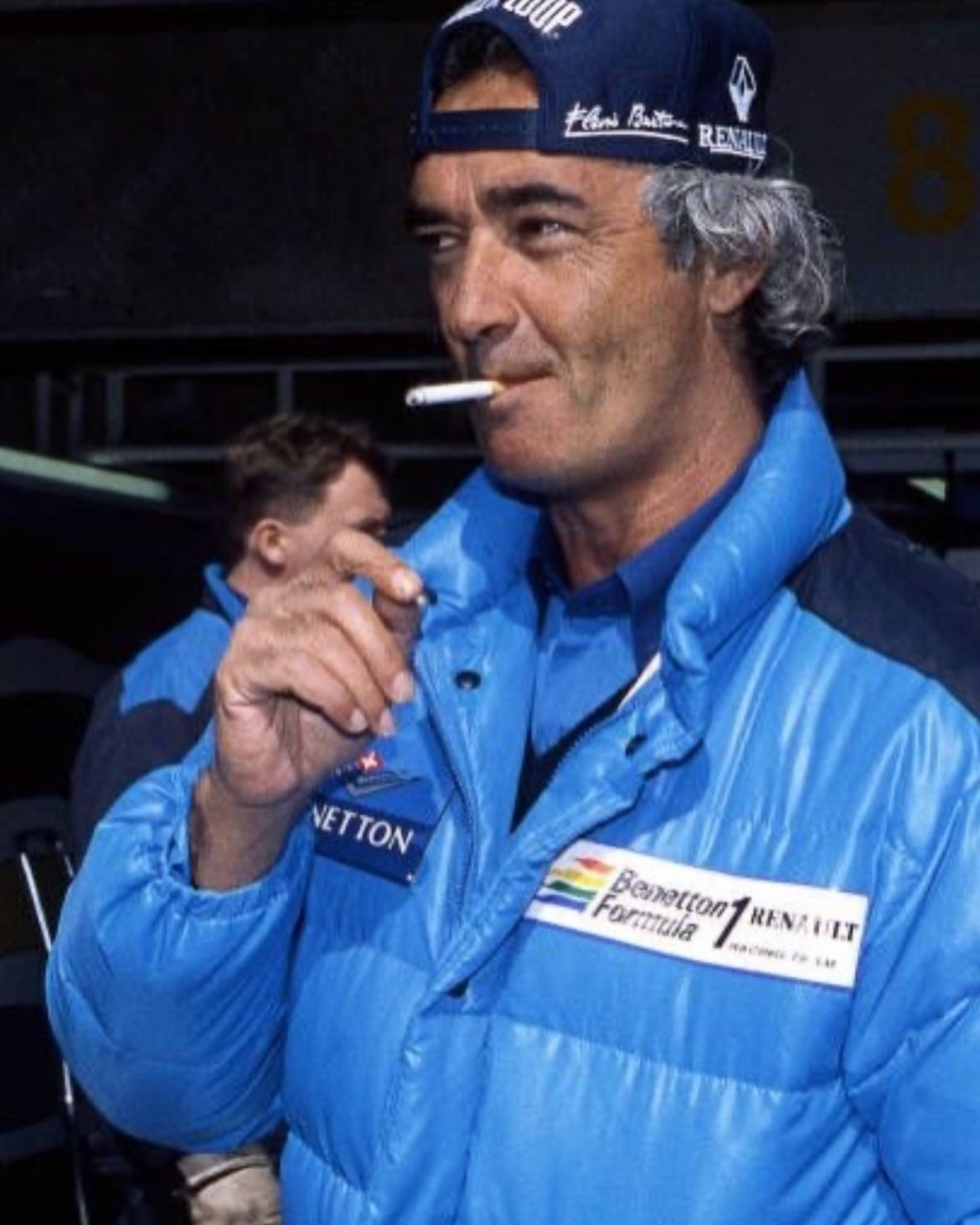
It’s a strange final note for a man who has never been a passive observer of anything in his life. He took his fugitive’s franchising commission and turned it into a fortune. He took a team nobody wanted and won two championships with it. He took a beach club’s rent roll and built a $100-million-plus hospitality group around it. He has identified value in places no one else has thought to look over the past 40 years. And now, sitting close to the center of one of the most desirable asset classes around, he’s choosing, for once, to watch.
Whether that is restraint, a shrewd strategy, or just a man who’s already built three separate fortunes and doesn’t need a fourth, is the only open question left in this story. Machiavelli never wrote a line about knowing when to wait. For Briatore, after five decades of betting on audacity, that may be the only bold move he has left.

Great article on a colorful F1 character to say the least! I mention it in this week's Business of Motorsport Roundup.
The final Alpine F1 question looks like one of capital efficiency. Flavio Briatore already exercises broad operational influence without tying up $720 million in a minority stake that would provide economics without control.
Renault retains the controlling interest, while much of the team’s day-to-day authority already appears to sit with Flavio. For someone whose career has repeatedly involved securing leverage without unnecessary ownership, watching may be one of his most characteristic moves.