

Remaining an independent source of motorsport business is what we strive for. If Business of Speed has provided you with useful insights this year, please consider subscribing.
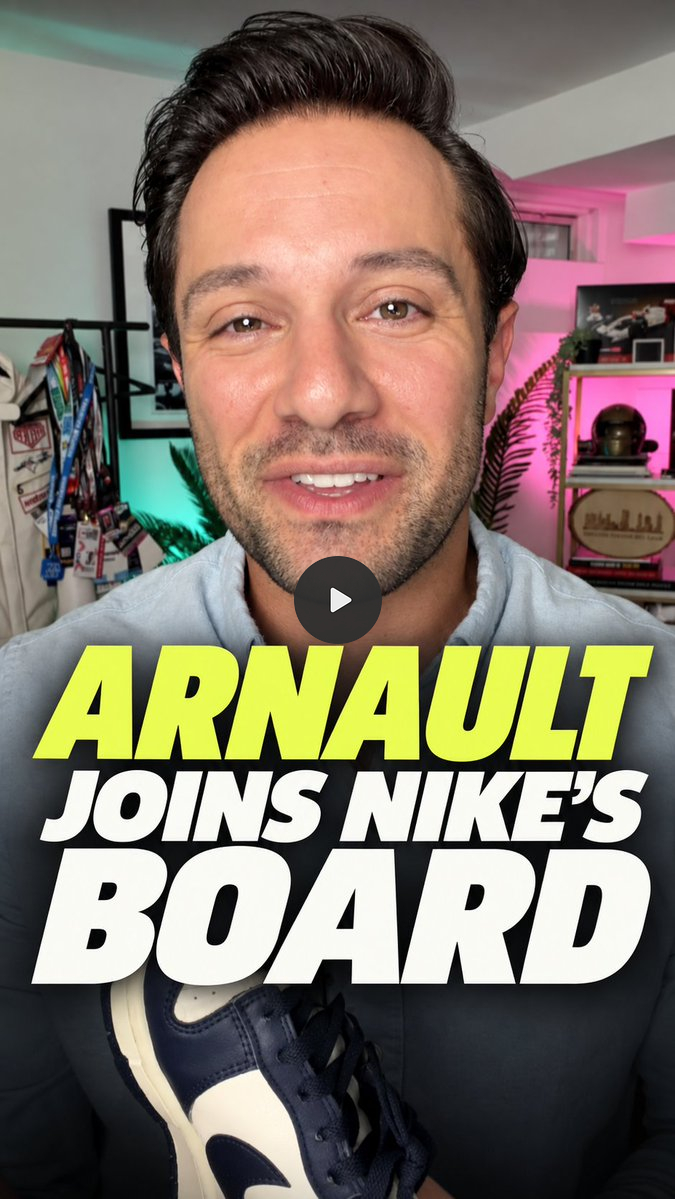
Nike CEO Elliott Hill is trying to bring consumers back to The Swoosh.
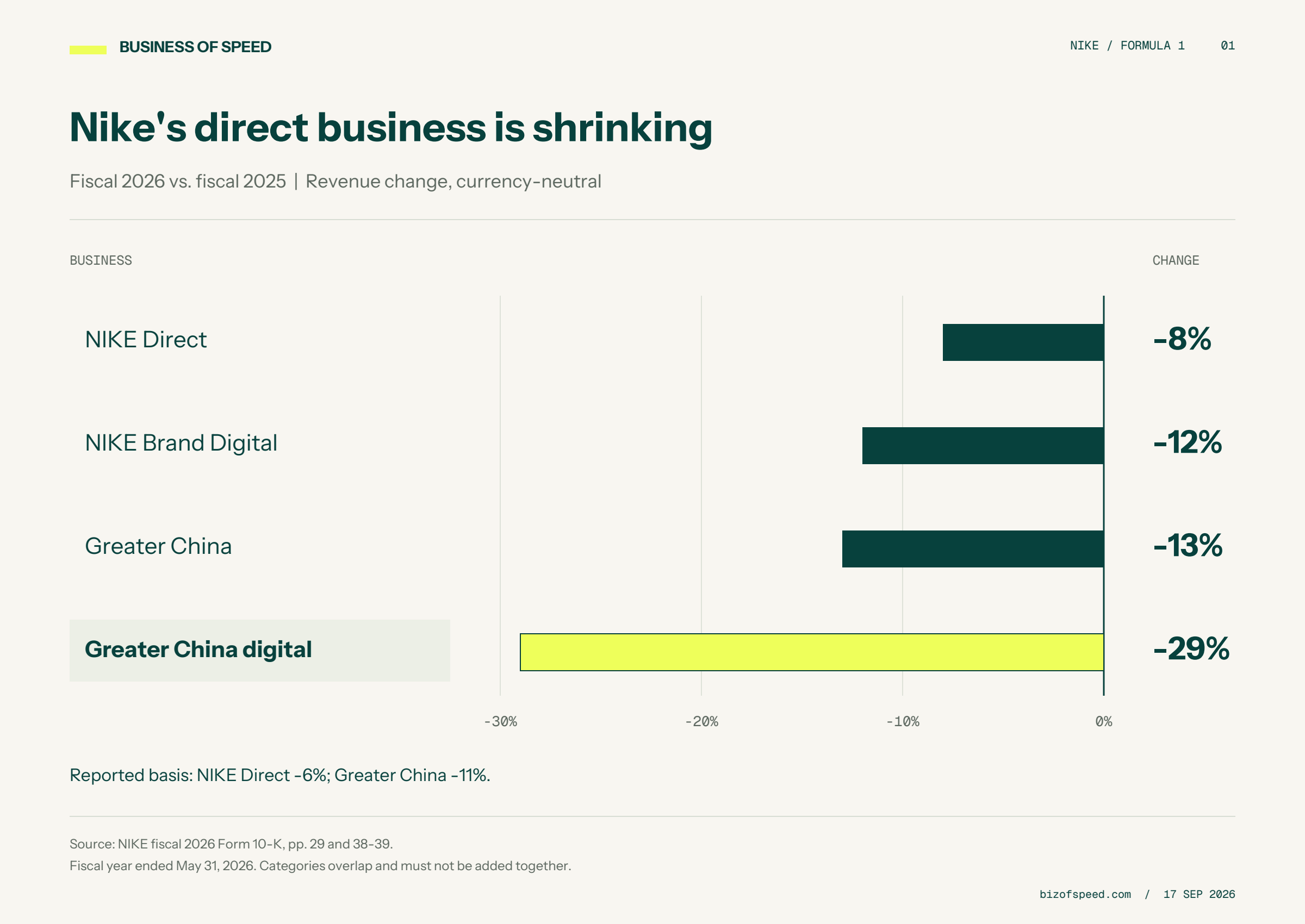
In fiscal 2026, Nike Direct revenue fell 6%, digital sales fell 12% on a currency-neutral basis, and Greater China revenue dropped 11%. The company attributed much of the digital decline to lower traffic. Nike’s annual report describes a business still clearing inventory and repairing how it sells.

Against those numbers, a Formula 1 deal makes sense. Hill needs places where Nike can give people a fresh reason to care about its products.
Reports suggest Nike is nearing an agreement to dress Formula One Management staff starting in 2027. On September 16, Nike also announced Alexandre Arnault’s appointment to its board. His résumé includes Rimowa, Tiffany, and his current role as deputy CEO of Moët Hennessy, a luxury group that has committed itself to Formula 1 for a decade.
These could be completely unrelated, but I’m not one to believe in pure coincidence.
A move like this would bring Nike closer to a sport where performance, fashion, celebrity, and spending meet throughout the year. And Arnault brings experience selling aspiration.
I like the potential fit, in theory.
The evidence for some massive turnaround, however, is considerably thinner. So let’s judge the two moves separately before giving them credit as a strategy.
Nike’s announcement praised Arnault’s ability to help established brands grow. Intern Pierre’s critique of the appointment raises a fair question about how much of that reputation outsiders can verify.
LVMH does not consistently publish separate revenue and profit figures for Tiffany and Rimowa. Their campaigns and collaborations are visible; Arnault’s individual contribution to their financial performance is harder to establish.
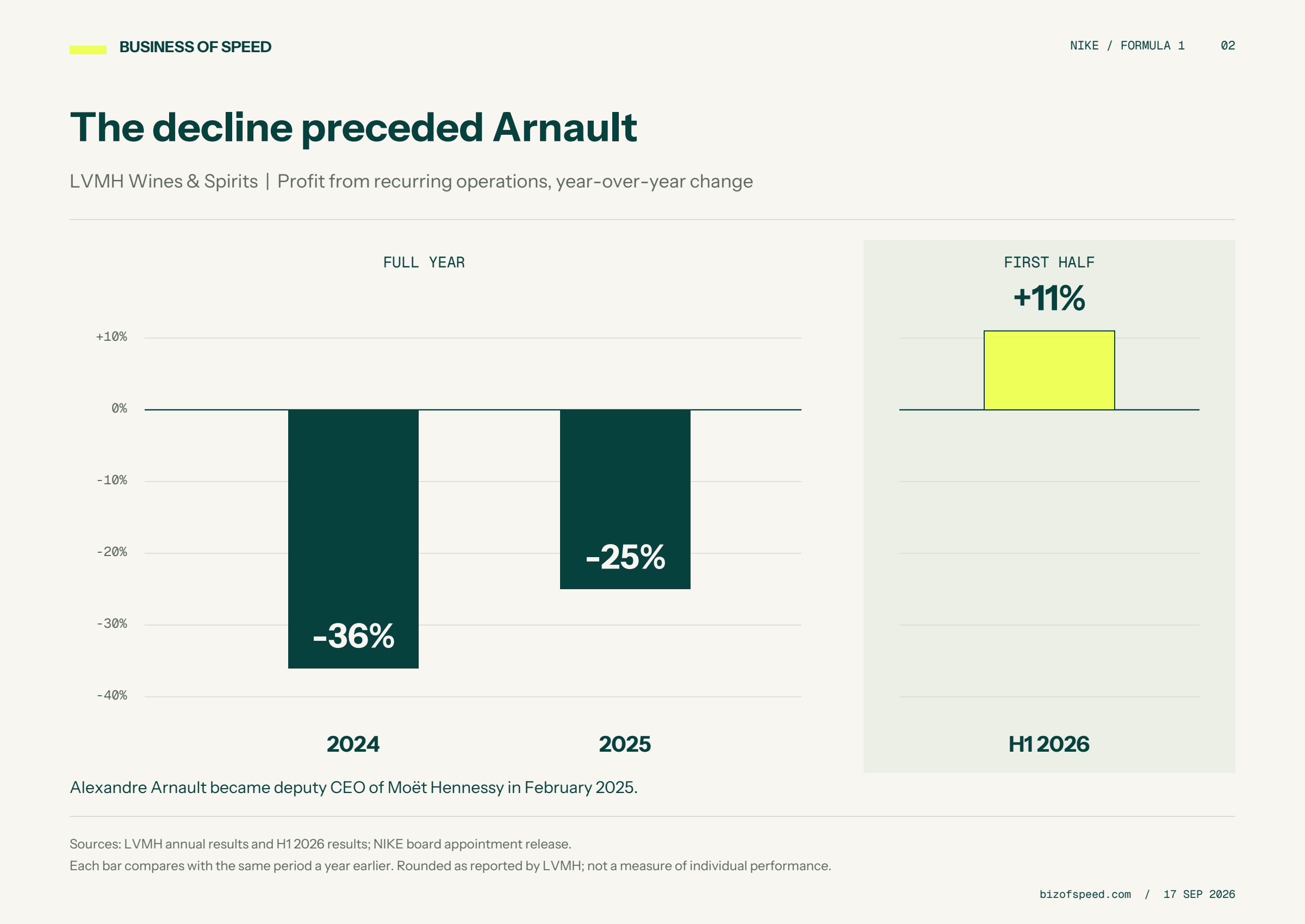
Moët Hennessy provides more numbers, though they require context. LVMH’s Wines & Spirits business reported a 9% decline in revenue and a 25% decline in profit from recurring operations in 2025. Arnault became deputy CEO that February. The downturn was already underway: divisional profit had fallen 36% in 2024.
Performance then improved. In the first half of 2026, organic revenue rose 5%, and recurring operating profit increased 11%, according to LVMH’s results.
Blaming him for the entire decline would be as careless as crediting him for the entire recovery. Nike’s board appointment puts his judgment to another test.
The more useful F1 lesson comes from a bottle of champagne.
After Nico Hülkenberg finished third at Silverstone in 2025, Sauber needed more champagne for its celebration. He had waited 239 starts for his first podium. Mercedes and Aston Martin staff supplied bottles, a detail Motorsport.com reported after the race.
Intern Pierre identified Laurent-Perrier in the footage; the problem with that is that Moët & Chandon is Formula 1’s official champagne.
That was a missed opportunity.
An agreement with Formula 1 does not establish control over everything an independent team buys, serves, or celebrates with. It shows how commercial value escapes the official schedule. The podium ceremony ends, cameras follow the driver back to his team, and another brand gets into the picture. Capturing that moment requires relationships and arrangements beyond the central agreement.
Nike will encounter the same boundaries. Dressing Formula One Management staff would give it no automatic claim on a driver’s footwear, a team’s clothing, or the merchandise fans buy.
Puma’s existing agreement makes those distinctions clear. Announced in 2023, it covered staff uniforms from 2024, licensed F1 apparel and footwear, consumer distribution, and trackside retail rights through its subsidiary stichd. Those were specified commercial rights.
Current reporting on a Nike deal indicates it includes only F1 staff kit.
A limited scope still has merit. Nike would get a season of operation inside the Paddock before deciding how much more to buy, but the stronger opportunity, obviously, is consumer demand.
Fans already choose clothes around race weekends. We explored that behavior in Twenty Four Runways per Year, including how apparel worn in the sport becomes a retail proposition outside the sport.
I suspect Nike’s best opening is with people who want to dress for a Grand Prix without committing their wardrobe to one team. A championship relationship could support that audience, provided the agreement includes the necessary rights. Nike would have room to make something recognizably connected to racing that people also wear on Monday.
That would suit Hill’s repair work. Nike pushed its familiar lifestyle franchises too hard and used promotions to clear excess inventory. Another scarce collaboration might sell out while doing little for the broader business. A product that earns repeat purchases at full price would give Hill a reason to expand.
China would be a revealing place to try it. Our reporting on F1’s commercial model there described growing fandom alongside the need for local distribution and marketing. Nike’s digital sales in Greater China fell 29% in FY2026.
A Shanghai release could test whether racing helps Nike reach consumers it has been losing. Useful evidence would include purchases, repeat visits, and retailer reorders.
My bet is that, if the staff agreement goes ahead, Nike will pursue consumer apparel or footwear around it by the end of 2027. Puma’s precedent and the retail audience make that the likely next step. If Nike remains a uniform supplier, the argument that this deal supports a broader cultural recovery weakens.
Nike should only consider expanding beyond this when they can prove the products sell through at full price and give customers a reason to return.
Business of Speed covers the business, technology, and lifestyle of racing: Formula 1, IndyCar, IMSA, WEC, NASCAR, and more. From Vincenzo Landino, entrepreneur and creator, featured in Bloomberg, TBPN, Yahoo! Finance, Forbes, Adweek, and Front Office Sports. You can find us on Instagram, Substack, and LinkedIn.


