

Business of Speed is heading into the summer with momentum: 77% subscriber growth since the beginning of the year; we’re now seeing over 100,000 visitors to the site per month, and our podcast has featured incredible guests including Tony Kanaan, Will Buxton, Marshall Pruett, and freaking Mario Andretti! That growth means more eyes on our partners.
We run our sponsorships like an F1 team. We have Title Sponsorship, Principal Partners, Official Partners, and Technical Partners. So there’s no shortage of ways to get involved. These are integrated partnerships, not just banner ads. If that’s interesting to you or someone in your network, please reach out to partnerships@bizofspeed.com
Fifty models walked the Silverstone pit lane this week, through the working garages, past the wheel guns and the jacks, as the British Grand Prix built toward an expected 565,000 people by Sunday night. Marks and Spencer put a catwalk on the most famous stretch of asphalt in British motorsport and used it to showcase a summer collection already on sale. Sharry Cramond, who runs marketing for M&S Fashion, Home and Beauty, called it “a really bold step for us” and said it was something no one has done before. Both claims check out. The more interesting part is how little it probably cost.

Six weeks ago, when Kering agreed to a reported $150 million to make Gucci the title sponsor of Alpine, we wrote that the house was buying 24 race weekends a year of paddock presence, twenty-four runways in effect, for a brand that had just posted its eleventh consecutive quarter of declining sales. The metaphor held for about six weeks before a 142-year-old British retailer built the literal version.
The Ladder
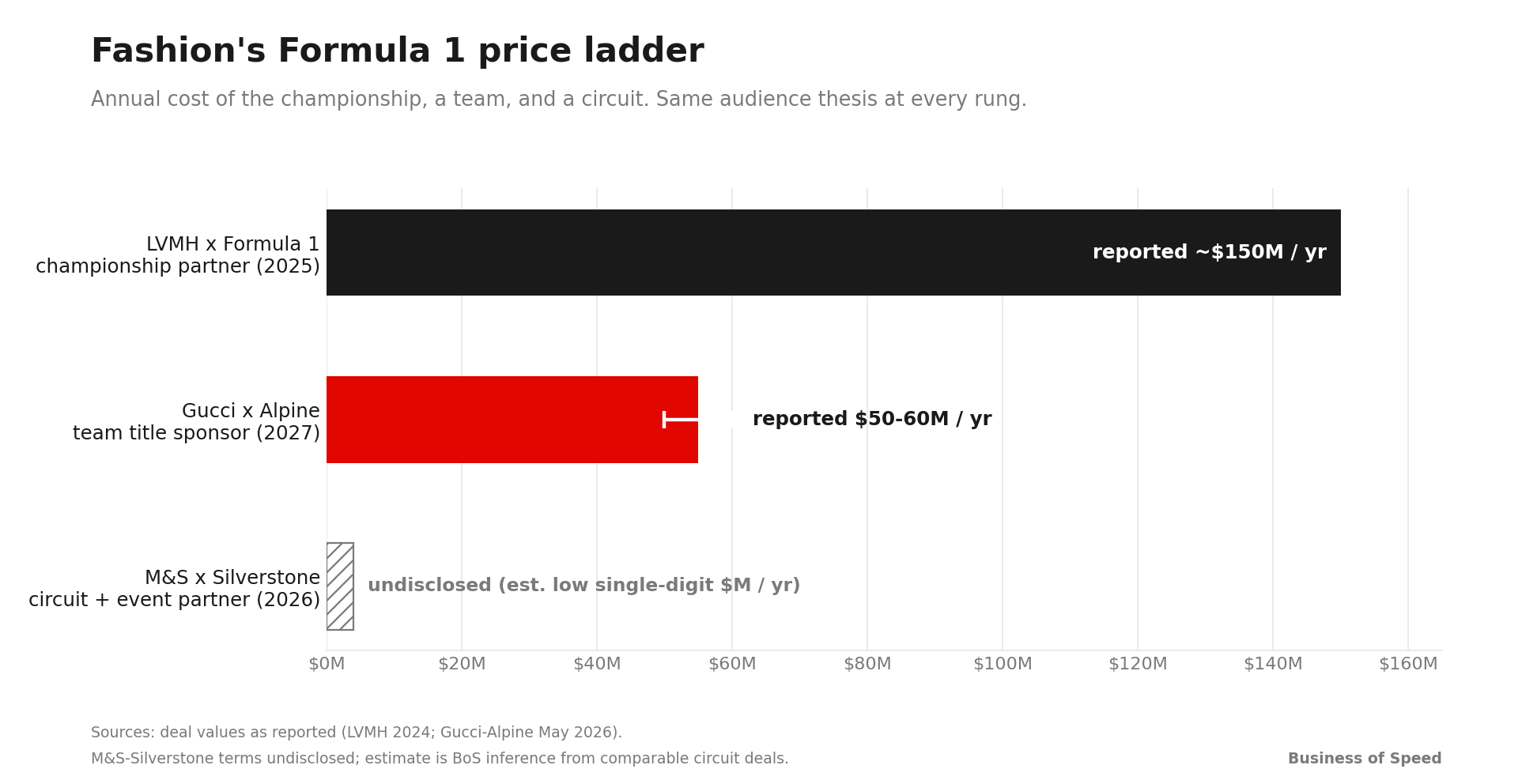
Fashion now has three price points for the same audience. LVMH pays a reported $150 million a year to be the championship’s luxury layer, with TAG Heuer timing the races and Louis Vuitton’s trunk carrying the trophy. Gucci will pay a reported $50 to $ 60 million per season, with escalators pushing the total value past $150 million, to put its name on a team that has not finished above fourth in the constructors’ standings in over a decade. M&S signed a multi-year circuit partnership whose terms neither side has disclosed.
I don’t know the fee. Comparable venue deals, an event partnership plus naming rights on a stage, tend to price in the low single-digit millions per year. But even doubled, it means M&S bought its way onto the same weekend LVMH pays nine figures to own.
Let’s calibrate for a moment: when we mapped the sponsorship market last summer, premium F1 title partnerships priced between $30 million and $70 million a year. The bottom of this ladder is very far from the top, and everyone on it is renting the same crowd.
What M&S Gets
The deal has two halves. The Silverstone half makes M&S an official event supporter of the British Grand Prix for its four-day run, July 2 through 5, with its name on the main stage, where up to 60,000 fans gather each night after track action ends. The partnership covers Silverstone’s full calendar, including MotoGP and CarFest.
The Williams half, signed in February, makes M&S the team’s official travel kit partner. The retailer dresses the entire operation, drivers, engineers, leadership, across 24 races in 21 countries, in tailoring from its Autograph Performance line. The same wrinkle-resistant, four-way-stretch pieces sell online and in stores, and some of them walked the pit lane inside the “Dress to Thrill” edit. Gucci bought a billboard that races. M&S turned a Formula 1 team into a never-ending catalog shoot.
Eight Years in the Making
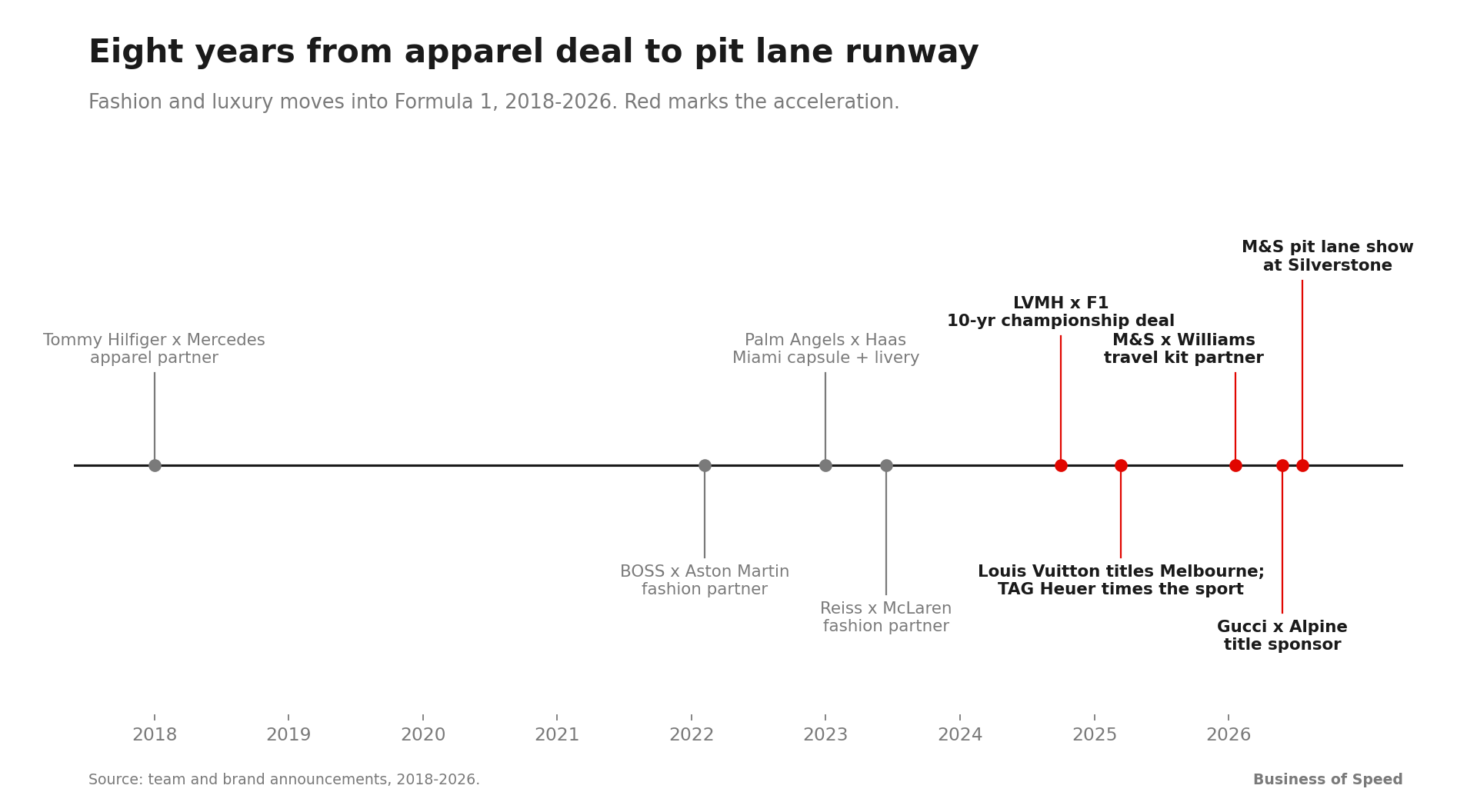
None of this arrived overnight.
Tommy Hilfiger started dressing Mercedes in 2018 and built the Tommy x Lewis line on Hamilton’s back. BOSS moved to Aston Martin in 2022. Palm Angels wrapped a capsule around Haas’s Miami weekend, Reiss took McLaren, and then LVMH made the whole category structural in October 2024 with a ten-year championship deal. By 2025, Louis Vuitton was titling Melbourne and TAG Heuer had taken over the clocks. The 2026 entries took five months: M&S to Williams in February, Gucci to Alpine in May, a catwalk on the pit lane in July.
The Cyber Year
Why would a mid-market retailer spend on spectacle right now?
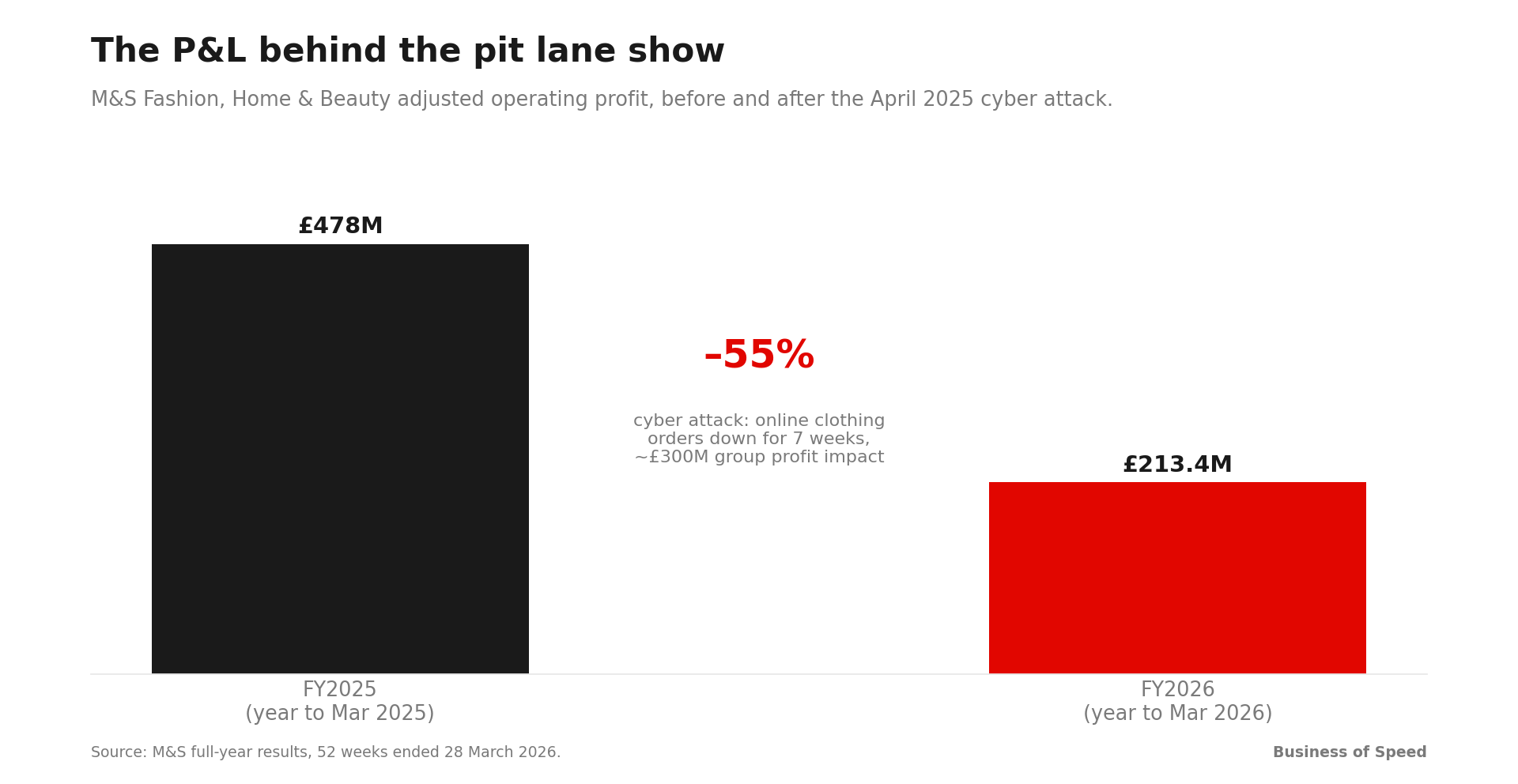
Look at what the last year did to its fashion business. Hackers got into M&S systems over Easter weekend 2025, and online clothing orders were stopped for seven weeks. The company has since quantified the damage at roughly £300 million in profit, including £131.3 million in identified incident costs. Group adjusted profit before tax fell 23.8 percent to £671.4 million in the year to March 2026, and the pain concentrated exactly where the pit lane show lives: Fashion, Home and Beauty adjusted operating profit came in at £213.4 million against £478 million the year before, a 55 percent drop, while Food grew sales 7 percent and carried the group.
Set against a £300 million hole, a runway costs nothing that matters. M&S has guided a return to profit growth this year, and the 2026 marketing calendar reads like a confidence restoration project: an Ibiza show in May to launch the “Summer of Love That” campaign, a pit lane in July, each one an argument that the fashion arm is back on offense after a year spent apologizing for empty shelves. Cramond’s line about “showing up in new, unexpected ways at the UK’s biggest moments” is the sanctioned version of the same thought.
The Crowd
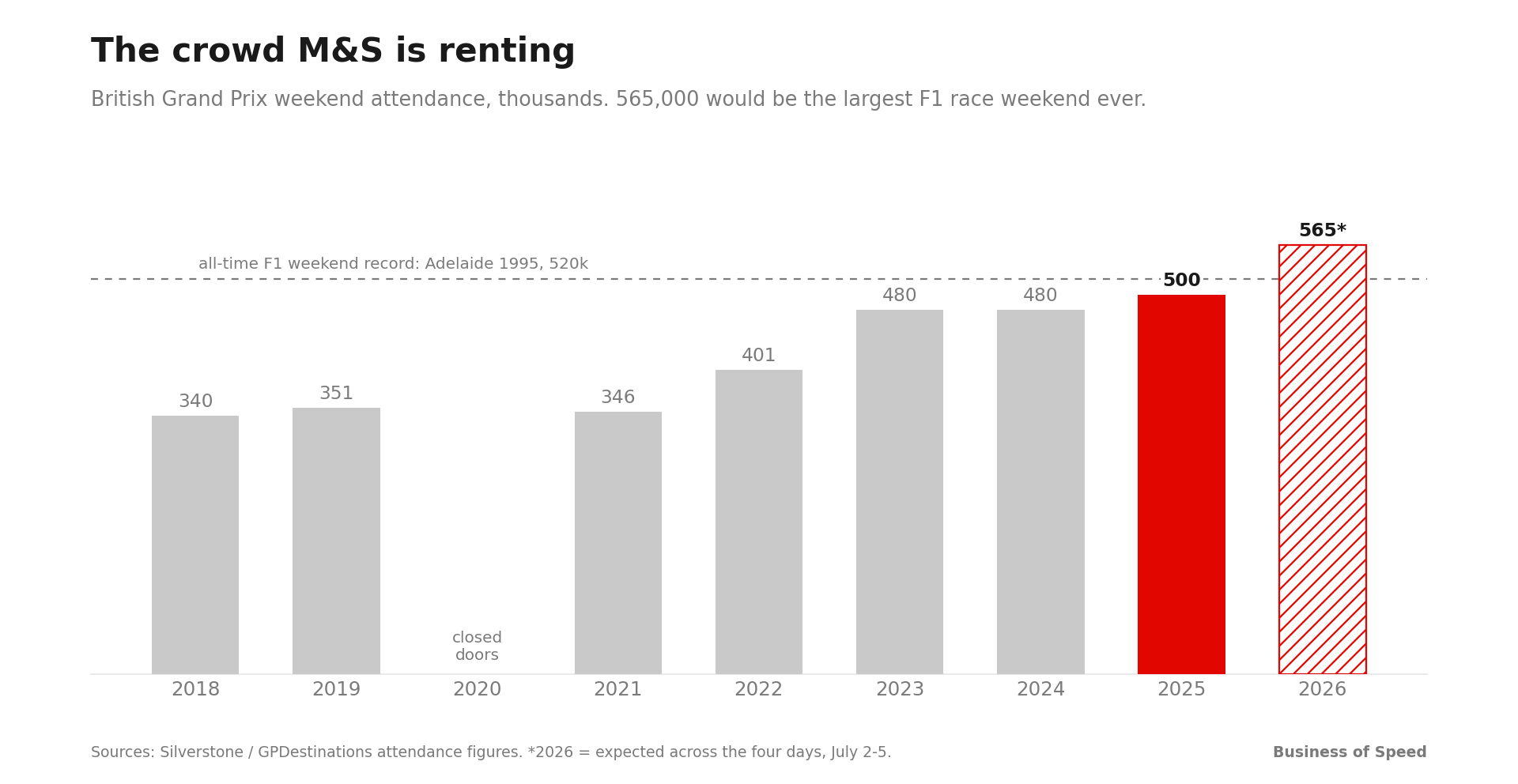
Silverstone is a rational place to make that argument. The British Grand Prix drew 340,000 people in 2018 and 500,000 last year, and the circuit expects 565,000 across this weekend’s four days, which would break the all-time Formula 1 attendance record Adelaide has held since 1995. More than 175,000 tickets are sold for Sunday alone. This is the same venue that nearly handed the race back in 2017 because the hosting fee was eating it alive, a story we told this week. Nine years later, it sells branded main stages and pit lane catwalks to retailers. We love a good recovery arc.
F1’s cumulative TV reach runs past 1.8 billion, and the fan behavior data we covered in May shows race weekends driving searches for what to wear to them. A grandstand full of people planning race-day outfits is about as addressable as a market gets for a high-street summer dress. Gucci needs that crowd to feel differently about the brand. M&S just needs them to shop.
Three Predictions
First: another mass-market brand stages a show at a heritage circuit within twelve months. Monza and Austin are two obvious venues, both sell experience inventory aggressively. To some extent, Las Vegas and Singapore could work as well.
Second: circuits productize this. Venue-as-runway becomes a rate-card item, as garage hospitality did, and the entry price for fashion in F1 keeps falling because the circuit tier has every incentive to undercut the teams.
Third: the proof lands in M&S’s numbers, so watch clothing market share and the Autograph Performance line through the autumn. If sell-through doesn’t move, this was theater with excellent lighting.
Now watch to see if the space gets even more crowded.


