

Every Monday, we publish a series called CAPITAL MOVES, a look into the off-track investments of individuals involved in the world of racing. Be sure to check out previous editions.
"When I was young I thought that money was the most important thing in life; now that I am old I know that it is."
Oscar Wilde, "Phrases and Philosophies for the Use of the Young," 1894
Edmund Patrick Jordan was born on March 30, 1948, in Dublin. His father kept the books at the ESB and turned out for Shamrock Rovers. His mother had the particular Irish iron will that either makes or breaks a boy.
Eddie had a flair for trade before he had anything worth trading. As a schoolboy, he dealt in marbles and textbooks. He thought about the priesthood. Then dentistry. He settled for a six-week accounting course and a teller’s job at the Bank of Ireland.
Most versions of this story end at the bank counter, with a safe career, a pension, and a quiet life. Jordan had other plans.
Jersey
A 1970 bank strike in Dublin cut off his income. Jordan went to Jersey for the summer, kept books by day, and pulled pints by night. One afternoon, he wandered into a kart meeting, watched for a while, and decided he wanted a go.
That afternoon rearranged him. An appetite for risk and a love of competition, long dormant, met his instinct to turn any situation into a transaction.
He went home, bought a kart, and won the 1971 Irish Kart Championship in his first season of racing. He was twenty-two. He moved up to Formula Ford and proved straight away that his talent for dealing would outlast his talent behind the wheel. He talked a Dublin carpet shop into sponsoring him, and the shop paid him in carpet remnants rather than cash, so on Saturdays he set up a stall on Dublin’s Dandelion Green and sold the offcuts himself. He loved the whole business of it, “the banter, the bartering, the blarney.”
Without quite meaning to, he was already proving the thesis that would sit under every decision he made for the next fifty years: there is a deal inside any situation if you are creative enough to see it.
In 1975, racing in British Formula 3, he crashed hard at Mallory Park and came away with two broken legs and nerve damage. The shock made his hair fall out in the hospital, and his charming, forceful mother told him to start wearing a wig.
He recovered, switched to Formula Atlantic, and won the Irish Formula Atlantic Championship in 1978. The next year, he was back in British F3 alongside Stefan Johansson, the two of them running as “Team Ireland.” By the end of 1979, the money had nearly run out, and Jordan had a clear read on his own ceiling as a driver. He founded Eddie Jordan Racing with no factory, no capital, and no obvious route to anywhere. What he did have was an eye for talent the market had not priced yet, and the nerve to act on it before anyone else.
The Team Builder
Jordan’s team won the 1987 British Formula 3 title with a young Johnny Herbert. He moved up to Formula 3000 and won the championship in 1989 with Jean Alesi.
Jordan found drivers before the market understood what they were worth, developed them on his own money, then sold access to them to bigger teams, sponsors, and manufacturers. He steered Alesi into Formula 1 and turned the relationship into a line to Camel’s sponsorship money. Every rung was a platform for the next deal. The junior team raced cars, and the business beneath it operated as a talent brokerage.
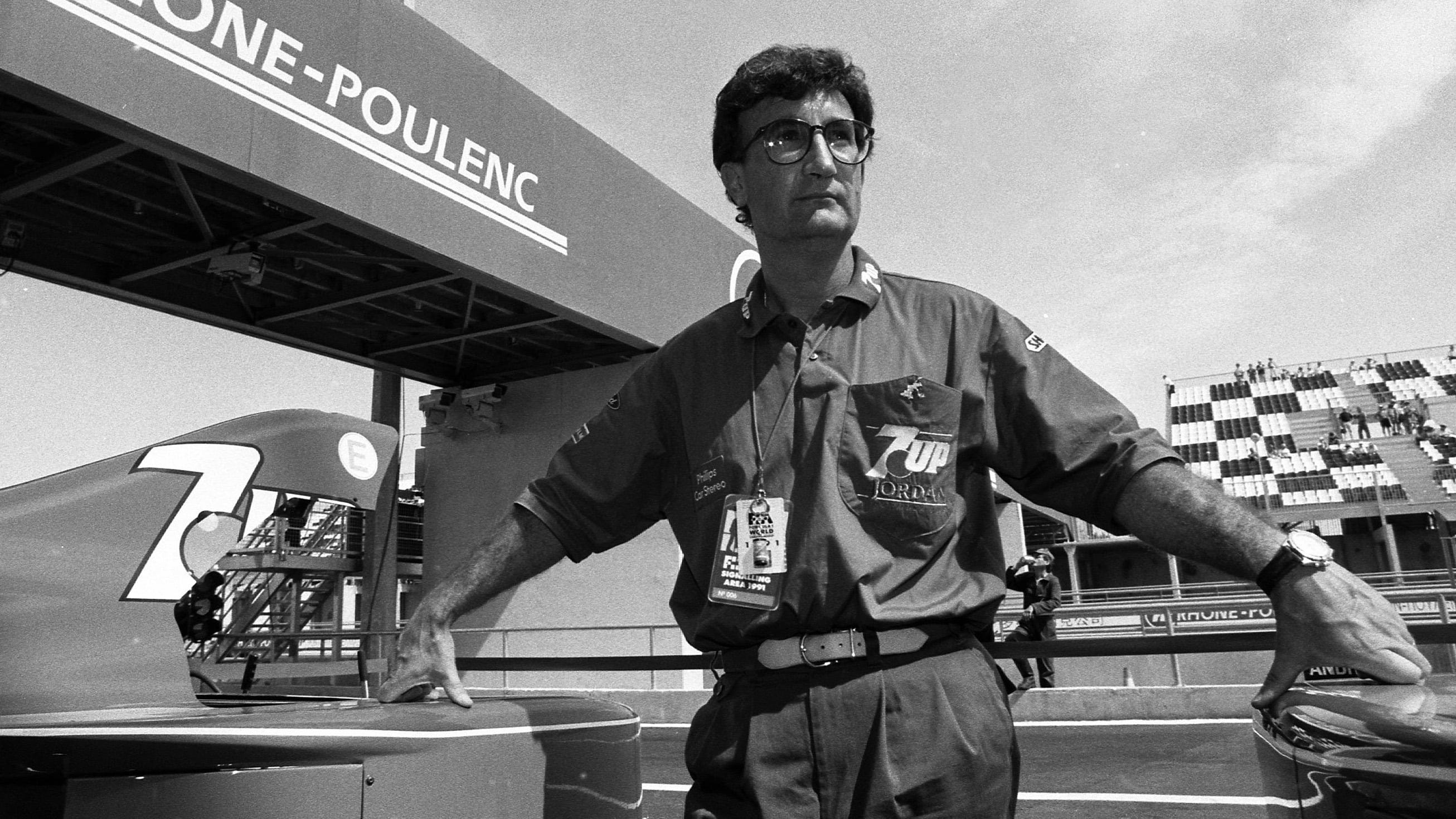
Over the winter of 1989 into 1990, Jordan put every penny he had into building a Formula 1 team. He hired three men to design the car: Gary Anderson, who had wrenched at Brabham and McLaren and drawn Reynard’s title-winning F3000 car; Andrew Green, a young mechanical engineer; and Mark Smith, who handled the transmission. The three of them worked out of a small unit at Silverstone and produced one of the most over-achieving first-year cars the sport has seen.
He landed a $7 million deal with 7UP and arranged Cosworth engines through Ford. He painted the car green for Ireland and put the Irish Tourist Board on the sidepod. The deal carried a standing obligation: every Thursday of a Grand Prix weekend, Jordan would turn up at an Irish embassy function and talk up the value of Ireland.
The car started life as the Jordan 911 until Porsche’s lawyers threatened to sue. Jordan flew to Stuttgart, sat down with them in person, and explained that a rebrand at that stage would wipe him out. He left with a brand-new Porsche 911 Carrera on an eighteen-month loan, handed over as compensation for renaming the car the Jordan 191. The rebrand cost him nothing.
Strip Jordan’s career down, and the method is always the same:
Walk into the room where the problem is.
Find the deal living inside that room.
Walk out with something nobody expected you to take.
His Friends, the Bailiffs
1991 was the best and most frightening year of Jordan’s working life. The money was so tight he was on first-name terms with every bailiff in Northampton. They would ring ahead to tell him they were coming and add, helpfully, “Just make sure you don’t answer the door.” The budget had been set at $7.5 million. The team was spending closer to $11 million.
On track, the joke was on everyone who had written them off. Race after race, the Jordan 191 was quick. It finished fifth in the Constructors’ Championship, ahead of Tyrrell, Lotus, and Brabham, three teams with history and money the new boys did not have. The owner of this fifth-place team had been selling carpet offcuts at a market stall less than a decade earlier.
Then came Spa.
In August, at Spa-Francorchamps, the season handed Jordan the moment he would spend the rest of his life proud of and unable to forgive. His driver, Bertrand Gachot, had sprayed CS gas at a London taxi driver during a row, drawn an assault conviction, and gone to prison for eighteen months, all just before the Belgian Grand Prix. Jordan had a car and nobody to drive it, and almost no money to pay whoever did. Stefan Johansson was the first call. Johansson wanted to be paid.
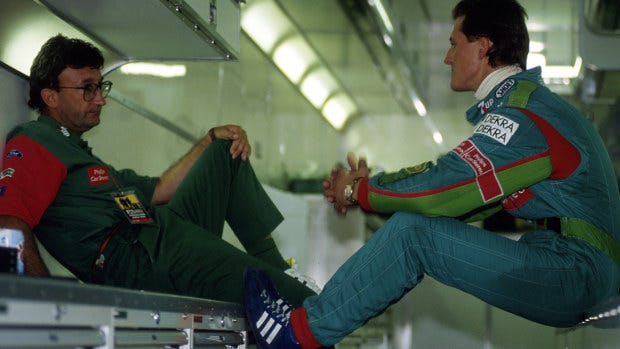
So Jordan kept looking. Word reached him from the Mercedes sports car program about a twenty-two-year-old German named Michael Schumacher. The economics ran backward in Jordan’s favor. Mercedes paid him $150,000 to give Schumacher the drive. He asked whether the kid had ever raced at Spa. Schumacher’s manager, Willi Weber, told him, “I think about 100 times.” It was a flat lie. The deal was done anyway.
Schumacher turned up at Spa, lifted a folding bicycle out of the boot of his company car, and pedaled round one of the most dangerous circuits in the world to learn it. Picture the future seven-time champion freewheeling up through Eau Rouge on a shopping bike, two days before his debut.
He qualified seventh and put four places between himself and his experienced teammate Andrea de Cesaris. “The test drive before Spa was a wonder of the world,” Jordan said later. “I had only experienced such a presence of a young guy, such talent, such incredible speed, such confidence, once before, with Ayrton Senna.”
The debut itself was brief. Schumacher’s clutch failed on the first lap and he was out, a Jordan error, money saved in the wrong place. The impression survived the result. Before the next race in Italy, Benetton poached him. Jordan went for an injunction and lost, because no final contract had been signed, and had to watch the sport’s next world champion walk off into Flavio Briatore’s pocket.
He never quite forgave the sequence. He did, in time, extract his price. When Ralf Schumacher later drove for Jordan and wanted out, Michael had to pay to release his younger brother. Jordan told him straight: “Have a look at the contract, you’re very good at looking at contracts. There’s a buyout clause; it’s two million quid. Pay me the two million, and you can take him wherever you like.” Michael paid roughly $3.3 million.
Benson & Hedges Years
The 1990s were the team’s peak, commercially and on the track. From 1996, Benson & Hedges came in as primary sponsor and gave a hand-to-mouth operation its first taste of real money. Jordan spent it on talent, the way he always had.
The Benson & Hedges liveries are among the most recognizable in the sport. The yellow-and-black snake, drawn up to dodge tobacco advertising rules, and the gold variations that followed, did more for the team’s profile than a plain cigarette logo ever could. Jordan had turned a ban into an advertisement. He had been running the same move since the day he took carpet instead of cash. The currency got bigger in the top flight. The method never changed.
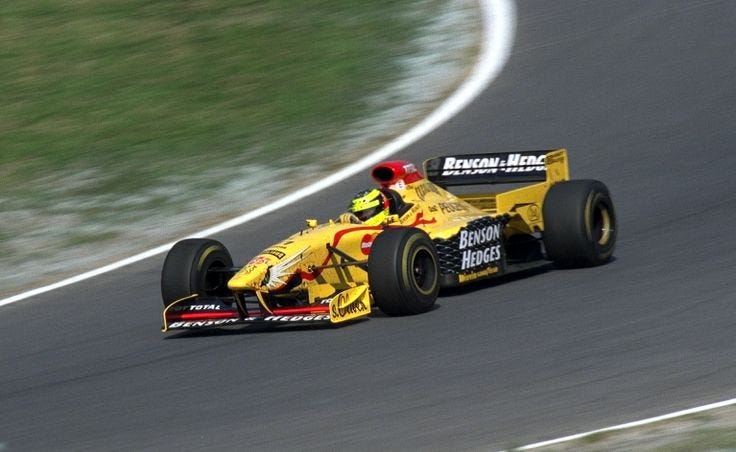
Everything the team had been building toward arrived on one soaking afternoon. The 1998 Belgian Grand Prix was chaos, and only a handful of cars made it to the finish. Damon Hill, the 1996 world champion, had been dropped by Williams, served a grim year at Arrows, and came to Jordan as a last throw of the dice. He won. His teammate Ralf Schumacher came home second. Nobody had planned for it, least of all the organizers, who had no Irish anthem ready for the podium and instead played “God Save the Queen.”
1999 was the year it nearly all came together. Heinz-Harald Frentzen had replaced Ralf, who left for Williams once Michael had bought out his contract. Frentzen won in France and Italy and arrived at the Nürburgring on 50 points, ten behind Mika Häkkinen and Eddie Irvine, who were tied at the top on 60. He took pole. He led. When Häkkinen pitted early for tires, and Irvine’s crew bungled a stop, both title contenders dropped out of the points. Hold that order, and Frentzen wins the race, draws level on points, and turns the championship into a three-way fight with two rounds to go.
It didn’t hold. Coming out of the pits after his first stop on lap 33, Frentzen left the anti-stall engaged; the car died at the first corner and would not restart. The team called it an electrical failure. Back in the garage afterward, the car fired up perfectly. The “electrical failure” line was there to spare a driver the humiliation of a self-inflicted error at the worst possible moment of his season, at home, with a world championship in view. Jordan never blamed him in public. “Psychologically, it was a huge chasm to climb out of,” he said. “That race was his.”
The team finished third in the Constructors’ and third in the Drivers’ that year. Nothing it did afterward ever reached that line again.
Collapse and Exit
The slide from 1999 to 2005 is the reason the team eventually sold for a meager $60 million. It is also why $60 million, taken at the right moment and put to good use, became the basis for everything Jordan did next.
In June 2003 he sued Vodafone for roughly $244 million, claiming the company had verbally agreed a three-year sponsorship before handing it to Ferrari. He tried to pull the case at the last minute, as the judge was about to rule, offering to cover Vodafone’s costs. Too late. The judge delivered the verdict anyway and called the allegations “without foundation and false.” The legal bill was steep. The reputational bill was steeper. Benson & Hedges and DHL both walked that same year, and a team that had finished third in 1999 was suddenly fighting to survive on a fraction of its old budget.
In early 2005, Jordan was sold to the Midland Group for about $60 million. He was selling the labor of love he had built from a kart bought with his savings, funded with carpet remnants on a Saturday stall, and kept breathing by bailiffs who were good enough to phone ahead.
That team kept changing hands. It became Force India, then Racing Point, and today it is Aston Martin. Lawrence Stroll bought it out of administration in 2018 for $120 million, and it is now valued at around $3.2 billion. The line runs unbroken from a $3.2 billion Formula 1 team back to the Jordan 191 and the Irishman who painted his cars green for a tourist-board cheque.
Second Act
Jordan sold the team in 2005 and treated the proceeds as ammunition for what came next.
Property came first. He put money into commercial real estate, residential developments across Ireland and the UK, land with a PGA golf course, and a stretch of the Bulgarian coast. He kept the Monaco apartment and added properties in London and Cape Town. The portfolio would eventually be valued at north of $100 million. Each property got the same test he had used since Jersey: find an asset the market has mispriced, and move before everyone else works it out.
He ran the same logic in financial services. He backed Clareville Capital, the hedge fund set up by photographer and investor David Yarrow. He took a seat on Citi Private Bank’s advisory board. He bought into Kinmont Advisory, a corporate advisory firm. What Jordan brought to each table was a contact book assembled over fifteen years at the top of motorsport, stocked with the names of some of the richest people and companies on earth. He had understood early that access is its own asset class. The $60 million was seed money. The network was the business.
In 2001, while he was still running the F1 team, Jordan joined a group of Irish businessmen, among them his friend Dermot Desmond, Ireland’s most powerful private investor, in putting about $24.5 million into Celtic Football Club. Jordan’s own stake was around $1.4 million. The Celtic cheque was as much about cementing a relationship as chasing a return, and Desmond and Jordan would co-invest together many times after it. Jordan grasped the sports-equity model, buying into cultural assets that carry brand value out of all proportion to their balance sheets, a good decade or two before it became fashionable.
The Gaming Play
While the public filed Jordan away as a retired team boss turned TV pundit, he was also building a serious position in European gaming.
He read the structural shift early: online regulation loosening across Europe, betting moving from the high street to the phone, back-end suppliers consolidating, live casino platforms growing fast. He positioned himself for every part of it.
His long-term holding in Entain, the London-listed operator behind Ladbrokes, Coral, and Bwin, gave him exposure to the world's largest regulated betting and gaming business. His stake in Evolution, the Swedish live-casino technology firm that supplies nearly every major online operator, handed him a piece of one of the fastest-rising stocks in European gaming history; Evolution’s shares climbed more than 2,000% between 2017 and 2021. His position in Scientific Games, the American lottery and gaming-technology group, completed a set that covered the whole structure of modern gambling: the operator, the technology supplier, and the infrastructure underneath.
In 2021, he founded JKO Capital with Keith O’Loughlin, a former Scientific Games executive who knew the global gaming-technology market from the inside. The point of JKO was to move from passive stakes into active acquisitions. Jordan wanted to stop deferring to other people’s decisions and start making the calls himself. He was seventy-three, and as hungry for a deal as he had ever been.
The Portfolio
The rest of the book was eclectic. He held stakes in Zwift, the indoor cycling and running platform; Docplanner, a medical technology company operating in 13 countries; Tosca, a reusable packaging specialist; Valeo Foods, the Irish food group; Jarvis Hotels; and Ceiba, a healthcare technology business.
In 2012, he went past passive ownership and co-acquired Debrett’s in a management buyout alongside the private-equity executive Darryl Eales. Founded in 1769, Debrett’s is the definitive British authority on the peerage and etiquette, the book that tells you how to address a duke, who outranks whom at a state dinner, and what every titled family is actually worth. A former bank teller from Dublin who sold carpet offcuts at a Saturday market ended up owning the rulebook of the British aristocracy. Let that sit for a second.
He built consumer brands of his own, too, with V10 vodka and an energy drink called EJ-10. He was a director of and investor in Spring Studios and George & Dragon, a PR and marketing agency. The man was everywhere, in on everything.
The range looks scattered until you find the through-line. It runs straight back to the day he talked a Dublin carpet shop into sponsoring a racing driver with no results to show for it. The sector never mattered much to Jordan. What mattered was getting in early, the strength of the relationship, and timing the exit. He dealt across markets because that is what dealers do, taking whatever offered the best terms.
The Final Move
In his last year, Jordan went after distressed sports assets with the same appetite he had carried from the start. Jordan Associates described the strategy plainly: minority strategic investments in sports entities carrying deep cultural and historical value. The model was the one City Football Group had proven, a web of connected clubs sharing infrastructure, data, commercial deals, and talent across leagues and borders, applied to rugby.
His last move in Formula 1 turned out to be the most consequential. In 2024, Jordan managed his friend Adrian Newey’s exit from Red Bull. Newey is the most decorated designer in the sport’s history, and Jordan brokered his switch to Aston Martin on a reported $30 million a year. When Christian Horner realized Jordan was behind it, he called him a “silent assassin.” Nobody had seen him coming. Very Eddie Jordan.
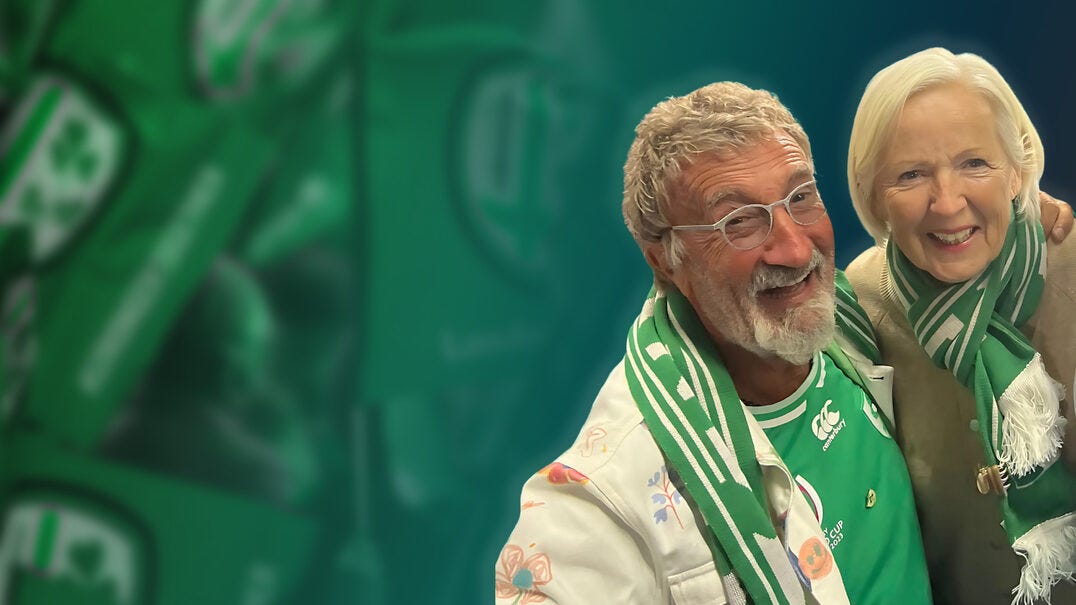
In February 2025, Jordan’s consortium completed a takeover of London Irish, the rugby club that had been thrown out of the Premiership, carrying debts of around $38.4 million. At the same time, the group was in talks to buy the French Pro D2 side AS Béziers Hérault, stretching the network model into another country.
The London Irish deal closed ten days before Eddie Jordan died, on March 20, 2025, after a short and brutal fight with cancer. He was dealing to the end. His final podcast appearance, with David Coulthard, went out the day he passed.
The Bottom Line
The estate Jordan left behind is estimated at around $600 million. Run the tape back to the start, and the arithmetic barely makes sense. A bank teller’s summer wages become a kart. Carpet offcuts sold on Saturdays fund a racing career. A first-year Formula 1 team stays alive on the goodwill of bailiffs who phoned ahead. A $60 million exit in 2005 seeded a portfolio spanning hedge funds, gaming technology, property on three continents, and sports equity.
He never won a Formula 1 championship. He never ran the fastest car on the grid. He spent all fourteen of his seasons as a team owner somewhere near the edge of ruin, and then turned $60 million into something close to $600 million across the twenty years that followed.
Here is the part most people get wrong about Eddie Jordan: the dealing was the point, start to finish. The racing, the property, the gaming stocks, the rugby clubs, all of it was the table he happened to be playing at on a given day.
So here is the call. Jordan’s loudest monument will not be the $600 million. It will be the team. The line runs unbroken from a Formula 1 team now worth billions, chasing its first championship with the best designer of his generation drawing its cars, all the way back to a green machine built in a Silverstone shed by three engineers and a man who paid his early bills off a trestle table on a Dublin green. If Adrian Newey makes Aston Martin a winner, the first title to trace cleanly back to the Jordan 191 will land years after its founder is gone, bought with the last deal he ever brokered. I think it happens. Jordan spent a lifetime being right about people before the market caught up, and Newey may be the last and best example of it.
Oscar Wilde understood something about money that some people still resist: that taking it seriously is not a character flaw. Eddie Jordan never needed the lesson. He made the deal his art form, and he worked at it until the week he died.
RIP Eddie. You legend.
Great article! And I commend your optimism for Newey’s future at Aston. Almost seems like they’re slipping into the old Ferrari adage that they can only either be good at making an F1 car or making road cars, not both at the same time.