


Remaining an independent source of motorsport business is what we strive for. If Business of Speed has provided you with useful insights this year, please consider subscribing.
Apple Continues Building a Content Stack Around Its F1 Rights
The race is almost secondary.
Before a wheel turns in Miami this weekend, Apple has built an entire layer of original programming around its Formula 1 broadcast rights, and the talent it selected reveals exactly what the company thinks it’s building.
Circuits in Focus debuts April 30, pairing 2016 F1 World Champion Nico Rosberg with racing driver and YouTuber Emelia Hartford. The two analyze the track strategy and braking points using EA Sports F1 25, which turns a video game into a legitimate broadcast analysis tool and quietly co-promotes EA’s latest racing title to every F1 fan watching, a three-way arrangement dressed up as a television show.
The POV takes a completely different approach. Former Red Bull Racing technician Calum Nicholas and engineer Christina Roki run a post-race social series reacting to key moments and strategic decisions, two people who actually sat inside an F1 operation, describing what they saw in terms that make the sport legible to someone watching their third race ever.
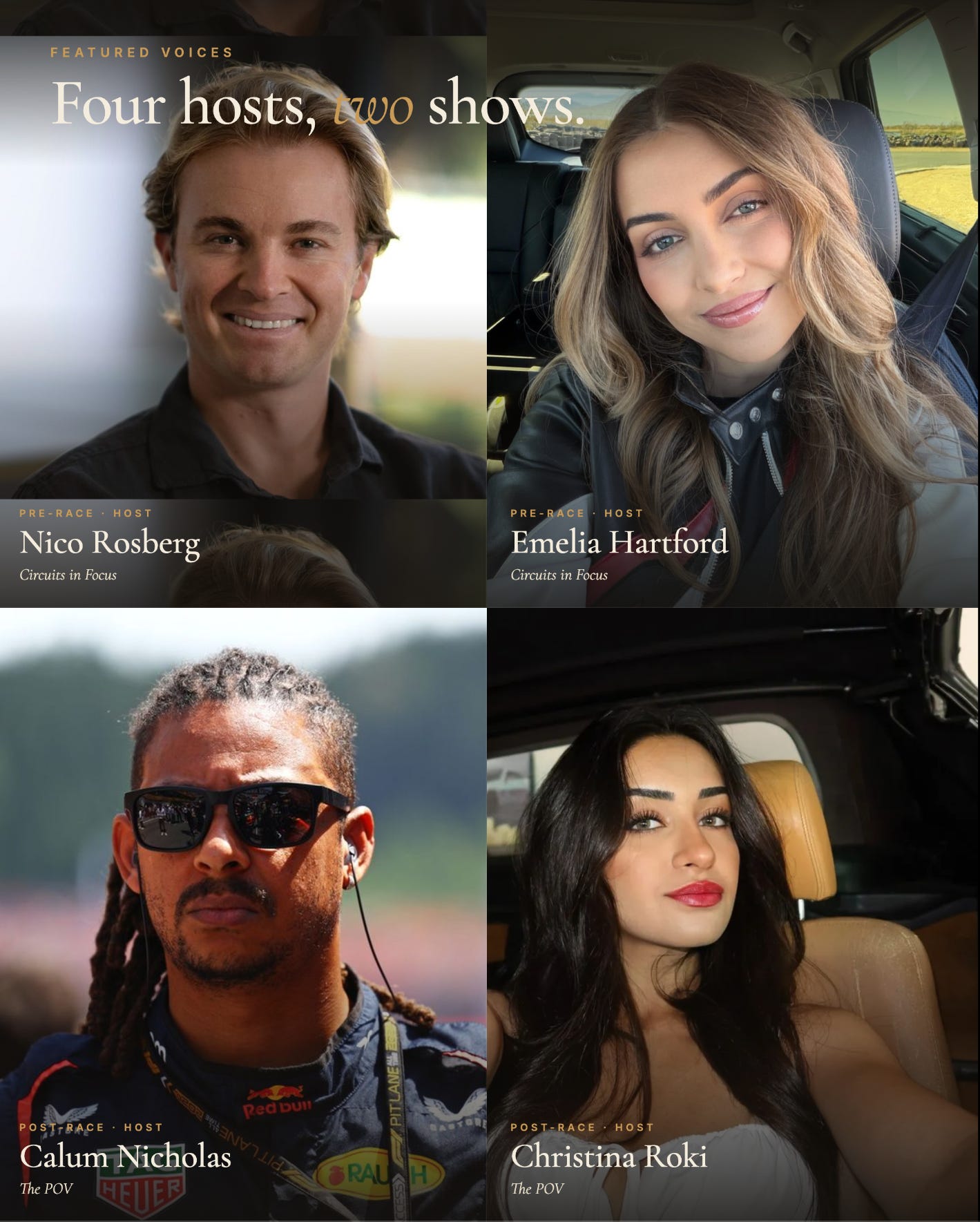
The Tubi arrangement deserves attention. The Fast Lane: Miami runs on Fox’s free ad-supported platform, with YouTuber Michelle Khare, Jeremiah Burton, and F1 instructor Scott Mansell providing live commentary from a creator-centered perspective. Apple routes the premium experience behind its $12.99/month Apple TV+ paywall and pushes the influencer-adjacent content to a service that costs viewers nothing. That’s audience expansion by design, and coordinating it with Fox signals an unusual degree of alignment between two companies otherwise competing for the same living room.
Apple’s physical footprint around the race is just as deliberate. On May 1, the Aventura store becomes a full-day race venue, with oversized screens and stadium seating for Practice and Sprint Qualifying, a live performance by DJ Dímelo Flow, and an Apple Books conversation with Susie Wolff about Driven, her memoir on building a career inside a sport that spent years making clear she wasn’t welcome.
The Cadillac F1 special livery is on display, a well-placed reminder that the sport’s new American team exists, at an event specifically designed to grow F1’s American audience. Sergio Pérez, now driving for Cadillac, shares a personal playlist through Apple Music.
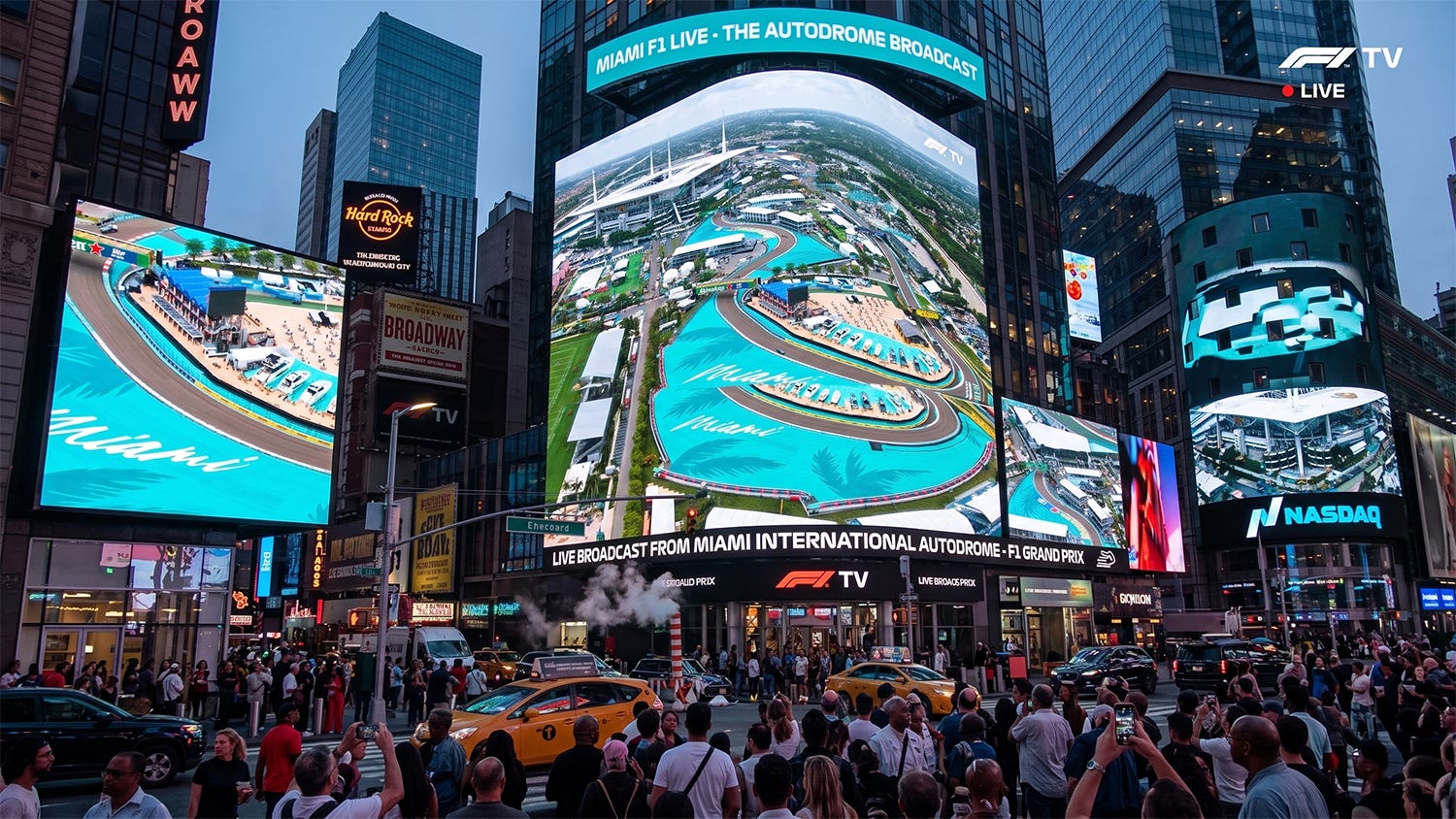
More than 50 IMAX locations nationwide are screening the Miami Grand Prix live, and Apple is running a public viewing of the race day in Times Square. Theatrical chains and streaming services have been locked in a low-grade war over the same eyeballs for years. Apple is routing a live F1 broadcast through IMAX infrastructure, which is a different kind of arrangement, and the Times Square screening makes the same point from street level: Apple wants race day to feel like something people show up for.
Talent architecture reveals Apple’s theory of long-term retention. Rosberg carries
championship credibility. Hartford brings accessibility and a female presence in broadcasting to a sport where the commentary booth has historically been narrow. Nicholas and Roki provide the technical granularity that turns a casual viewer into someone who actually understands what they just watched, the kind of viewer who clears their calendar the following Sunday.
Apple’s F1 deal spans a decade. Original programming is how a ten-year contract becomes a habit rather than a scheduled event, and getting someone to open Circuits in Focus on a Thursday afternoon builds a fundamentally different relationship with the sport than selling them a Sunday broadcast slot. The rights get you in the room. The programming, the store takeovers, IMAX partnerships, and public screenings are what keep people there.
Whether any of these specific formats survive long enough to compound is the real test. Creator talent moves. Production costs stack across ten seasons. Building a sustained audience for sports analysis content is genuinely hard. But the underlying logic of layering original content and physical presence around expensive rights is sound, and the mix of championship pedigree (Rosberg), technical credibility (Nicholas and Roki), and creator-economy reach (Khare, Hartford, Burton) suggests Apple is at least asking the right questions. Which of these formats gets renewed at the end of 2026 will tell you what Apple actually learned.
Barilla Made a Pasta for Race Day
Angie Cotter, Barilla’s U.S. pasta category marketing director, launched Racing Wheels this week: a special-edition pasta cut shaped like an F1 wheel, ridged and circular, built for al dente texture and sauce pickup. Available on Walmart.com now, with broader retail through spring. Race weekend activation at the Miami Grand Prix includes two Lasagna Bars on-site and dishes in the Paddock Club.


Barilla holds the title of Formula 1’s official pasta partner, and Cotter’s team decided to build a product with it. Racing Wheels is a new SKU that exists because of the F1 relationship: it costs $1.17, it sits in a grocery aisle, and it puts the partnership in someone’s kitchen. That kind of move is rare in motorsport sponsorship, where the default is signage, hospitality access, and a logo on the broadcast.
The campaign wrapping it is called “Domenica Italiana,” built on the Italian tradition of Sunday meals shared while watching the race. It works because it describes what people already do on race Sundays.
Every food and beverage brand on the F1 grid should study what Cotter’s team built and ask the same question: what artifact of the partnership lives outside the circuit and inside someone’s daily life? Barilla’s answer is on Walmart.com right now and will be in Miami in three weeks.
Business of Speed covers the business, technology, and lifestyle of racing: Formula 1, IndyCar, IMSA, WEC, NASCAR, and more. From Vincenzo Landino, entrepreneur and creator, featured in Bloomberg, TBPN, Yahoo! Finance, Forbes, Adweek, and Front Office Sports. You can find us on Instagram, Substack, and LinkedIn.