

We strive to remain an independent source of motorsport business. If Business of Speed has provided you with useful insights this year, please consider subscribing.
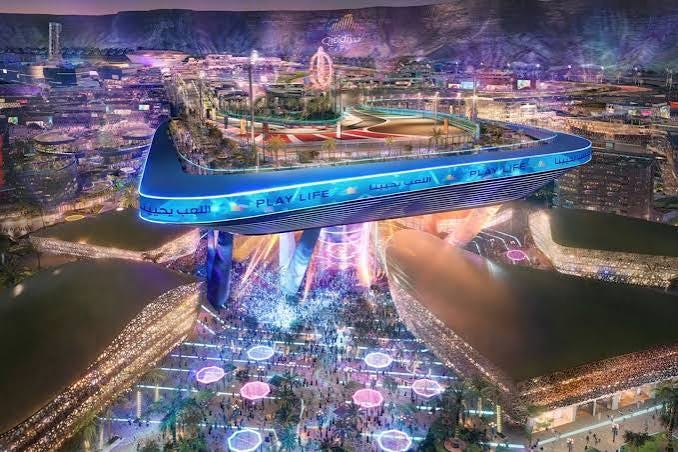
Saudi Arabia’s sovereign wealth fund is paying for a new Formula 1 circuit outside Riyadh, and the country’s current race in Jeddah was canceled earlier this season. The Speed Park Track at Qiddiya City is built around Turn 1, “the Blade,” a corner Qiddiya says rises 70 meters. That’s nearly the height of a 20-story building.
My friend, Ahmed Baokbah, has been photographing the build month by month. He’s a presenter and commentator from Jeddah who posts about planes and F1 as @ahmed_baokbah on X.


Ahmed posted that the Blade is nearing completion and could be finished as early as the first quarter of next year. He says cladding work has already started on the corner, the motorsport village, and the paddock.
I asked Ahmed to talk a little bit about what he’s seen from the build and speak to the progress as well. Be sure to watch the video above.
Qiddiya Investment Company, wholly owned by the Public Investment Fund, unveiled the track in early 2024. Alex Wurz, the former F1 driver, and Hermann Tilke, the circuit designer, are credited with the layout. It has 21 corners, 80 garages, more than 108 meters of elevation change per lap and top speeds over 325 km/h, according to PIF.
Qiddiya hasn’t published a lap length yet. Tilke’s firm says it will be longer than Spa, the longest track on the current calendar. The firm was also hired to build it to FIA Grade 1, the license a circuit needs to host F1.
WSP, the engineering firm on the Blade, told Gulf Construction in late September that the corner runs more than 380 meters and includes a 70-meter cantilevered section. That means part of the track hangs out past its supports. By then the foundations and lower structure were done, and the concrete and steel above them were well along. A music venue is planned underneath.
Qiddiya was always supposed to be the home of the Saudi race. The original plan had it taking over in 2024, but that date shifted as the wider Qiddiya plans grew. Jeddah was built fast as a short-term home, and it has since hosted five Grands Prix.
Ahmed’s read on why Saudi Arabia didn’t wait is simple. The country wanted to introduce itself to F1 fans first, before the venue “they want to wow the world with.”
Jeddah is back on the 2027 calendar for March 19 to 21. Saudi Arabia signed a 10-year deal for its 2021 debut, and the contract to 2030 covers the Saudi Arabian Grand Prix wherever it’s held.
Ahmed’s case for the corner starts with what the calendar already has. There’s Las Vegas. For glitz and glamour, he said, there’s Monaco. Abu Dhabi doesn’t always deliver the best races, but as a venue it’s spectacular.
“Now, you come as Saudi Arabia. How would you impress the world and bring them something different from all these? You have to go as crazy bananas as possible and come up with an engineering structure that everyone will think it is impossible to be built, but actually build it.”
He also likes that most of it is a real circuit. F1 keeps adding street tracks, and Ahmed says Qiddiya isn’t one, “except for probably three or four corners of it.” The official layout is a hybrid, with a fast open section and a street section that runs through the city’s entertainment districts.
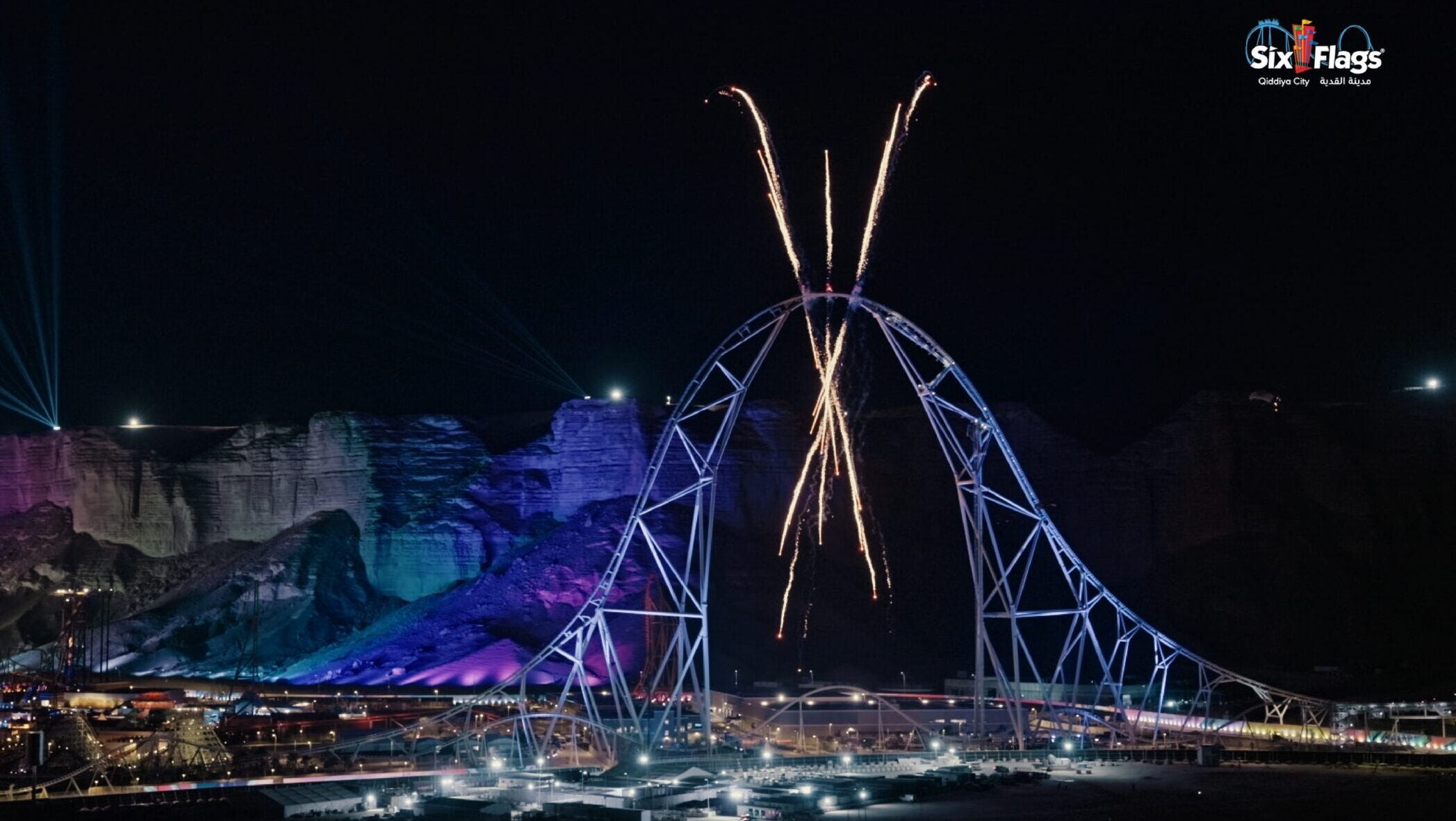
His proof that Qiddiya builds what it draws is right next door. When Falcons Flight was announced, he said people called it “too ambitious, not going to happen, and it’s too dangerous.” The coaster opened on December 31, 2025, at Six Flags Qiddiya City as the world’s tallest, fastest, and longest. Ahmed rates it above the Blade as the most impressive thing at Qiddiya.
On safety, he takes the question seriously. “Is the fear of safety for something like this valid? Yes, I think it is.” His answer comes down to who signs off. He doesn’t think any engineer or organization would put up a structure like this and risk “their licenses” or their credibility down the road.
Then there’s how Saudi institutions handle big projects. In the US, he said, you get daily or weekly updates on politics and sport. In Saudi Arabia, big organizations and media work the other way: “Let’s just wait, keep our heads down, let’s work on this, and once it’s ready, we’re going to present it to the world for them to see it, and then they can judge it.”
The money is PIF’s. AGBI has called Qiddiya a $40 billion project, and Bloomberg put it at $32 billion in February.
Qiddiya is one of the projects Saudi Arabia has kept in focus, alongside Expo 2030 and the 2034 World Cup, according to Reuters. It’s also a World Cup host city. Morgan Parker, vice chairman of Qiddiya Investment Company, said in November 2025 that sovereign money carries the project and that “building a city the size of Las Vegas will take some time.”
A race date isn’t set yet. Prince Khalid bin Sultan Al-Abdullah Al-Faisal, chairman of the Saudi Motorsport Company, told The Race in April 2025 that the track would be ready in 2027, with the race to follow once the rest of the city catches up: “we’re thinking about ‘28, maybe ‘29.” Both the Prince and Wurz say the first race comes once the hotels and roads around the track are ready.
F1 has corners people know by name. Eau Rouge, 130R, the Monaco hairpin. Those corners sell tickets, hospitality and TV moments decades after they were built, and no new circuit has really created one since. Most new tracks get remembered for the city around them, not the lap.
That’s what Saudi Arabia is trying to change with the Blade. The corner is so tall it gets its own camera shot every lap. It also gives sponsors something worth putting a name on. If it works, Qiddiya won’t need to compete with Las Vegas or Monaco on glamour because it’ll have something those cities could only dream about building.


