

Remaining an independent source of motorsport business is what we strive for. If Business of Speed has given you useful knowledge this year, please consider a subscription.
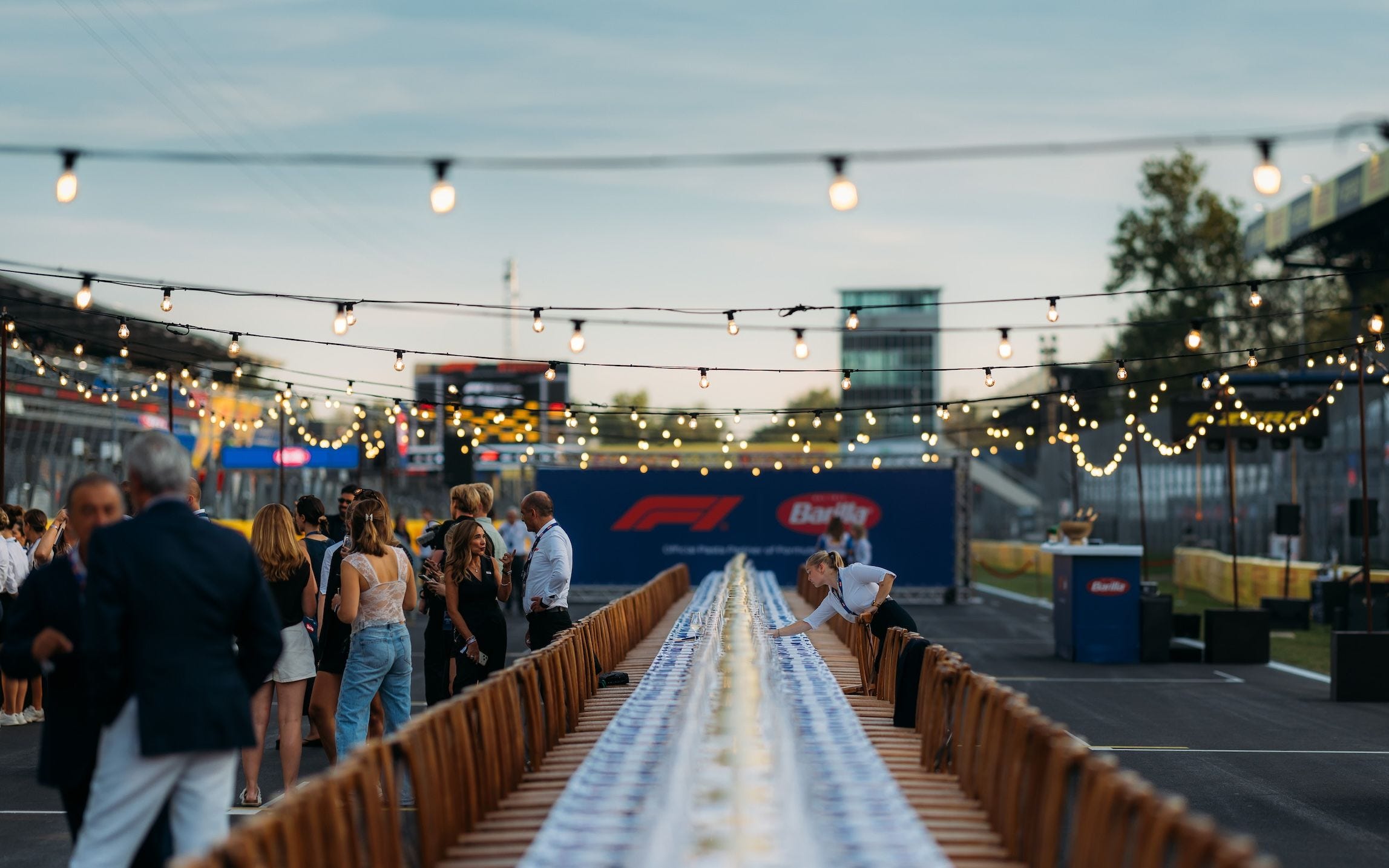
Barilla opened the Italian Grand Prix weekend by seating 220 members of the Formula 1 community at a 77-meter table on Monza’s starting grid.
Three days later, Kimi Antonelli became the first Italian to win at Monza since Ludovico Scarfiotti in 1966. Then he ate spaghetti from the trophy.
The dinner took more than a year to plan. Antonelli’s celebration was an accident. Together, the images explain why Barilla’s Formula 1 partnership works.
Barilla found a role inside the sport. It’s the host.
The answer is simple because the best brand ideas usually are. The hard part is recognizing an idea that belongs to the company, then carrying it through every decision without sanding away what made it interesting.
Recognizing and protecting that fit is the business of taste.
A Table Barilla Could Own
Francesco Giliotti, Barilla’s Group Chief Communication, External Relations and Legal Officer, first envisioned La Tavolata more than a year before it arrived in Monza.
One of his references came from his hometown of Parma. La Cena dei Mille gathers 1,000 people around a table that runs approximately 400 meters through the city’s historic center. Barilla pasta is among the products representing the Parma Food Valley.
Giliotti took that civic ritual and brought it onto the grid. In a LinkedIn post after Monza, he described the idea as a meal for people who usually compete against one another. His next ambition is to make La Tavolata recur, with more of the paddock joining “race after race.”
Veronica Calvi-Musini, who helped lead Barilla’s Formula 1 work, dates the first idea to March 17, 2025.
The guest list mattered more than its size. Drivers and team principals sat with mechanics, engineers, strategists, tire technicians, media personnel, partners and officials. Barilla centered the people whose work usually disappears once the television director cuts to the cockpit.
I spoke by phone with Nicolas Jayr, co-founder and CEO of SIDEQUEST, one of the teams that produced La Tavolata. He told me SIDEQUEST had presented a similar idea to Barilla in October 2025, then learned that Barilla had already been exploring it internally.
I’ve seen plenty of Formula 1 sponsors struggle to define a credible place in the paddock. What struck me here was that Barilla and SIDEQUEST found the same answer independently.
“That’s the role Barilla wanted to play,” Jayr said. “To be the ones who can bring those rivals together.”
Barilla Had Been Setting the Table
Barilla entered Formula 1 through a multi-year agreement announced in April 2025. The rights package made it Formula 1’s official pasta partner and placed Barilla Pasta Bars in the Paddock and Paddock Club, alongside track signage, digital work and consumer promotions.
Barilla didn’t wait to get to work.
At Imola in May 2025, Barilla revived its Domenica Italiana platform by sending meal boxes to 4,909 families, matching the circuit’s length in meters. It also donated more than 6,000 packages of pasta to Banco Alimentare’s Imola operation. The campaign moved Formula 1 from the track into the Sunday meal.
Four months later, Barilla introduced Tastes Like Family at Monza. The campaign told the story of Luigi “Pasticcino” Montanini, who began cooking in the Formula 1 paddock in 1979. His improvised meals brought drivers, mechanics, and rivals together during an era when teams handled much of their own food beside the garages.
Formula 1 described Pasticcino’s cooking as a point of connection across team lines. Barilla had found a piece of paddock history that already carried the behavior it wanted to own.
By 2026, that idea had a consumer product. Racing Wheels, a wheel-shaped pasta introduced for the U.S. market, put the partnership in the grocery aisle and on the family table. We covered it in April in The Broadcast Is the Least Interesting Part, where we noted that a box of pasta may be the most accessible piece of Formula 1 merchandise.
Pasta Bars served race guests. Domenica Italiana gave fans a ritual at home. Racing Wheels gave them something to buy. Pasticcino supplied the history. La Tavolata served an entirely different purpose.
Taste Is Care
When I asked Jayr about taste, he was careful with the word. He’s spent 15 years across agencies, brand marketing and production, including three years leading brand marketing at Formula 1 during the early Liberty Media period. He now runs SIDEQUEST with Charles Leclerc and photographer-filmmaker Antoine Truchet.
“Taste is about care and craft,” he told me.
If you’ve worked inside a Formula 1 partnership, you know how easily an idea gets flattened by approvals.
For La Tavolata, that meant the ceramics, tablecloth, lighting, music, service and camera positions had to express the same idea. Massimo Bottura designed the menu with DO&CO. The table ran from P1 to P11, and the team served 35 kilograms of pasta during the evening.
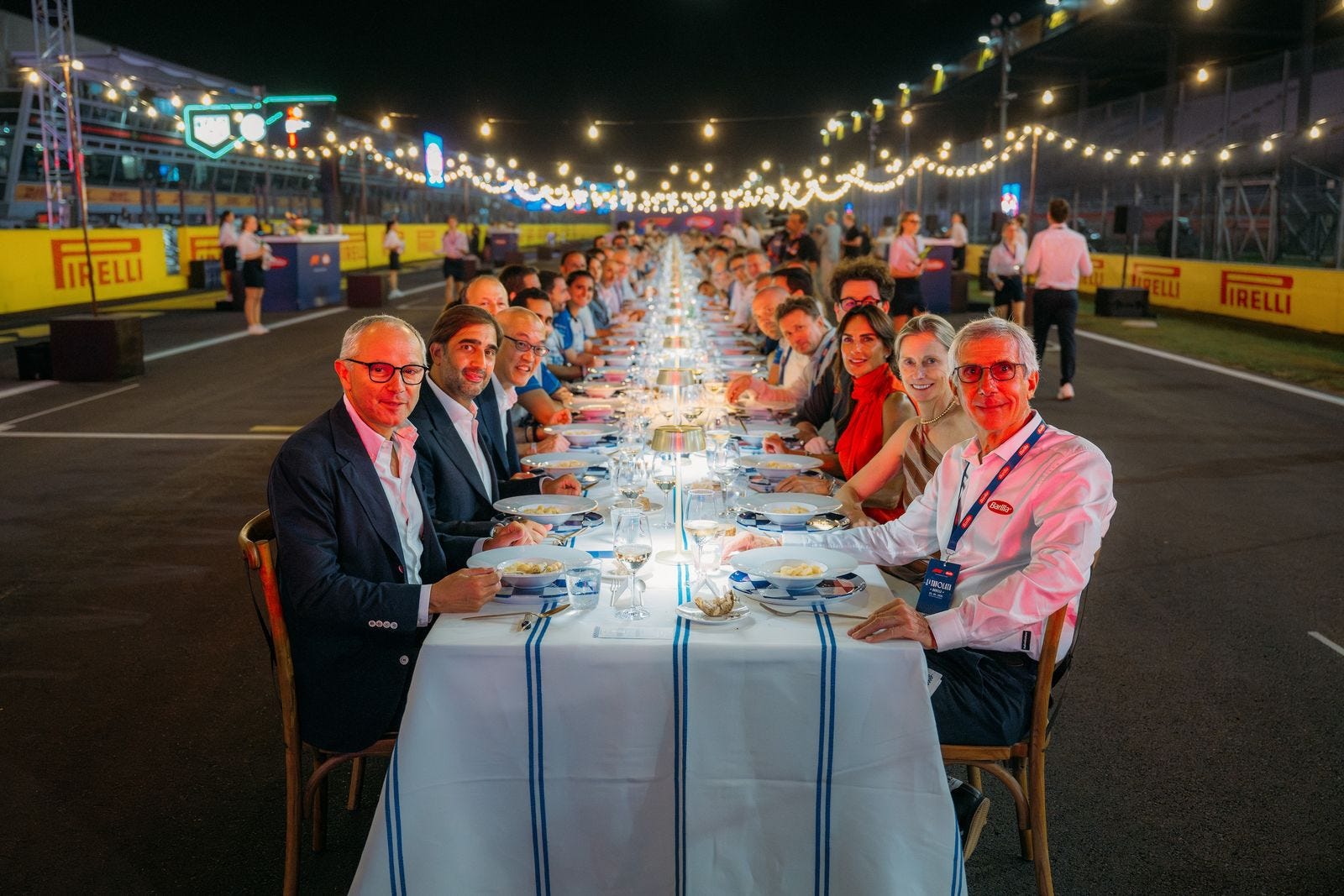
The overhead image was the priority. SIDEQUEST could hire gifted photographers on the ground, although none could show the full table cutting through the grid. Formula 1 controlled the drone operation, which required Jayr’s team to bring the rights holder into the creative process and communicate exactly what the final frame needed to do.
The image works in a phone scroll because the idea survives reduction. A long table occupies the place where 20 drivers usually line up against each other. Barilla feeds the people sitting there. It doesn’t need the caption to explain itself.
I think this is where taste becomes commercially useful. Taste helps a team decide which idea deserves money and access, then which one earns distribution. We can measure impressions, video completion, brand lift, and purchase intent after the event. Those numbers can’t rescue an idea people forget.
By the Numbers
Barilla’s public reporting provides an early business case for its Formula 1 program.
In its 2025 annual report, the company said Formula 1 generated incremental coverage among younger consumers and added to brand equity around modernity and performance. Classic Barilla pasta volume grew 4% in Italy during the year.
We can’t assign that 4% to Formula 1. Barilla attributed the result to several factors, including an average price reduction of approximately 10%, the Tastes Like Family campaign, and Formula 1. The report doesn’t isolate the partnership’s contribution to volume.
The available evidence lets us reach a narrower conclusion. Formula 1 is helping a 149-year-old food company reach younger audiences and reshape how they perceive the brand. La Tavolata gives that change a physical form.
Few sponsors arrive with this much native credibility. Paolo Barilla raced for Minardi in Formula 1 and won Le Mans with Porsche in 1985. CEO Gianluca Di Tondo previously held global responsibility for the Heineken brand. Jayr said Calvi-Musini worked on Heineken’s Formula 1 partnership before joining Barilla. He pointed to that experience as part of Barilla’s fluency inside the sport.
Barilla’s program started with people who knew the sport, a family member who had raced, and a product capable of serving everyone from a Paddock Club guest to someone shopping at Walmart.
That’s why good judgment has a chance to survive the process.
Make It a Property
Giliotti wants La Tavolata to grow. Jayr believes the idea can travel, and Barilla should pursue it.
I wouldn’t make the next edition longer just to get a bigger number. I’d keep Monza as La Tavolata’s home, where Barilla and Formula 1 share their strongest connection. Selected races could host local versions built around the same behavior, with food and guests reflecting their respective markets. Scale should come through participation, access, and distribution.
A recurring format would give Barilla something more valuable than a large dinner. It would create an event that teams, media, and partners anticipate, an image Formula 1 knows how to capture, and a role competitors can’t adopt without looking derivative.
Most Formula 1 sponsorship packages offer some combination of signage, hospitality, and content. But a sponsor can’t stop at the inventory. The question brands need to be asking is which human behavior they can credibly own within the sport.
For me, Barilla’s answer is gathering people around a table.
Business of Speed covers the business, technology, and lifestyle of racing: Formula 1, IndyCar, IMSA, WEC, NASCAR, and more. From Vincenzo Landino, entrepreneur and creator, featured in Bloomberg, TBPN, Yahoo! Finance, Forbes, Adweek, and Front Office Sports. You can find us on Instagram, Substack, and LinkedIn.
Vincenzo, I am sure it will be no surprise that Italians like to eat well and are generous hosts. In the 1980's the IMSA paddock was treated to pasta lunches cooked by Gianpiero Moretti of MOMO fame. In the 1990's Superbike paddocks in Europe and in the US the place to catch lunch was with Eraldo Ferracci of Fast By Ferracci fame.
The scope and setting of the Barilla feast is fitting for Formula1.
Thanks for the details and perspective. Think some brand wants to get in on the wine and espresso deal?