


I’ll be honest I usually spend my Januaries recovering from the previous race season and consuming myself in NFL playoff misery (go Steelers…?)
And yes, I’m still taking media appearances talking F1. The guys over at TBPN invited me on to talk F1 business earlier this month. You can watch the full 30-minute segment below.
I also had an opportunity come across my desk to attend a race I will finally get to check off my bucket list: The Rolex 24 at Daytona. (thanks IMSA!)
So later this week, Lali Michelsen and I will head down to Daytona to cover the action on and off the track.
While F1’s off-season was dominated by new regulations and Toto Wolff's share sale, I found myself digging deeper into IMSA's business side.
If you haven’t looked at IMSA lately, you’re missing what I believe might be one of the most important hidden stories in the motorsport business.
I spend so much time analyzing F1’s billion-dollar valuations and private equity inflows that I sometimes forget the other side of the equation, the part that made me fall in love with racing: the actual cars.
And right now, if you want to see where the global automotive industry is actually putting its money to test the future of mobility, you don’t look at the grid in Monaco. You look at the GTP class in IMSA.
Here’s why the manufacturers are flocking to North America, and what it tells us about the future of the car in your driveway.
The Manufacturer Stampede
In Formula 1, there are 11 teams. Four of them are effectively independent constructors. Getting a new manufacturer (like Audi or Cadillac) to enter is a massive, years-long geopolitical struggle.
Now look at IMSA’s top class. Acura, Aston Martin, BMW, Cadillac, Porsche, Lamborghini.
Why? Because the ROI calculation actually makes sense.
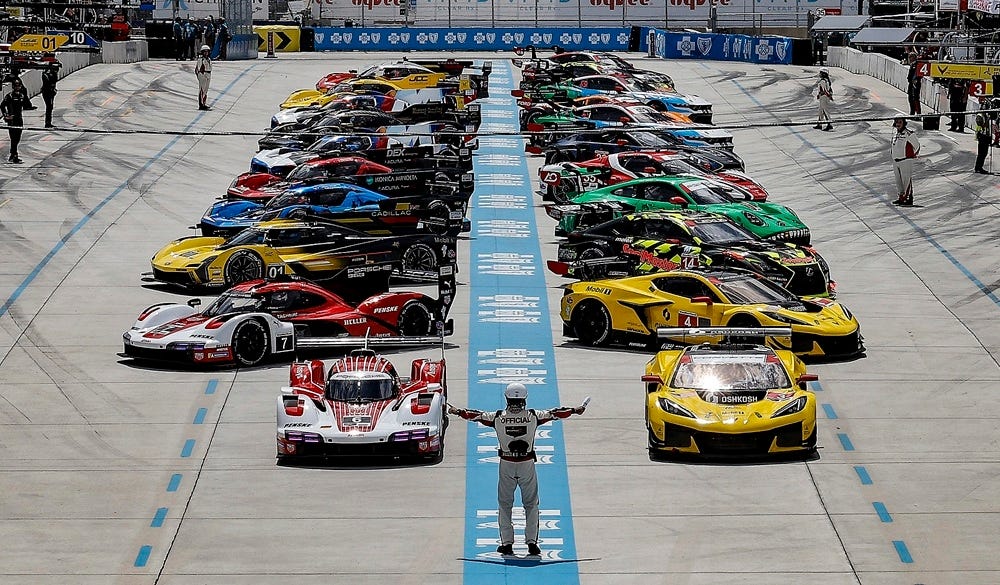
For a fraction of the cost of an F1 engine program, these brands get to race hybrid prototypes that look vaguely like their road cars and, crucially, run on technology they can actually sell.
Liberty Media turned F1 into a marketing platform. IMSA (and by extension, the WEC) has managed to remain an engineering platform without bankrupting its participants.
The “Relevant Tech” Argument
The GTP (Grand Touring Prototype) class is built around a hybrid convergence that mirrors the road car market. It’s about energy management, software deployment, and sustainable fuels.
Hybridization: The LMDh platform allows manufacturers to pair their own combustion engines with a spec hybrid system. It keeps costs down but relevance up.
Sustainable Fuels: IMSA has been aggressive in this area.
Tire Tech: Michelin is using sustainable materials in endurance racing that eventually trickle down to the tires you put on your EV.
This is the “Lab” concept that motorsport has always promised but rarely delivered. In F1, the tech is so spaceship-advanced it rarely translates. In IMSA, the distance between the track and the dealership is much shorter.
The Business of “Win on Sunday, Sell on Monday”
We love to mock the old “Win on Sunday, Sell on Monday” adage as a relic of the 60s. But in the era of the Software-Defined Vehicle (SDV), it’s making a comeback.
The battleground for future mobility is in software.
Managing the handoff between electric and combustion power at 200 mph requires mastery of coding. That same code is what differentiates a luxury EV from a commuter appliance.
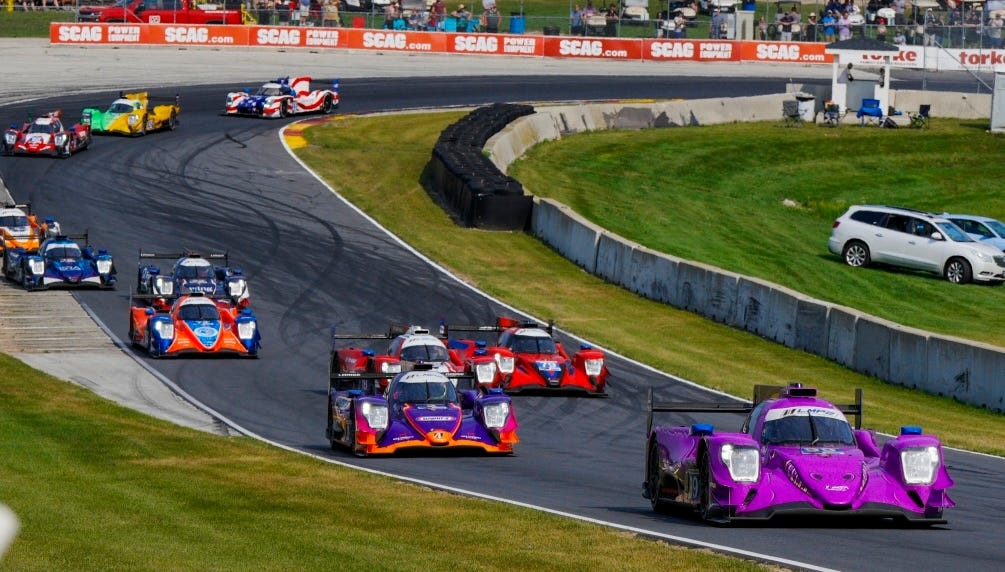
Manufacturers have joined IMSA to stress-test their software and engineers in a high-consequence environment.
What This Means for the Future
Does this mean IMSA will overtake a series like F1 in popularity? No.
But that’s also because F1 has become an entertainment property while IMSA still feels like a true motorsport one. And as we look toward the next five years, I think we’ll see a divergence in how these sports are valued.
F1 teams will continue to trade like sports franchises (think NFL or NBA). Their value is in the scarcity of the slot and the broadcast rights.
IMSA teams and manufacturers, however, will be valued on their utility. They will become essential arms of corporate R&D departments.
If F1 is the Super Bowl, IMSA is Silicon Valley. And right now, I say business is booming.
Loved the use of "appliance" one of the most insider-old schoolers I know uses it too to dismiss bland no character offerings.
having been to a few IMSA paddocks, I think the main opportunity is increasing sponsorship 'luxury' for non-car buffs. It's great if you know people, but otherwise difficult to really interact with other companies / sponsors of other teams.