

Remaining an independent source of motorsport business is what we strive for. If Business of Speed has provided you with useful insights this year, please consider subscribing.
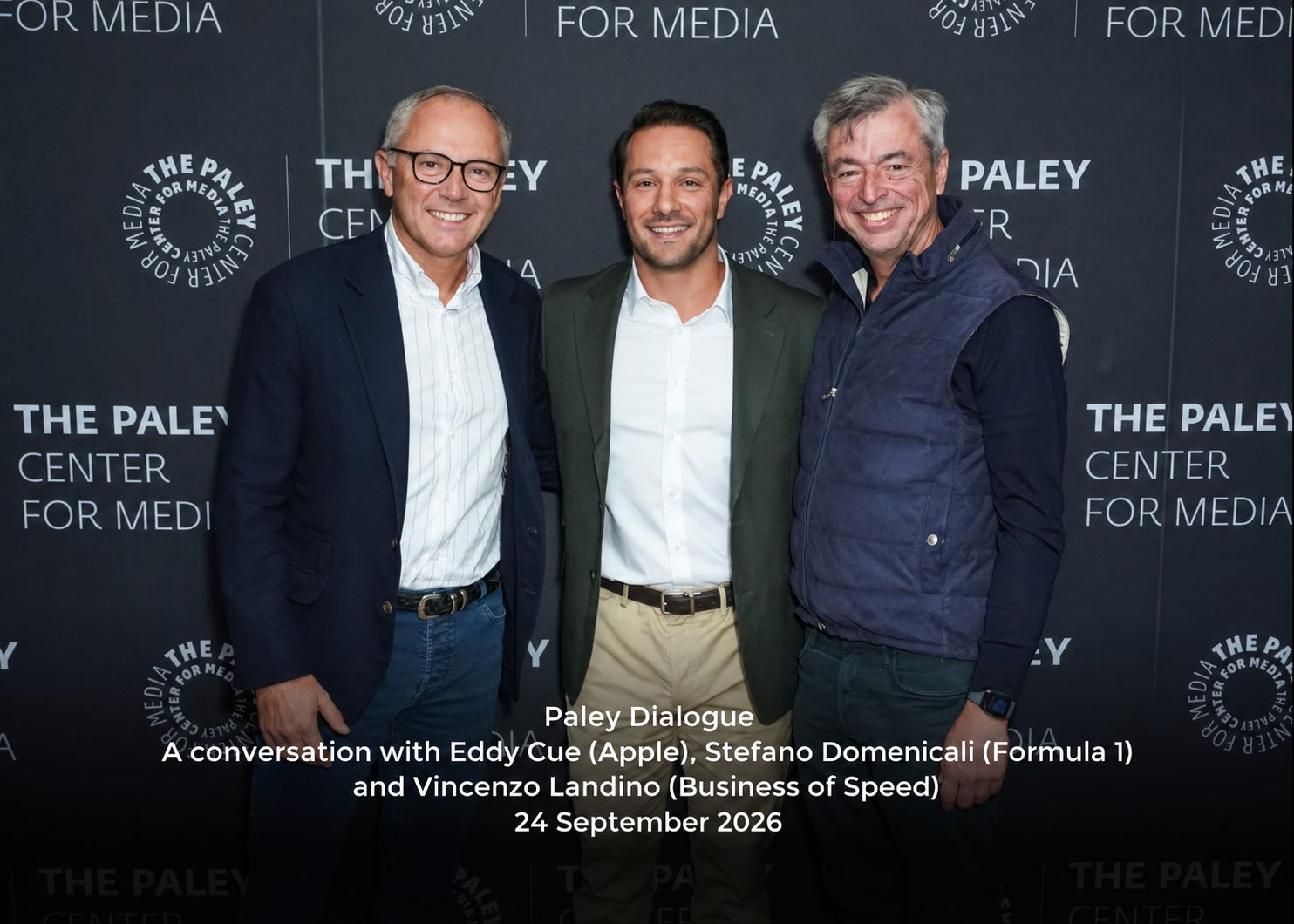
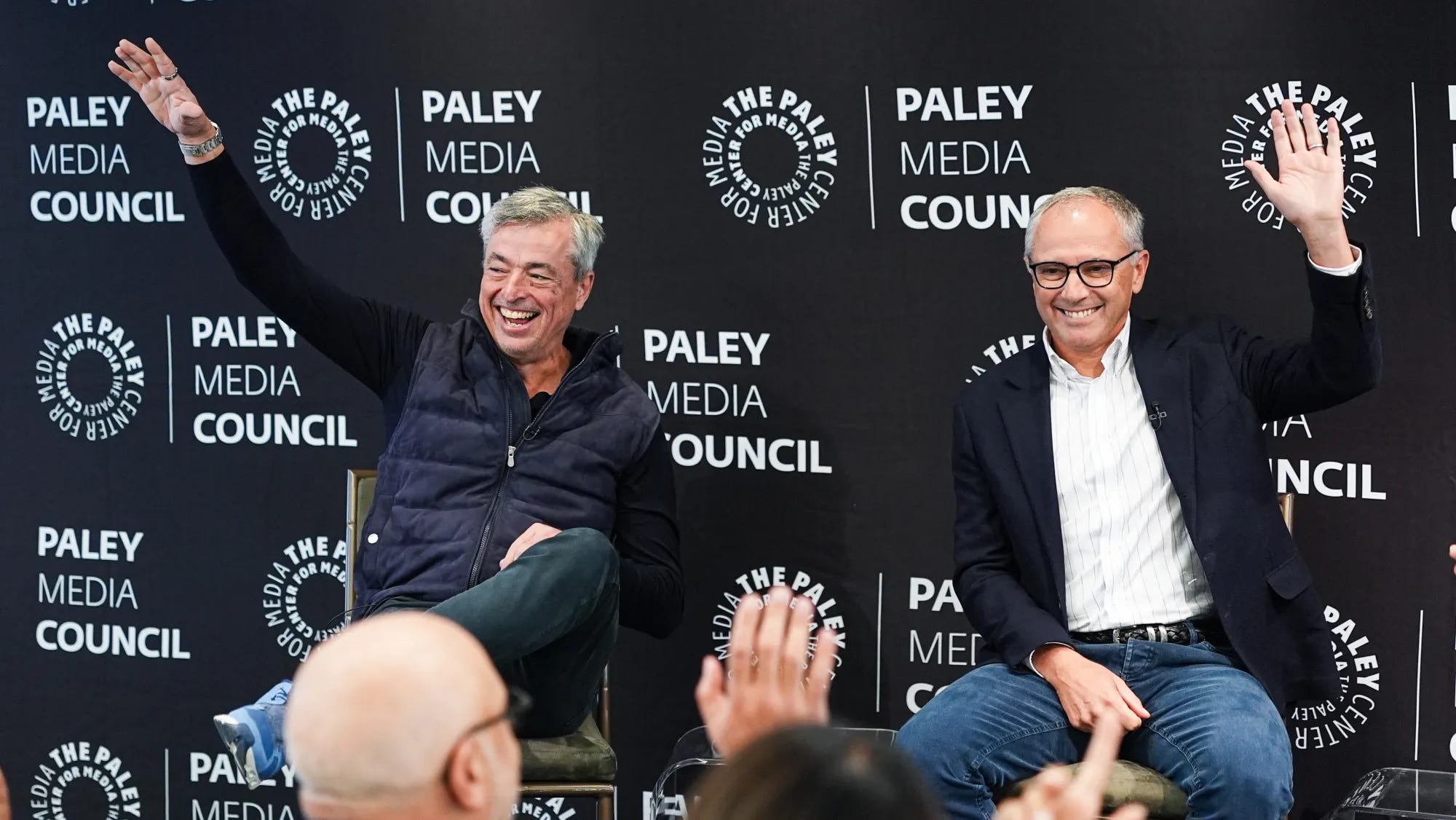
At the Paley Center in New York on September 24, Eddy Cue told me how he pitched Stefano Domenicali and Liberty Media CEO Derek Chang for Formula 1’s U.S. media rights. He had named another company that could do the job: Netflix.
“You should either do the deal with Netflix, or you should do it with us,” Cue recalled. Netflix had built Drive to Survive and knew how to bring the sport to a wide audience. Apple, he argued, would make F1 its top priority. He gave the people selling the rights a reason to consider his rival while asking them to choose him.
I think that was the most honest moment of our conversation. Cue understood what Netflix had done for F1, and Apple had already spent three years showing Domenicali how it worked. His pitch carried the weight of a partnership F1 could inspect for itself.
F1 signed a five-year agreement for Apple TV to carry every race for U.S. viewers beginning in 2026. The financial terms were not disclosed. Reuters reported an annual figure of around $140 million, compared with roughly $90 million in ESPN’s previous deal. A check large enough to change F1’s U.S. media revenue mattered, but so did trust and passion.
Domenicali was moving the sport away from a broadcaster that had just delivered its largest U.S. television audience, averaging 1.3 million viewers per race in 2025. Those fans had to learn a new destination, with most races behind a subscription. Apple would also have to reach people that ESPN never reached. A larger rights fee paid to F1 immediately, with growth happening over years.
The Audition
The relationship had a working product before the rights negotiation. BoS covered Apple’s film project in June 2022. When the television deal was announced in October 2025, Domenicali said the two companies had spent the previous three years working together on F1: The Movie. The film put Apple inside live Grand Prix weekends, where the schedule belongs to the race and every extra piece of equipment needs a reason to be there.
The camera story is a useful measure of what that meant. Cinematographer Claudio Miranda and his team worked with Sony and Panavision on miniature cameras and mounts for the movie cars. Apple built separate wing-mounted cameras to capture footage at real races. According to Panavision’s account of the production, the crews also had to solve vibration, wireless coverage, and frequency conflicts while coordinating with Mercedes and F1. The film cars ran at more than 180 mph. Nobody was going to move a race timetable because a camera lost its signal.
Making the movie required access to teams, drivers, circuits, and broadcast positions during the 2023 and 2024 seasons. That gave F1 a long look at how Apple and its filmmakers handled the sport’s operational limits. We can’t see F1’s private assessment, but we can see the work completed before Apple offered to buy the races. As we argued when the rights deal was announced, the film was the proof of concept.
Why Domenicali Cares about Passion
Cue’s attachment to the sport predates Apple TV. He has spoken about discovering F1 at about 10 years old in a Miami library, where he found a magazine page about a championship he couldn’t watch on American television. He liked cars, and he liked Ferrari because it was red. He told that story himself when the rights deal was announced, as he did again during our discussion.
Domenicali grew up in Imola, watched races from Tosa, and remembers sitting with Ferrari mechanics at the circuit. He later ran Ferrari’s F1 team and now runs the championship. Their childhood routes into racing were different, but both men can recall what first made the sport feel close to them.
Onstage, Stefano said the deal would not have happened without the passion. I took him to mean something specific to commerce. Cue could speak to a fan’s first encounter with F1, and the years of film work let Domenicali judge whether that interest survived the hard parts of a partnership. Shared enthusiasm opened the conversation, but the movie tested whether Apple could finish the work.
Stefano also described the result he wants in America: people waking up curious about what happened in F1. That asks more of Apple than moving existing viewers from one screen to another. It requires a reason for someone to check the sport between races, then come back when the cars are on track.
Executive chemistry makes a convenient story after a contract is signed. F1 could also point to the film’s production record and to the product Apple subsequently shipped: every race on Apple TV, free practice sessions, multiple live feeds, and F1 woven into Sports, News, Maps and Music. BoS has covered that distribution system in detail. It gives the rights holder more opportunities to meet a prospective fan on days other than Sundays.
Why Eddy Cue kept Netflix in the plan
Cue’s advice was about the live U.S. rights. He told F1 that Netflix, which had worked with the series since 2018, was a credible alternative to Apple. He also said the documentary should continue on Netflix.
I wouldn’t mistake that pitch for charity. Cue narrowed a crowded field to two companies, then explained why Apple should be one of them. But admitting what Netflix had built lent credibility to his case. He was asking F1 to trust Apple with the live product without asking it to dismantle the series that had helped create the audience.
After Apple won, the companies acted on the logic Cue described. Season eight of Drive to Survive appeared on Apple TV in the U.S. while remaining on Netflix. Netflix, in turn, carried the 2026 Canadian Grand Prix live for U.S. viewers alongside Apple. Apple held the exclusive domestic season package yet still allowed a rival to put one race in front of its subscribers. It also put creator-led race altcasts on the free service Tubi.
When I pressed Cue as to why Apple would play nice with the competition, he didn’t even skip a beat: “Because I care about growing F1, first and foremost.”
These choices have a commercial purpose. Netflix keeps the series that introduces viewers to drivers. Apple puts the same series beside live races. Viewers on Netflix and Tubi can sample a Grand Prix without first subscribing to Apple TV. What I gather from all of this is that Cue is willing to share a small amount of live inventory to reach more people who might pay for the next race on Apple.
We don’t have public conversion figures for that path. Cue said at Paley that race-day viewing was up by a double-digit percentage year over year. He singled out Saturday viewing and said Apple’s audience was younger and more female than ESPN’s. Apple hasn’t released comparable race averages or enough data to show how many Netflix and Tubi viewers became regulars. But both men seemed happy about the current state of the numbers.
The Check Still Matters
Apple’s reported bid was higher than ESPN’s previous annual fee, and Reuters reported that ESPN would not match Apple’s offer. Cue acknowledged onstage that if another company offered a wildly outsized fee, F1 should take it.
F1 had watched Apple build a movie under race-weekend constraints. Domenicali knew Cue well enough to take his account of the sport seriously. Cue gave an honest assessment of Netflix’s strengths. Apple then offered a rights fee that met Liberty Media’s financial test. Each piece strengthened the next.
The governing question remains whether Apple can turn its expensive first season into repeat viewing that endures into the next season and beyond.
My bet is that more premium sports rights negotiations will be preceded by smaller joint projects. A film, a data product, or a distribution experiment lets a league see how a would-be broadcaster works before committing an entire season. Apple put cameras on F1 cars before it put a price on the U.S. races.
Business of Speed covers the business, technology, and lifestyle of racing: Formula 1, IndyCar, IMSA, WEC, NASCAR, and more. From Vincenzo Landino, entrepreneur and creator, featured in Bloomberg, TBPN, Yahoo! Finance, Forbes, Adweek, and Front Office Sports. You can find us on Instagram, Substack, and LinkedIn.


