


Formula 1’s most reliable revenue stream is about to take its first real test since the pandemic.
Promoter fees, the payments circuits and governments make to Liberty Media for the right to host a Grand Prix, generated $824 million in 2025. That was 27% of F1’s primary revenue. The money arrives on contract, years in advance, with built-in escalators. It is the financial equivalent of a fixed-income instrument inside a growth business. Stable. Predictable. Boring in the best way.
Until a missile hits the Crowne Plaza Hotel in the Manama district, the neighborhood where F1 teams stay during race week, wounding two US Department of Defense employees.
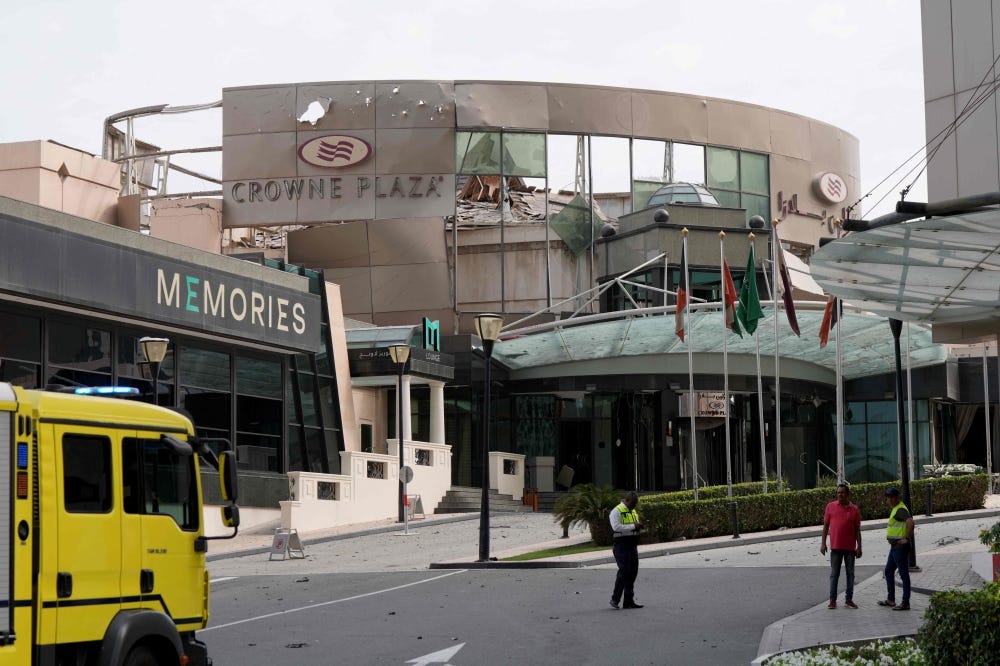
F1 is expected to formally cancel the Bahrain Grand Prix (April 12) and the Saudi Arabian Grand Prix (April 19) this weekend. The races will not be rescheduled. They will not be replaced. The calendar shrinks from 24 to 22 races. And according to a Guggenheim Partners analyst note published Friday, the cancellations will cost Formula 1 approximately $190 to $200 million in revenue and $80 million in EBITDA.
That is not an existential number. F1 generated $3.87 billion in total revenue last year with $632 million in operating income. The sport can absorb the loss. But the loss reveals something about F1’s financial architecture that the growth narrative tends to obscure: the single most lucrative region on the calendar is also the most geopolitically fragile.
The Promoter Fee Machine
When Liberty Media acquired Formula 1 from CVC Capital Partners in 2017, promoter fees amounted to $503 million, roughly 34% of primary revenue. Eight years later, that line item has grown to $824 million. The growth has come from two forces: new races in premium markets (Miami, Las Vegas, Qatar, Saudi Arabia) and annual escalation clauses embedded in most hosting contracts. Standard escalators run at approximately 5% per year, meaning a circuit that signed a $30 million deal in 2020 is paying close to $38 million today without any renegotiation.
The revenue breakdown matters here. F1’s 2025 financials showed four primary streams: media rights at 31%, race promotion at 27%, sponsorship at 22%, and everything else (hospitality, licensing, F1 TV) at 20%. No single stream dominates, and that diversification is a genuine strength. But within the promoter fee category, the concentration is extreme.
Five races in the Middle East and Caucasus sit on the 2026 calendar: Bahrain, Saudi Arabia, Azerbaijan, Qatar, and Abu Dhabi. Guggenheim estimates that Bahrain and Saudi Arabia alone account for roughly $115 million in combined hosting fees. Saudi Arabia and Qatar are believed to pay approximately $55 million each. Bahrain pays an estimated $45 million. Abu Dhabi sits at around $42 million. Azerbaijan may actually top them all at roughly $57 million. Add it up, and this region represents well over $250 million in annual promoter fees. That is roughly a third of the entire category, coming from a part of the world where bombs are dropping all around.
For comparison, Silverstone pays approximately $26 million. Monza is in the $20-$30 million range. European circuits operate against their own balance sheets. Gulf states operate against their treasuries. That distinction is what made Liberty’s calendar expansion so profitable. It is also what makes this moment so uncomfortable.
