

Every Monday, we publish a series called CAPITAL MOVES, a look into the off-track investments of individuals involved in the world of racing. Be sure to check out previous editions.
In East of Eden, John Steinbeck wrote that “in human affairs of danger and delicacy, successful conclusion is sharply limited by hurry.”
Lawrence Stroll has spent his entire career buying things at the moment of maximum distress and minimum consensus: an unknown fashion designer for $200,000, a bankrupt Formula 1 team, a car company that had gone bust seven times. And then doing the one thing many investors can’t do.
He waits.
Will Aston Martin, the most famous British car brand in the world, and the most expensive investment of Stroll’s career, turn out to be his worst bet yet?
Montréal
Lawrence Stroll did not choose the fashion business. He was born into it.
His father, Leo Strulovitch, was a clothing importer who built a business in Montréal on the back of two licences: Pierre Cardin and Ralph Lauren, both of which he brought to Canada at a time when those names carried enormous global aspirational weight.
Lawrence spent much of his childhood learning the business at his father’s side. In the showroom, in the stockroom, listening to the conversations his father had with buyers, distributors, and brand representatives. From a very young age, he was intuitively absorbing an important lesson: a brand is not a product. A brand is perception. And perception, managed correctly, is worth an enormous amount of money.
In 1976, still in his teens, Lawrence was given the license to Pierre Cardin’s children’s wear line. He wasn’t enrolled in university, so this was more a responsibility than a gift. He was not given a salary, a desk, or a title. He was given a business to run while most of his peers were sitting in a classroom. He ran it for the better part of a decade, steadily and methodically growing the brand’s Canadian distribution and learning the mechanics of how a luxury brand actually moves through a market: how it gets into the right stores at the right price.
Then came the moment that changed everything, and it arrived sideways, as some of the best moments in business and life often do.
Stroll found himself in a bidding war against Ralph Lauren (the man himself) for a car. Lauren won the car, but Stroll walked away with something much more valuable: the European license for Polo Ralph Lauren, under the company Poloco S.A. He had lost the auction and won the relationship. It was the first demonstration of a quality he has honed throughout his career: the ability to identify what is actually worth having in any given situation and walk away with it.
Through Poloco, Stroll took Ralph Lauren to Europe in partnership with Silas Chou, a Hong Kong-based textile manufacturer whose father had worked with Leo Strulovitch. The partnership between Stroll and Chou was productive almost immediately. Ralph Lauren grew quickly in Europe under their management. By 1989, they had built enough capital and enough credibility to make their first truly independent bet.
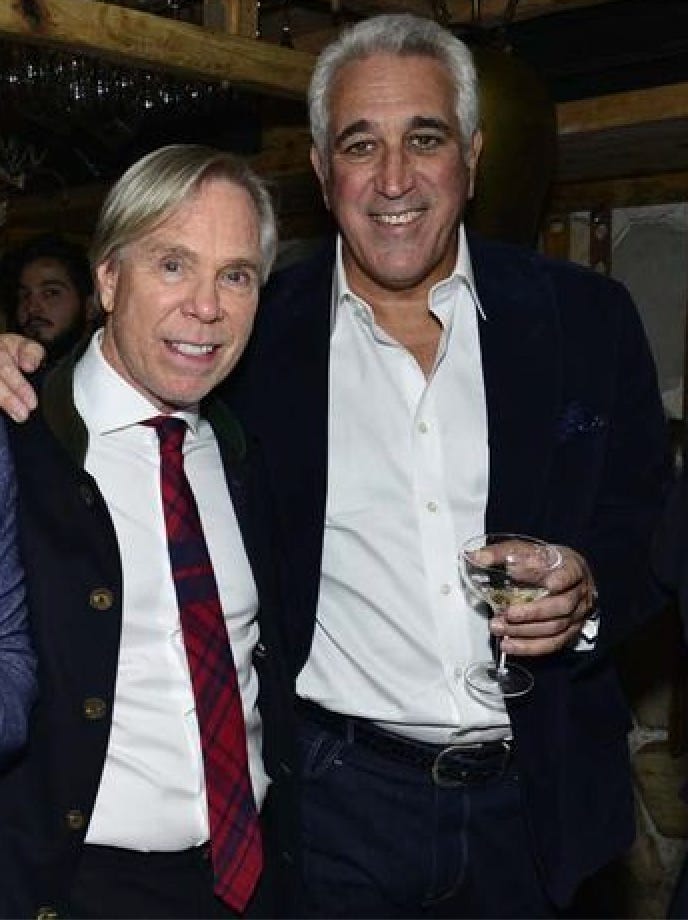
They called the vehicle Sportswear Holdings Ltd. The first thing they put into it was a 70% stake in a virtually unknown American fashion designer named Tommy Hilfiger, reportedly for little more than $200,000.
The $200,000 Bet
In 1989, the Tommy Hilfiger brand was in trouble. Its original backer, Mohan Murjani, an Indian-born fashion entrepreneur who had launched the brand in 1985 and had created Gloria Vanderbilt jeans before it, had run into severe financial difficulty, with debts exceeding $150 million. The brand had a designer with genuine talent and enormous ambition, and no one to take it mainstream.
During a trip to Hong Kong, Stroll and Chou met Hilfiger and agreed to form an alliance on the spot, creating Tommy Hilfiger Inc. and giving the designer the financial backing he needed. Rather than take a license (the more conventional move for a distribution partner), Stroll and Chou insisted that the company owns the name outright.
They took 70% between them, split equally. Hilfiger retained 22.5%. Joel Horowitz, a former Murjani executive who had worked with the Hilfiger brand since its inception, joined as President and CEO of Tommy Hilfiger Corporation, holding the remaining 7.5%. Stroll himself took the role of CEO of Tommy Hilfiger (HK) Ltd., overseeing the Asian operations.
The total investment was approximately $206,000. At the time of acquisition in March 1989, the company was generating $25 million in annual sales across five or six different business lines, while losing $5 million a year. The first decision Stroll and Chou made was to eliminate every business line except menswear. In year one, menswear alone generated $25 million, and the company broke even. Every year after that, they roughly doubled.
What followed was one of the great brand-building stories in American fashion history. Sales grew from $25 million to $50 million, then $100 million, then $500 million, then $1 billion, then $2 billion. The brand caught fire in the mid-nineties when hip-hop culture adopted it. Snoop Dogg wore Hilfiger on Saturday Night Live in 1994, and the brand’s trajectory changed overnight. In the fall of 1992, the company made an initial public offering on the New York Stock Exchange at $15 a share, and the stock soared to $25 within two months. Three secondary offerings followed in successive years.
By 1996, Stroll, Chou, and Horowitz had netted a combined $325 million on their original $206,000 investment. That is a return of 157,767%. Fashion is a tough, high-risk business for returns on investment, often compared to the restaurant industry in terms of failure rates. That return is extraordinary, particularly because the brand was losing $5 million per year just seven years earlier.
In June 2002, Stroll stepped down as co-chairman and director of Tommy Hilfiger Corporation and sold his equity stake, ending a 13-year run. “It’s been a wonderful 13-and-a-half years since acquiring Tommy,” he told WWD. “I feel I’ve done all I can do.” Apax Partners took the brand private in 2006 for $1.6 billion.
Not every bet landed this cleanly. Between Hilfiger and their next major move, Stroll and Chou invested in British luxury goods brands Asprey and Garrard in 2000, a bet outside their core domain. It is the one confirmed capital loss in an otherwise unblemished record. The disappointment didn’t slow them down. If anything, it sharpened them.
The next bet was Michael Kors.
In 2003, Sportswear Holdings acquired an 85% stake in Michael Kors Holdings for approximately $100 million. Kors was a critically respected designer with a devoted following and essentially no global infrastructure. The playbook was identical to Hilfiger: find the underappreciated talent, buy control, build the infrastructure, take it public. When Kors went public in December 2011, the company was valued at $3.8 billion. Stroll and Chou continued reducing their stake as the share price quadrupled in the years that followed.
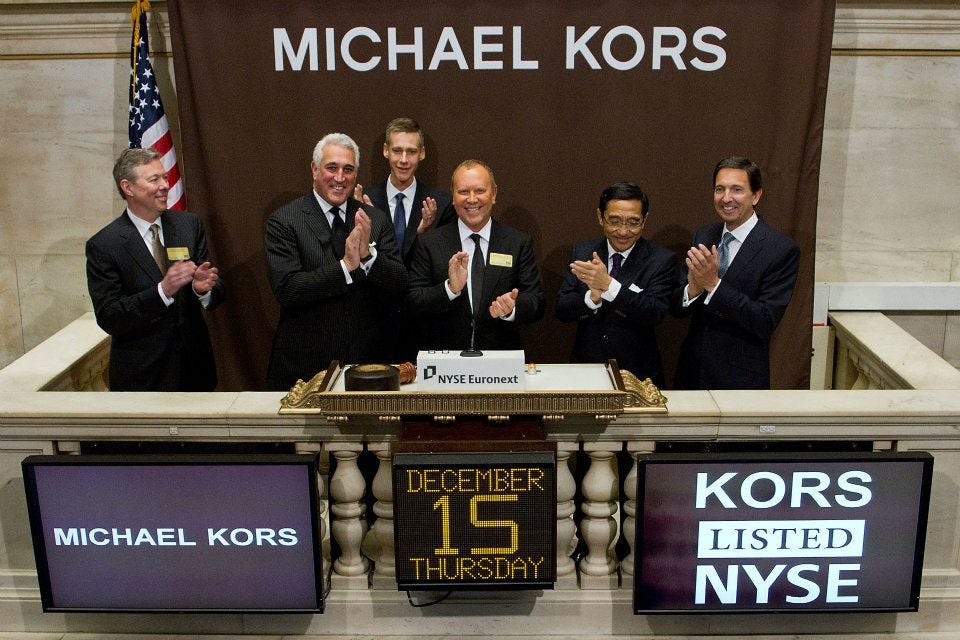
In September 2014, they sold their final 5.7% stake worth approximately $893 million in a secondary public offering.
After two fashion companies were taken from obscurity to global recognition, Stroll’s personal net worth had reached approximately $2.3 billion. He was 55 years old. And he was about to do something that could be seen as completely irrational: buy a Formula 1 team.
The Racetrack and The Son
By the early 2000s, Lawrence Stroll was a billionaire with a collection of vintage Ferraris that occupied an entire climate-controlled facility. He also had a son, Lance, who had started karting and shown genuine promise.
Depending on who you ask, this part of the story is either that of a devoted father doing everything in his power to give his son every possible advantage or a billionaire manufacturing a Formula 1 career for a driver who would not otherwise have one.
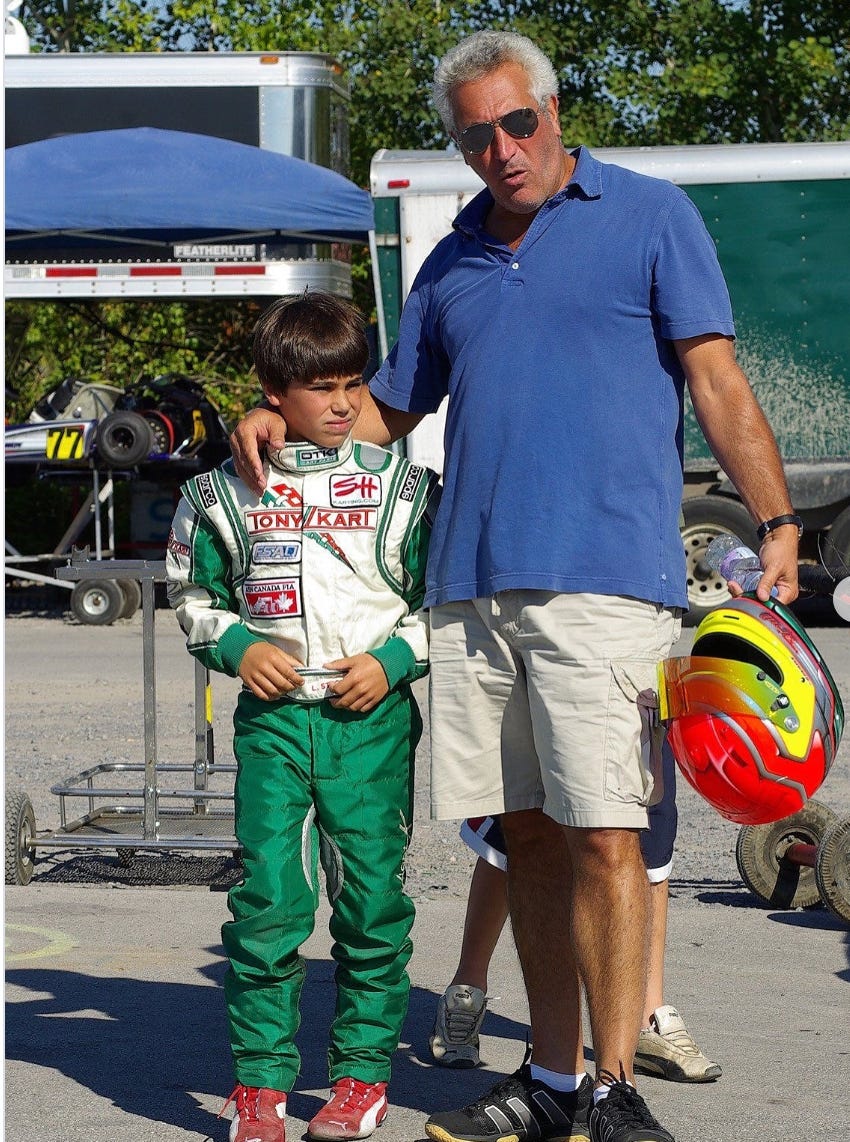
The truth probably lies somewhere in between. That is a story for another time. The facts are not in dispute.
When he was eleven years old, Lance was recruited to the Ferrari Driver Academy. He won the Italian Formula 4 Championship in 2014. He won the Toyota Racing Series in 2015. In 2016, he won the FIA Formula 3 European Championship with Prema, dominating the field by 187 points, winning 14 races.
He was accused throughout the season of manufacturing his title via team orders. The paddock was not quiet about it. Lawrence Stroll had hired former Ferrari chief track engineer Luca Baldisserri to run Lance’s campaign; he had invested in and part-owned the Prema team and had given his son every advantage available.
The next stop was Williams F1. According to Auto Motor und Sport, Lawrence Stroll spent approximately $80 million preparing Lance for his Formula 1 debut, covering an extensive global testing program at multiple circuits, five Mercedes engineers, a state-of-the-art simulator built specifically for Lance at Williams’ Grove headquarters, and two specially prepared Mercedes engines. “The last rookie with that many kilometres of testing for his debut was Jacques Villeneuve,” admitted Williams’ Pat Symonds.
The paddock’s reaction was quite predictable. The criticism was loud and sustained. Lance himself did not help matters when he told Auto Bild: “Motorsport is a sport where money is important, of course, so I’m very happy that my father helps me.”
What his critics consistently understate is that, regardless of his advantages, Lance Stroll has earned results that cannot be bought. He scored a podium finish at the 2017 Azerbaijan Grand Prix, becoming the second-youngest driver to score a podium in Formula 1 history. He took a pole position at the 2020 Turkish Grand Prix in wet conditions so treacherous that qualifying was suspended twice, a session in which Mercedes (who had claimed every pole position that season) finished sixth and ninth, and Lewis Hamilton was nearly eliminated in Q1. No amount of money could manufacture that.
Is the nepotism argument valid? Yes. Is it also, in the context of Lawrence Stroll’s career, somewhat beside the point? Yes. He has spent his entire life identifying undervalued assets and doing whatever was necessary to maximize their potential. Lance Stroll is his son. Whether that makes it nepotism or conviction is for each person to decide.
What Lawrence Stroll did next is a much more interesting story.
In 2018, he bought a Formula 1 team. The world assumed it was for Lance. The numbers tell a much juicier story.
The Force India Moment
On July 27, 2018, the High Court in London appointed an administrator for Force India Formula One Team Limited. The team had debts exceeding $134 million. The action had been triggered by Sergio Pérez, the team’s own driver, who was owed more than $4 million in unpaid sponsorship arrangements. Mercedes, the team’s engine supplier, was owed approximately $17 million. Leading sponsor BWT was also a creditor. The team had not paid its employees for months. Over 400 creditors were waiting. The team that had finished fourth in the Constructors’ Championship twice in the previous four years had approximately $320,000 left in the bank.
Lawrence Stroll had been keeping an eye on this debacle.
The consortium he assembled moved quickly. It included his longtime business partner, Silas Chou; Canadian entrepreneur André Desmarais; fashion executive John D. Idol; telecommunications investor John McCaw Jr.; and financial expert Michael de Picciotto. These were not motorsport people. They were capital allocators. Stroll had recruited them the same way he had recruited Chou for Tommy Hilfiger: people who trusted his judgment on distressed assets, who had seen what he could do, and who were willing to move fast. The vehicle they used to make the acquisition was Racing Point UK Ltd.
On August 16, 2018, Racing Point UK Ltd. acquired Force India’s assets for approximately $120 million, explicitly excluding any debts or liabilities associated with former owner Vijay Mallya. The consortium then did something that almost never happens in administration proceedings: Stroll personally committed additional capital to ensure all creditors were paid in full, immediately, rather than waiting for the standard post-administration process that typically takes one to two years.
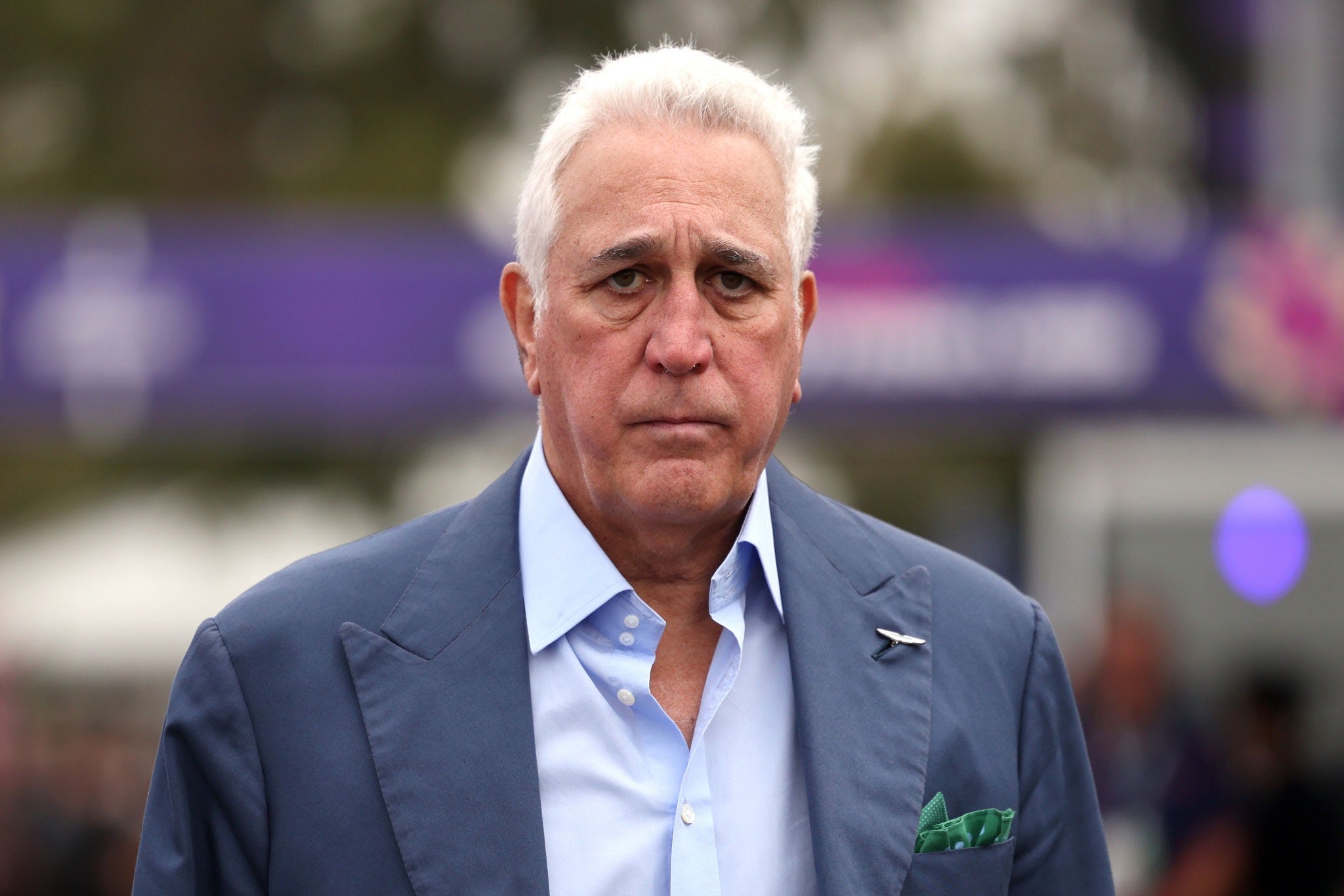
Team principal Otmar Szafnauer, retained from the Force India era, described the instruction from his new owner: “Lawrence wanted to do what’s right by the suppliers that have supported us. He’s definitely a motivator, and he’s a clear and direct talker, so you get good direction. He’s got high expectations, which is fine by me.”
The $120 million price tag was not a bargain. Force India had debts exceeding $134 million. It had an owner whose personal legal and financial troubles in India had precipitated the entire crisis. But it did have two race-winning cars, a world-class engineering operation in Silverstone, a Mercedes power unit supply agreement, and a group of roughly 400 people who had been building competitive Formula 1 machinery on a fraction of the budget of their rivals for a decade.
“What impressed me, and the reason for the purchase,” Stroll told GP Racing magazine, “was that it was a team that operated on a budget of approximately $120 million and only 400 employees, but two years in a row it was fourth in the championship. They did more with fewer employees than other teams. It was an incredible opportunity to build on an already strong foundation.”
Given the team had finished fourth in the Constructors’ Championship in 2016 and 2017 with a budget approximately one-fifth the size of Mercedes’, it was arguably the most efficient racing operation in the sport. Stroll had bought it at the moment of maximum distress. Same playbook he’d been using since 1989.
The team re-entered the championship as Racing Point Force India at the 2018 Belgian Grand Prix, the first race after the summer break. They finished fifth and sixth that weekend, scored 52 points in their remaining races, and finished seventh in the Constructors’ Championship. The following year, with the team renamed Racing Point F1 Team and Lance driving alongside Sergio Pérez, they finished seventh again.
In 2020, Lance Stroll took pole position at the Turkish Grand Prix. Sergio Pérez won the Sakhir Grand Prix in Bahrain. The team finished fourth in the Constructors’ Championship, matching the best result Force India had ever achieved, and did so wearing the livery of a car company that Lawrence Stroll had spent the previous twelve months acquiring in the most deeply consequential bet of his career.
The Seventh Bankruptcy
There is a phrase that Andy Palmer, Aston Martin’s CEO, used repeatedly in the years before Lawrence Stroll arrived. “In the first century, we went bankrupt seven times. The second century is about making sure that is not the case.”
Seven times. The first in 1924. The most recent in 1974. A company that the entire world recognizes, that James Bond drives, that carries more than a century of heritage. A company that has sold approximately 70,000 total cars across its entire history, a number Nissan eclipses in a single week. Aston Martin has 13 million Instagram followers and has never sold more than 7,300 cars in a single year.
This is the kind of asset Lawrence Stroll has been looking for his entire life.
On January 31, 2020, Stroll led the Yew Tree Investments consortium (which included his long-time partner Silas Chou, JCB chairman Anthony Bamford, and former Power Corporation of Canada chief André Desmarais) to invest $233 million into Aston Martin Lagonda in exchange for a 16.7% stake in the company. He beat out Chinese automaker Geely, owner of Lotus and Volvo, to close the deal. He was appointed executive chairman immediately upon completion.
What he had acquired was a company in genuine distress. Aston Martin had floated on the London Stock Exchange in October 2018 at approximately $25 per share, a listing that went poorly from the first day, with shares immediately trading below the IPO price. By the time Stroll arrived, they had lost nearly 80% of their float value. The company had reported annual losses in 2018 and 2019 and was on course to report them again in 2020. Its debt was mounting. Its previous owners, Kuwaiti investment groups, were not in a position to provide further capital. The $642 million total package Stroll assembled, including a $408 million rights issue alongside his consortium’s $234 million, gave the company the liquidity it needed to survive.
The Racing Point F1 team, which Stroll already owned, was rebranded as the Aston Martin F1 Team in 2021, marking the British manufacturer’s return to Formula 1 after a 61-year absence. The F1 program was a brand-building investment, a decision to spend money on the most visible motorsport stage in the world at the exact moment Formula 1’s American audience was beginning to explode.
He did not stop at 16.7%. By March 2025, Stroll confirmed that since 2020, the Yew Tree Consortium had invested approximately $756 million into Aston Martin. His stake has grown incrementally with each injection of capital: from 16.7% to 27.7%, and most recently to 33% following a $68 million investment confirmed in March 2025, with the consortium targeting 35% when possible.
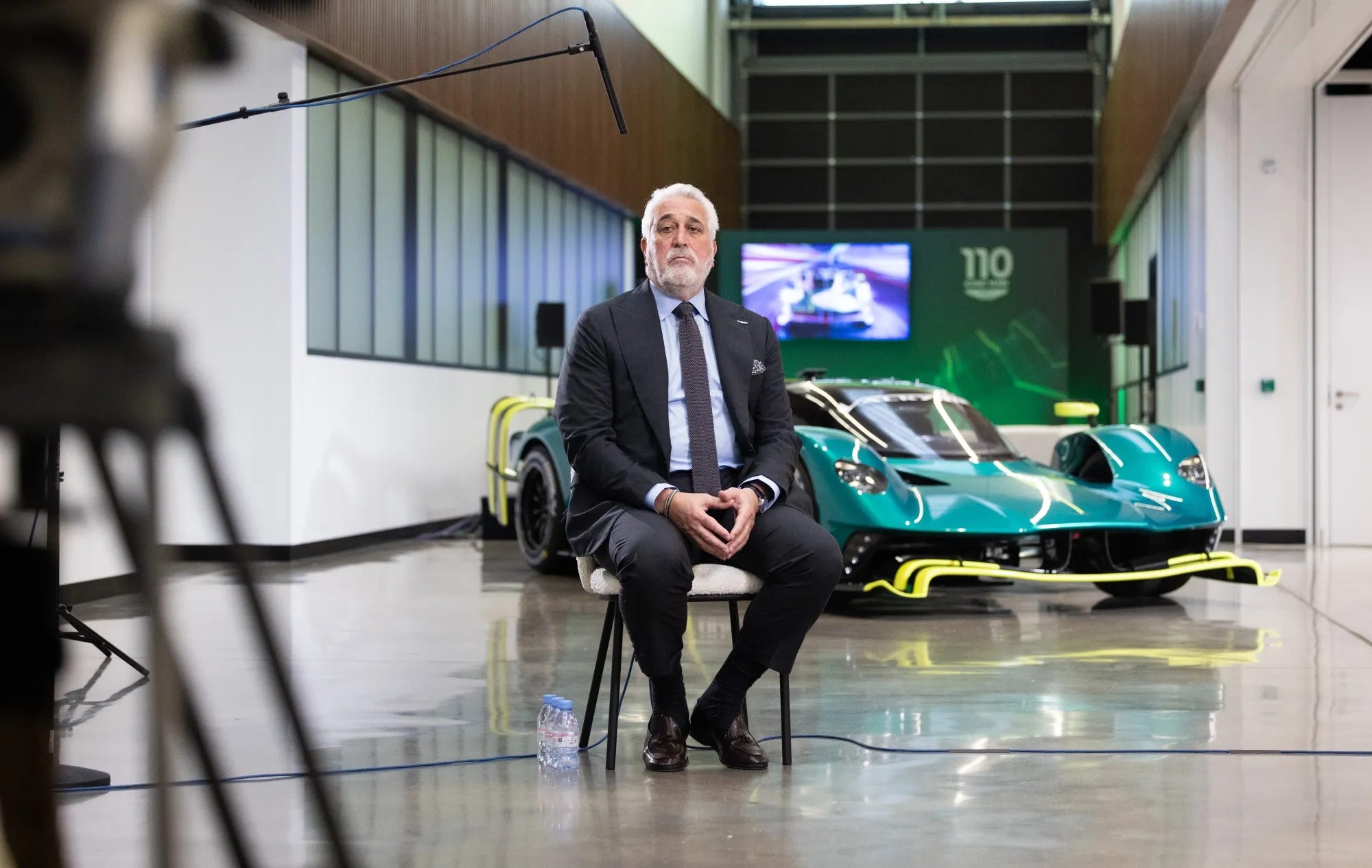
He recruited Fernando Alonso from Alpine in 2023, a two-time world champion who brought immediate credibility, championship-level development feedback, and a global fanbase. He announced in September 2024 that Adrian Newey, the most celebrated aerodynamicist in Formula 1 history with 13 Drivers’ and Constructors’ Championships, would join Aston Martin as managing technical partner, on a reported package worth approximately $30 million per year. He secured a Honda power unit partnership beginning in 2026, replacing the Mercedes supply agreement. (We can debate that decision another time.) He also committed to a new $275 million facility at Silverstone, the most advanced F1 factory in Britain.
The numbers at the car company itself tell a more complicated story. In 2024, Aston Martin reported pre-tax losses of approximately $323 million, up 48.7% from the prior year. Net debt increased 43% to approximately $1.46 billion. Deliveries totaled 6,030 units, down approximately 9% from 2023. The share price, which peaked in 2021, trades today at a fraction of that.
Stroll’s response to every piece of negative news has been identical: he puts more money in with the deliberate conviction of a man who has the capital and the patience to wait out his bet.
“Since 2020, my partners in the Yew Tree Consortium and I have invested approximately $756 million in the company,” he said in his most recent statement. “This proposed investment further underscores my conviction in this extraordinary brand.”
It is the same sentiment he expressed for Tommy Hilfiger in 1989. And about Michael Kors in 2003. And about Force India in 2018.
The question that matters for Lawrence Stroll as an investor is whether Aston Martin is the same kind of asset as those. Or whether it is something structurally different: a brand so compromised, so chronically undercapitalized across its entire history, that no amount of money, talent, or conviction can fix it permanently.
The Numbers
What he has spent: The Force India consortium acquisition in August 2018: approximately $120 million. The Aston Martin car company investment through Yew Tree Investments in January 2020 was approximately $233 million. Additional capital injections into both the car company and the F1 team through 2025: approximately $756 million at blended rates across those years. The new Silverstone factory alone: approximately $275 million. Adrian Newey’s reported annual package: approximately $30 million.
The total capital deployed is exorbitant. But by the standards of what Stroll has built, it is also somewhat rational.
What he owns: The Aston Martin F1 team, acquired for $120 million in 2018 out of administration, was valued at $3.2 billion in a July 2025 stake sale confirmed by Bloomberg. That is a transaction-verified increase of approximately 2,550% on the original acquisition price, in seven years. Sponsorship revenue at the team has increased by more than 1,000% since Stroll bought it in 2018.
The valuation trajectory of the F1 team alone tells the story:
November 2023: $1.3 billion (Arctos Partners stake sale)
March 2024: $2.4 billion (HPS Investment Partners and Accel Partners)
July 2025: $3.2 billion (latest confirmed stake sale, Bloomberg)
In less than two years, the team’s transaction-verified valuation more than doubled. This was not driven by on-track performance; 2024 and 2025 were difficult years to say the least. It was driven by the structural growth of Formula 1 itself, by the infrastructure Stroll has built around the team, and by the credibility that Newey’s arrival and the Honda partnership have injected into the long-term thesis. (Whether the Honda engine’s early struggles will affect further valuations is not for us to hypothesize here.)
His stake in the Aston Martin car company sits at approximately 33% of Yew Tree’s holding, which controls the majority of Aston Martin Lagonda. The car company itself remains deeply loss-making (pre-tax losses of approximately $323 million in 2024, net debt of approximately $1.46 billion), but Stroll’s position is structural and long-term. He is, as ever, patient.
Forbes’ most recent confirmed figure places his net worth at approximately $3.9 billion as of 2024, up from $2.4 billion in 2016, the year before he entered Formula 1. The $1.5 billion increase in eight years is almost entirely attributable to the appreciation of his motorsport and automotive holdings.
He has also been inducted into the Canadian Motorsport Hall of Fame (2019) and received the Queen Elizabeth II Platinum Jubilee Medal in 2022.
The Question
Lawrence Stroll’s record is practically unblemished: Pierre Cardin children’s wear at seventeen. Ralph Lauren across Europe. Tommy Hilfiger for $200,000, returned at $325 million combined by 1996. Michael Kors for $100 million, returned at $2.3 billion by 2014. Force India for $120 million, now valued at $3.2 billion.
Aston Martin is different because of the nature of the asset itself.
Tommy Hilfiger was a brand problem. It had a gifted designer, an unloved product, and no infrastructure. Stroll and Chou provided the infrastructure. Michael Kors was the same. Force India was a liquidity problem masquerading as a structural one, a team that was genuinely world-class but simply had an owner who had run out of money. Stroll provided the liquidity. In each case, the underlying asset was sound. The problem was solvable. The fix was capital and management.
Aston Martin, the car company, is something more complicated. It has gone bankrupt seven times because the underlying business model, hand-building ultra-luxury cars in small volumes at extremely high cost, is structurally difficult to sustain at a profit, regardless of how much capital you inject. The brand is undoubtedly extraordinary. The product is spectacular. But the economics are brutal.
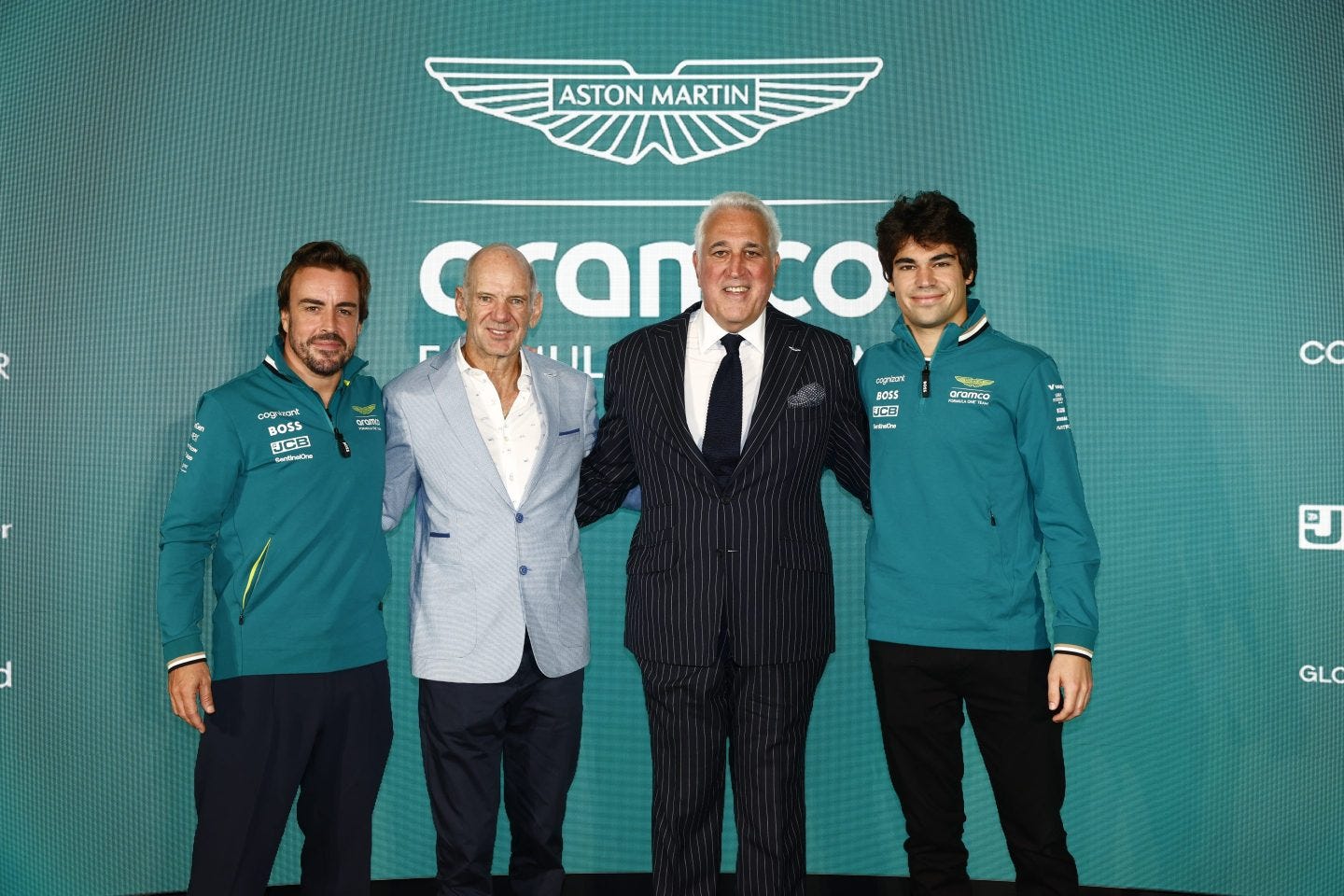
The F1 team’s 2024 and 2025 on-track results have been poor, leaving Aston Martin ranked near the bottom of the Constructors’ standings. The question we should ask is whether the asset he is building it around, a car company with a profitability problem that no previous owner has solved, is the same kind of asset as Tommy Hilfiger and Michael Kors. Or whether it is something structurally different: a brand so chronically compromised by its own finances that patience and capital alone cannot fix it.
The Bet Is Still On
Steinbeck was right in that often, a successful conclusion is sharply limited by hurry. Lawrence Stroll has never hurried. Not in fashion, not in Formula 1, not in the boardroom of a company that has gone bankrupt seven times and is betting its second century on a man from Montréal who learned about brand value at his father’s side.
He is 65 years old. He is a billionaire whose daily life will be unaffected if the Aston Martin investment doesn’t pan out. He likely needs it to work because walking away from a bet is something Lawrence Stroll has never done.
The cars are in the garage at Silverstone. Newey is at his drawing board. Honda is trying furiously to perfect the lackluster engine. And at any given paddock, there’s a Canadian man who paid $200,000 for Tommy Hilfiger and walked away with $2.3 billion from Michael Kors, doing the one thing he has always done better than anyone else in the room.
He is waiting.

Another great profile! What a story!