

We strive to remain an independent source of motorsport business. If Business of Speed has provided you with useful insights this year, please consider subscribing.
Alain Prost needed 72 laps to win his first Williams race. Africa has now spent more than 33 years waiting for another Grand Prix.
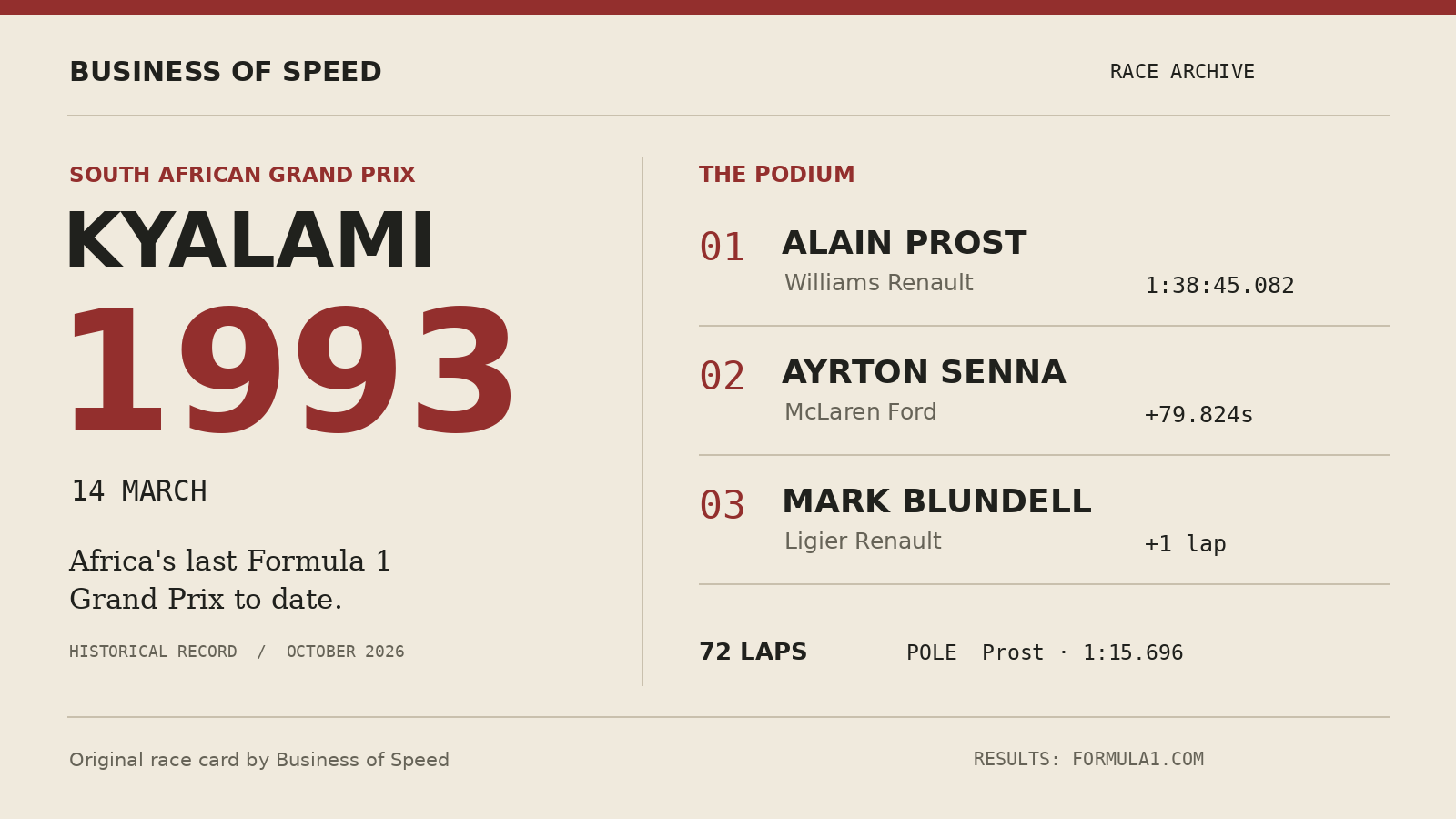
On March 14, 1993, Prost beat Ayrton Senna at Kyalami by 79.824 seconds. Mark Blundell took third for Ligier, a lap behind.
Today’s 10-year agreement with Rwanda, targeting the early 2030s, gives us a reason to revisit that afternoon. Kyalami’s disappearance shows how quickly a race can leave the calendar when its funding fails, even with a circuit and a recent championship result already secured.
Prost was returning after a year out. Senna was still at McLaren, now driving a Ford-powered car. Michael Schumacher qualified third for Benetton. You could hardly ask for a more recognizable opening act.
Saturday’s times were closer than Sunday’s result suggests. Prost’s 1:15.696 beat Senna’s 1:15.784 by just 0.088 seconds, according to the starting grid. Schumacher was another 1.477 seconds behind Senna. The front row had its own competition.
Senna led away. Prost recovered from a poor start, passed Schumacher and then spent several laps trying to get past his old rival. On lap 24, he took the lead. Senna’s afternoon became a defense of second place against Schumacher, whose attempt to pass ended in contact and retirement on lap 40. Late rain complicated the finish, but Prost’s win was secure. Motor Sport’s contemporary report captures a season beginning with familiar arguments over who had the better car and who could overcome it.
There were new arrivals, too. Rubens Barrichello made his debut for Jordan, qualifying 14th before a gearbox failure ended his race. Sauber’s first Grand Prix produced a fifth-place finish for JJ Lehto. By the end, only five drivers were still running. Ferrari’s Gerhard Berger was classified sixth and collected a point despite retiring.
The final results don’t explain why F1 didn’t come back.
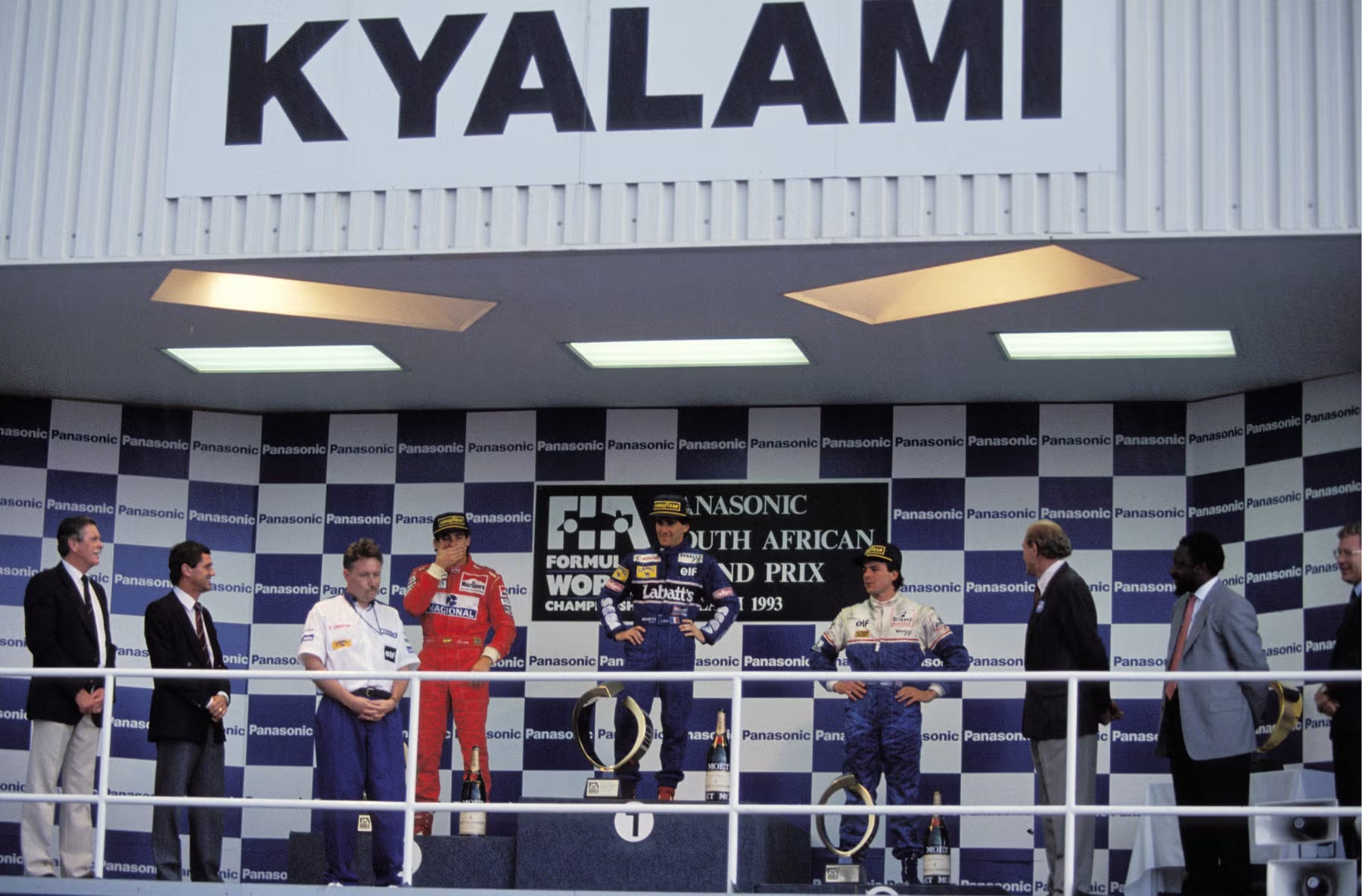
Kyalami had already been rebuilt for the championship’s return in 1992. South Africa was then negotiating its transition from apartheid; the country’s first democratic elections followed in April 1994. The politics belong in this history. So do the specific financial problems that undermined the race’s brief revival.
Stellenbosch University’s Dr. Gustav Venter has traced those problems to shrinking government support, a weakening rand and the collapse of Tollgate Holdings, which had interests in motor racing. The government had helped finance the return to attract international tourists. That support couldn’t sustain the event. Motor Sport was already reporting Tollgate’s collapse before the 1993 race.
In July 1993, a March 13, 1994 South African Grand Prix was still expected.
By December 1995, Grandprix.com reported that Kyalami’s new Automobile Association owners were making money from the venue, including conferences and exhibitions in the pit buildings. Bringing F1 back still required substantially more funding. A profitable circuit couldn’t automatically afford its most famous race.
We’ve been covering that gap for years. BoS’s June 2022 Kyalami report described another attempt to turn the venue’s history into a calendar fixture. Rwanda now has an agreement, with a circuit still to build and an inaugural date still to announce.
Business of Speed covers the business, technology, and lifestyle of racing: Formula 1, IndyCar, IMSA, WEC, NASCAR, and more. From Vincenzo Landino, entrepreneur and creator, featured in Bloomberg, TBPN, Yahoo! Finance, Forbes, Adweek, and Front Office Sports. You can find us on Instagram, Substack, and LinkedIn.