


We strive to remain an independent source of motorsport business. If Business of Speed has provided you with useful insights this year, please consider subscribing.
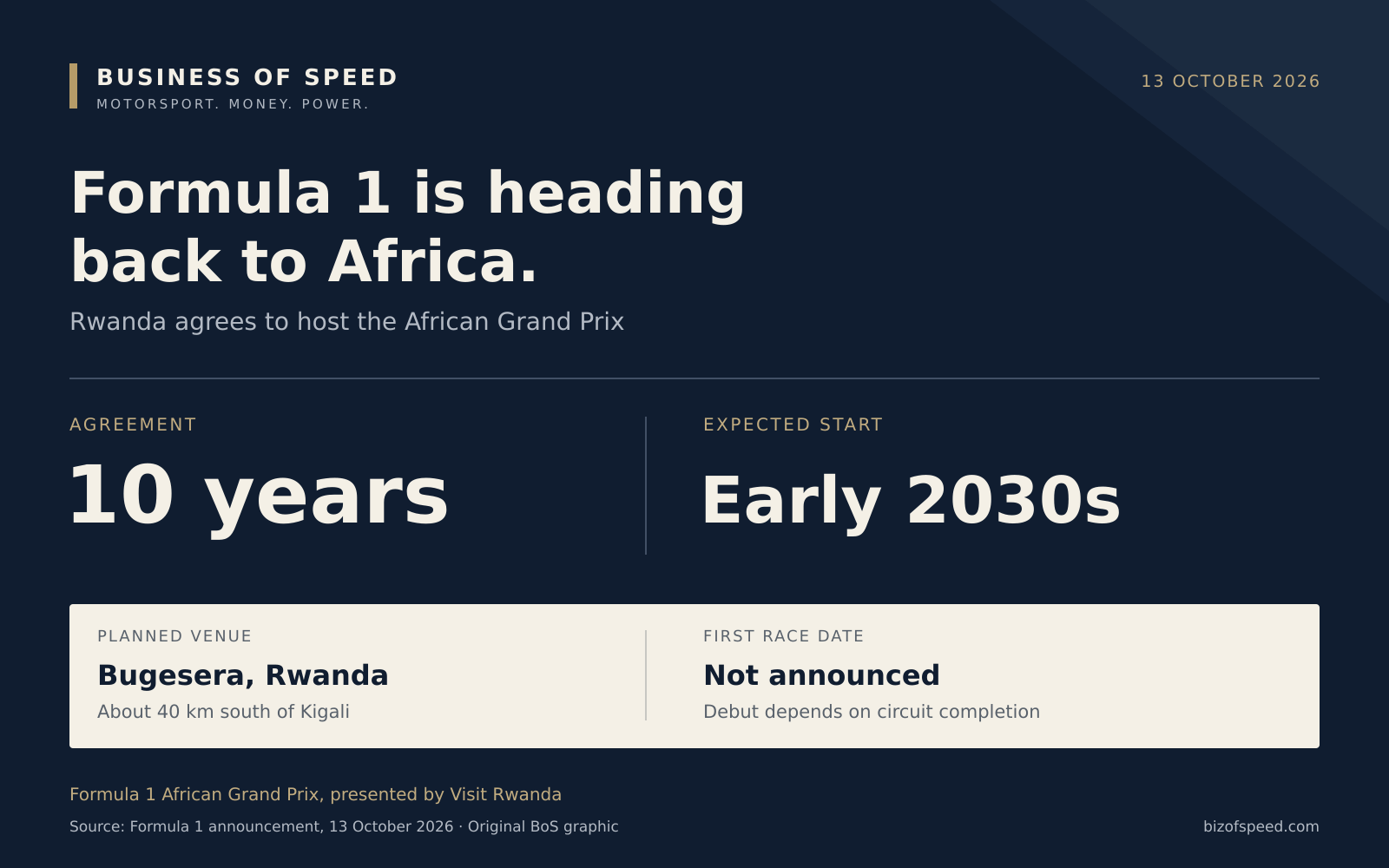
Formula 1 has agreed to race in Rwanda for 10 years, confirming on October 13 that the African Grand Prix, presented by Visit Rwanda, will join its calendar in the early 2030s.
The race will take place at a purpose-built circuit in Bugesera, about 40 kilometers south of Kigali, near the capital’s new international airport. Its debut depends on completing that circuit. F1 hasn’t committed to 2030, the year cited in earlier reporting.
Africa hasn’t hosted an F1 race since the 1993 South African Grand Prix at Kyalami. Reuters reports that Stefano Domenicali, F1’s CEO, put the sport’s African fan base, over 100 million, above the sport in Tuesday’s statement.
That audience gives F1 a reason to go. Rwanda’s ability to build and pay for a race will determine what it can deliver.
Bugesera comes first
Former F1 driver Alex Wurz’s WurzDesign and Tilke Engineers and Architects are developing the final layout, which will use the site’s elevation changes. The track is planned to meet FIA Grade 1 standards, the requirement for hosting a Grand Prix.
The Rwanda Development Board is leading the broader development, with plans to host other motorsport events and conferences throughout the year. It’s still a planned venue. F1 says it will announce construction milestones later.
Rwanda’s pursuit has lasted years. BoS covered the talks in August 2024, when Domenicali was preparing to meet the country’s representatives about a permanent track. Tuesday’s announcement turns those negotiations into a long-term agreement.
A place on a crowded calendar
The commercial question reaches beyond Bugesera’s construction schedule.
Louise Young, F1’s chief race promotion officer, said at Leaders Week London that the series intends to maintain a 24-race calendar. As BoS reported on October 11, she described the standard for new hosts as “really high” and acknowledged that making room can mean ending relationships stretching back decades.
Young’s requirements include government support, easy travel between the airport, hotels and city, and enough entertainment to keep visitors occupied throughout the race weekend, all of which will matter in Rwanda as the country builds its first F1 venue beside a new airport.
We’re still missing the calendar decision. F1 hasn’t named an existing Grand Prix that Rwanda would replace, and a broad launch window doesn’t tell us which season’s contracts will matter.
Host agreements are a large part of F1’s business. Liberty Media’s 2025 annual filing says race promotion generated 26.7% of F1’s revenue that year. That category includes Las Vegas ticket sales; it shouldn’t be read as hosting fees alone. Most promoter contracts also include annual fee increases.
Rwanda’s government is selling the agreement as an investment in tourism and jobs. President Paul Kagame said the circuit and airport would bring long-term business to the country. Its commercial return will depend on how many visitors come, what they spend, and how much Rwanda pays to host them. A continental fan count can’t answer those questions.
The choice of host has already faced objections. In February 2025, Congo’s government asked F1 and other sports organizations to end their dealings with Rwanda over the conflict in eastern Congo. That month, the UN Security Council called on Rwanda’s forces to stop supporting M23 and withdraw from Congo. Rwanda denied backing M23.
Rwanda’s annual hosting fee and the circuit’s construction budget weren’t disclosed in Tuesday’s announcement.
Business of Speed covers the business, technology, and lifestyle of racing: Formula 1, IndyCar, IMSA, WEC, NASCAR, and more. From Vincenzo Landino, entrepreneur and creator, featured in Bloomberg, TBPN, Yahoo! Finance, Forbes, Adweek, and Front Office Sports. You can find us on Instagram, Substack, and LinkedIn.