

We strive to remain an independent source of motorsport business. If Business of Speed has provided you with useful insights this year, please consider subscribing.
Alain Prost needed 72 laps to win his first Williams race. Africa has now spent more than 33 years waiting for another Grand Prix.
On March 14, 1993, Prost beat Ayrton Senna at Kyalami by 79.824 seconds. Mark Blundell took third for Ligier, a lap behind. The official result makes the afternoon look considerably easier than it was.
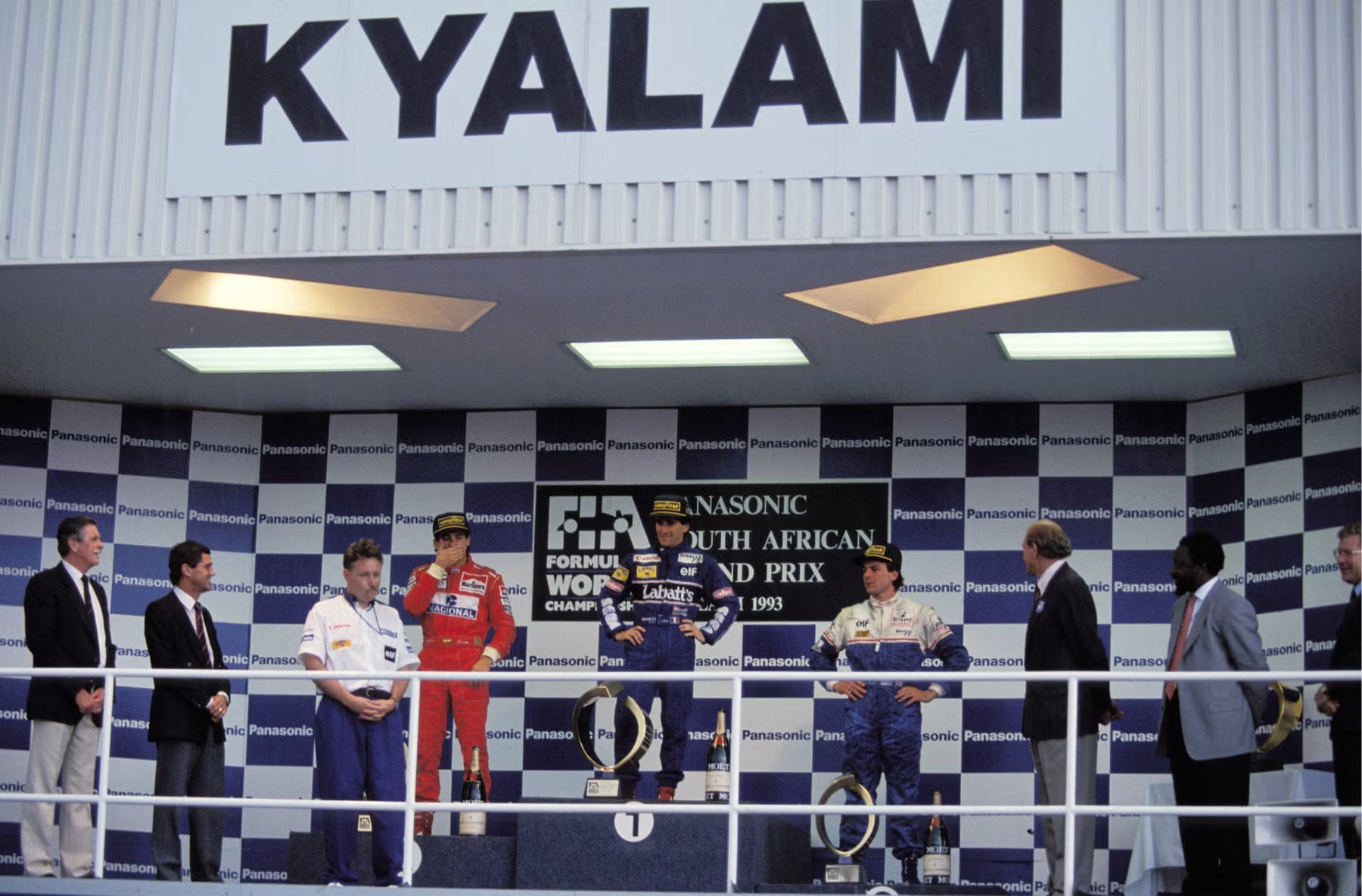
Today’s 10-year agreement with Rwanda, targeting the early 2030s, gives us a reason to revisit that race. Kyalami’s disappearance shows how quickly a Grand Prix can leave the calendar when its funding fails, even with a circuit and a recent championship result already secured.
Prost was returning after a year out, and his confidence had taken a beating. After a testing crash, illness and a threatened disciplinary sanction, he admitted: “I really wondered why I was coming back to Formula One.” David Tremayne’s contemporary report catches the uncertainty beneath what would become his fourth championship season.
Senna had his own reasons to hesitate. Honda had withdrawn, leaving Ron Dennis to negotiate a customer Ford engine deal while Benetton retained the closer factory relationship. McLaren’s account of the 1993 season describes Senna refusing to commit to a full-year contract. He would negotiate race by race.
Saturday gave him encouragement. Prost’s 1:15.696 beat Senna’s 1:15.784 by just 0.088 seconds. Schumacher, third in the Benetton, was another 1.477 seconds behind Senna. The starting grid put the old rivals almost together and everyone else well behind.
Prost lost that advantage at the start. Senna led, Damon Hill briefly took second in his first Williams race, then spun in front of the pack. He escaped without being hit but finished 12th on the opening lap. Schumacher took second, leaving Prost to recover through the two drivers immediately ahead.
By lap 13, Prost had passed Schumacher, and the three leaders were covered by 0.835 seconds. Jean Alesi’s fourth-place Ferrari was roughly 26 seconds back, according to this lap-by-lap retrospective. Senna’s McLaren, Prost’s Williams and Schumacher’s Benetton were running their own race.
Senna put a wheel in the dirt exiting the final corner, giving Prost a run toward the first turn. Prost took the inside for the right-hander; Senna stayed alongside and held the inside for the left-hander that followed.
Prost made the pass stick on lap 24. McLaren’s own history records Senna leading the first 23 laps. Schumacher also got ahead of Senna, but their tire stops reversed the order again. McLaren’s mechanics returned their driver to second, with the Benetton pursuing him.
Senna was now fighting an active-suspension problem, as was Schumacher. On lap 40, the German tried the inside, the cars touched, and the Benetton spun out. Prost continued toward victory while Senna’s remaining job was to bring the McLaren home.
The newcomers had a harsher afternoon. Michael Andretti qualified ninth for McLaren, three seconds behind Senna, stalled at the start and retired after completing four laps. Hill’s recovery ended in a collision with Alex Zanardi’s Lotus. Rubens Barrichello started his first Grand Prix 14th for Jordan and lost his gearbox after 31 completed laps. The Race’s retrospective shows how much unfinished business sat behind the famous names at the front.


Peter Sauber had more to take home. His new team’s black C12s qualified sixth and tenth with JJ Lehto and Karl Wendlinger. An early stop sent Lehto toward the back, but his recovery had pace behind it: his second-fastest lap of the race, 1:20.113. Only Prost went faster.
The weather supplied the final complication. With two laps remaining, a thunderstorm drenched part of the circuit. There was barely any race left in which to make a tire change worthwhile. Prost slowed enough for backmarkers to unlap themselves as the remaining drivers tried to reach the flag.
Blundell finished third, his first F1 podium. Christian Fittipaldi brought Minardi home fourth, and Lehto took fifth for Sauber on its debut. Behind them, Derek Warwick crashed his Footwork in the closing stages. Berger’s Ferrari also stopped; Tremayne reported that newspapers had clogged its radiators, causing the engine to overheat.
Only five cars were still running at the finish. Berger and Warwick were nevertheless classified sixth and seventh, both with 69 completed laps. Berger collected the final point.
The circuit had already been rebuilt for F1’s return in 1992. South Africa was negotiating its transition from apartheid; the first democratic elections followed in April 1994. The financial support that had brought the race back was coming apart.
Stellenbosch University’s Dr. Gustav Venter has traced those problems to shrinking government support, a weakening rand and the collapse of Tollgate Holdings, which had interests in motor racing. The government had helped finance the return to attract international tourists. Its support began to fall while the race’s other financial foundations weakened.


The warning preceded Prost’s win. Motor Sport’s March 1993 diary reported Tollgate’s collapse and rumors that the Grand Prix might move near Durban when Kyalami’s contract expired in 1996. People were still discussing where the race would run several seasons ahead.
In July 1993, a March 13, 1994 South African Grand Prix was still expected.
Later attempts, including the 2022 talks about a return, kept Kyalami’s name in the conversation. Rwanda now has the agreement, but the circuit still needs to be built, and the inaugural date remains to be announced. Its plans for Bugesera include conferences and other events throughout the year.
Kyalami had already developed that kind of business. By December 1995, Grandprix.com reported that its new Automobile Association owners were running the venue at a profit, using the pit buildings for conferences and exhibitions. A driving school added another income source. Bringing back the Grand Prix still required a substantial sponsor or government backing.
Business of Speed covers the business, technology, and lifestyle of racing: Formula 1, IndyCar, IMSA, WEC, NASCAR, and more. From Vincenzo Landino, entrepreneur and creator, featured in Bloomberg, TBPN, Yahoo! Finance, Forbes, Adweek, and Front Office Sports. You can find us on Instagram, Substack, and LinkedIn.