

If you’ve read this newsletter for any period of time, you understand there’s a resurgence of excitement around all motorsports, not just F1. While we cover a lot of Formula 1-related topics and stories, the American open-wheel series, IndyCar, deserves its flowers.
The plan is to bring you more around what’s happening in IndyCar this season, so stick around.
IndyCar just raced between a football stadium and a baseball stadium in Arlington, Texas. Sold-out grandstands. Up to $100 million in projected economic impact. Drivers who’ve raced all over the world say it felt like a completely different series.
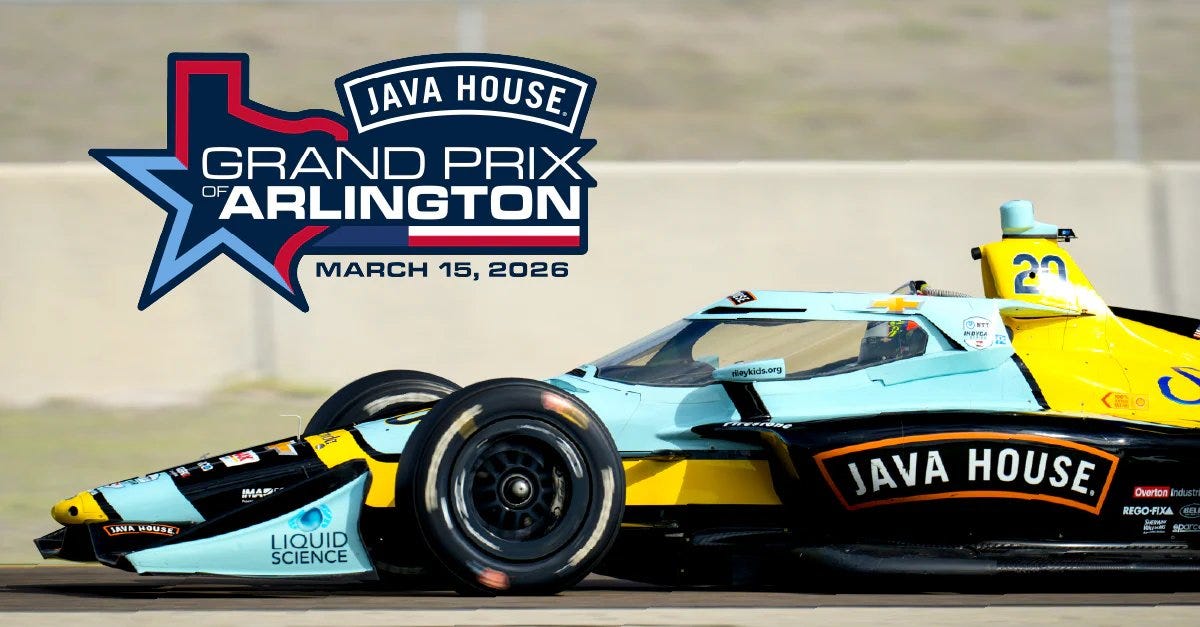
The Java House Grand Prix of Arlington, held March 15, ran a 2.73-mile, 14-turn street circuit threading between AT&T Stadium and Globe Life Field. Longest street course in IndyCar history. Kyle Kirkwood took the win.
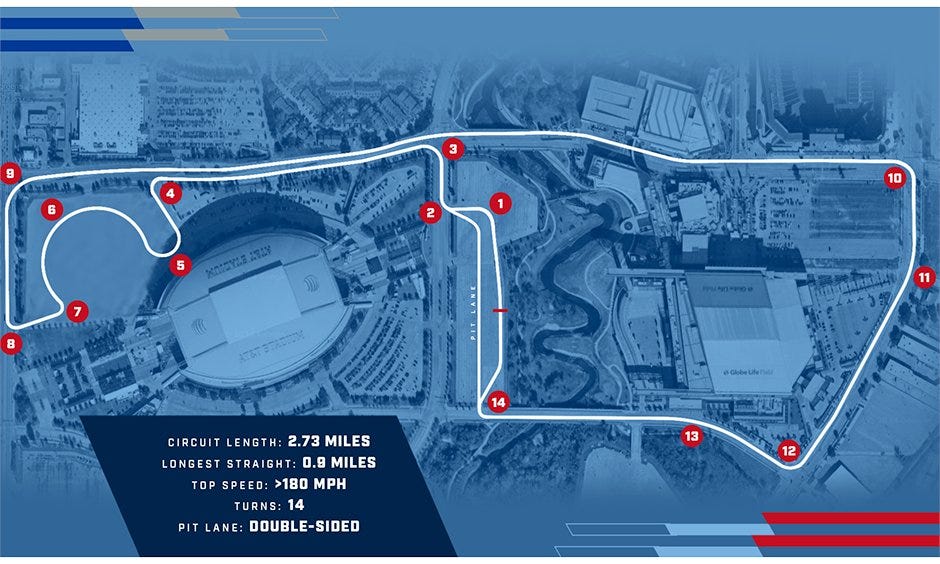
The real story, however, is what the track was built on. Parking lots. Service roads. The kind of infrastructure that exists for one reason: moving 100,000 people in and out of a building on a Sunday afternoon. Penske looked at that and saw a racetrack.
Let’s talk about the money. Penske Entertainment, the Dallas Cowboys, the Texas Rangers, and the City of Arlington split the $50 million build cost four ways. For context, building a permanent racing circuit from scratch runs anywhere from $250 million to over $1 billion. Arlington’s math looks very different.
Mark Miles, Penske Entertainment CEO, put it plainly: the existing pavement, roads, and parking lots “require relatively little expenditures to get into racing fitness.”
The infrastructure was already there. It just needed a different purpose for one weekend.
Why a Stadium District Changes Everything
Street racing has always carried logistical baggage. You shut down a city center. Reroute traffic. Negotiate with local businesses losing foot traffic. Relocate utility access. It’s expensive, politically messy, and the goodwill runs out fast.
Nashville learned this the hard way. The Music City Grand Prix ran downtown across the Korean War Veterans Memorial Bridge starting in 2021. Then construction began on the new Titans stadium, displacing the circuit. The race hasn’t returned.
Arlington sidesteps all of it. The entertainment district exists specifically to absorb massive crowds. Wide roads. Modern pavement. Hotels, restaurants, and convention infrastructure are already operating at scale. Sixteen million visitors come through that district annually. Doug Boles, IndyCar’s president, put it simply: “You are in and amongst the community, but you have the benefit of these massive parking lots.”
Scott Dixon, six-time champion, said after the race: “I didn’t think I was turning up to an IndyCar event. I thought it was maybe an F1 event.” Then he added something that should probably hang on a wall somewhere at Penske Entertainment headquarters: “I think this is the new standard. This is what IndyCar needs to stick to.”
Santino Ferrucci called it IndyCar’s “first Formula 1-style street course.”
The closest comparison in American motorsport is the Miami Grand Prix, which races around Hard Rock Stadium, home of the Dolphins. Stephen Ross built that model from scratch, turning a stadium parking lot into a temporary circuit surrounded by a multi-day festival. The result: $449 million in economic impact and a race weekend that sells out months in advance. Arlington took that same stadium-as-backdrop concept, applied it to an entertainment district that already had two venues instead of one, and executed it for a fraction of the cost. Where Miami spent years and hundreds of millions building its footprint, IndyCar walked into an infrastructure package that was already assembled.
Motorsport’s push into American culture has largely been driven by spending into new markets. IndyCar is finding a different entry point. Same instinct, leaner execution.
Fox’s Role
In July 2025, Fox Corporation acquired a one-third interest in Penske Entertainment for roughly $125 to $135 million. Bundled with a multi-year extension of IndyCar’s media rights.
Think about what that means for venue selection. A broadcast partner wants compelling television. Fine. An ownership partner wants compelling television in top-10 media markets, with iconic visual backdrops that enhance the value of their investment. Different conversation entirely.
And this goes beyond corporate strategy. Fox CEO Eric Shanks is an Indiana native who used to go to the Speedway as a teenager and tell people Rick Mears was his uncle to try to impress girls. As Will Buxton put it on the Business of Speed podcast: “What better platform could you have than the boss of the network being this huge fan who just wants to do it right and wants to tell the story and promote it and make it as big as he thinks it should be and should always have been.”
Fox ran IndyCar commercials during the Super Bowl. Think about what those slots cost. Eight figures, easy, for airtime they could have sold to advertisers. That tells you something about conviction.
DFW is the fourth-largest metro in America. AT&T Stadium is one of the most recognizable buildings in professional sports. Fox didn’t need much convincing.
The early returns are worth noting. The 2025 Indianapolis 500, Fox’s first as broadcaster, averaged 7.01 million viewers. A 41% increase. A 17-year high. The full 2025 season averaged 1.36 million viewers per race, up 27% over 2024. Buxton offered a stat that doesn’t get enough attention: in 2025, IndyCar and Formula 1 both averaged 1.3 million viewers in the United States. The same number.
Fox is also reviving the SPEED brand as a cross-series motorsport media platform, pulling NASCAR, F1, and IndyCar content under one roof. Own a piece of the series. Broadcast the races. Build the media ecosystem around them. Stadium-district races in major markets feed every layer of that stack.
The Audience Was Already There
The series has a well-documented structural problem. Eighty-seven percent of its television audience disappears after the Indianapolis 500. 87%. The series has struggled for years to build sustained fandom in individual markets.
Marshall Pruett, who’s covered IndyCar longer than most people have watched it, framed the challenge on Business of Speed: “IndyCar’s greatest problem is not the quality of the drivers, racing, none of that. The product’s phenomenal. Not enough human beings know that it exists.”
Tony Kanaan said nearly the same thing from the team operations side: “Fox bought into the series. I think we need to get known. The series is great, the cars are great. It will not matter if people don’t know who we are.”
NFL stadiums offer a shortcut to that awareness problem. And a pretty elegant one.
The Cowboys’ marketing machine, their sponsor network, their fans. These are assets IndyCar could never build on its own in a market like Dallas-Fort Worth. Jerry Jones showed up in hospitality. Pudge Rodriguez and DeMarcus Ware gave the start command. That kind of crossover doesn’t happen organically. It gets engineered through partnership.
Pruett sees this as the real unlock for IndyCar’s growth: getting big partners with big marketing machines to tell the story for you. “What’s more important,” he asked, “IndyCar adding a lot more money to its bottom line or figuring out ways to use big companies with big marketing machines to say, hey, you probably know F1, you probably know NASCAR. Let us tell you about this American tradition.” The Cowboys and Rangers are exactly that kind of megaphone.
Arlington’s entertainment district draws from a metro of 8 million people. Roughly 40% of race weekend visitors came from outside Texas. IndyCar didn’t build that audience. The Cowboys and Rangers had already built it. IndyCar just showed up with cars.
Conor Daly put his finger on what Arlington delivered that most IndyCar weekends still lack: “We just got to figure out a way to get more of the, ‘Hey, whoa, what’s happening there? We got to go there.’ That factor. Right now, it’s really cool to go to an F1 race. We just need to have a little bit more of that as well.”
Arlington had it. The question is whether it can travel.
And for brands looking at the series, the sponsorship entry point starts around $500K. The venue economics are built on splitting costs with partners who already own the real estate. When you’re trying to attract commercial partners and grow the grid, that accessibility matters.
Denver, D.C., and What Comes Next
Arlington looks like a proof of concept. Not the endgame.
Promoters in Denver have proposed a 1.8-mile street circuit around Empower Field at Mile High, home of the Broncos. They’re targeting 2027 and seeking a four-year commitment from the city. Same model: NFL entertainment district, existing infrastructure, major media market.
Washington, D.C., follows a different version of the same logic. The Freedom 250 Grand Prix, scheduled for August 23, 2026, will run a 1.66-mile circuit near the National Mall. Pennsylvania Avenue. The Washington Monument. The Capitol. Free to the public, with over a million spectators expected. No NFL stadium, but the principle is the same: race in front of something iconic. Make the broadcast impossible to ignore.
IndyCar also just restructured its relationship with Honda and Chevrolet, offering transferable equity-like charter stakes through 2030. The manufacturer deal, the Fox ownership stake, and the stadium venue strategy. All load-bearing walls in the same structure that Penske is building.
The Template
Roger Penske bought IndyCar and the Indianapolis Motor Speedway in 2020. Since then, the strategic direction has been consistent: raise the floor on every dimension of the product. Broadcast quality. Venue quality. Partnership quality.
For years, the results lagged behind the ambition. Pruett was blunt about it: “Looking for moves, looking for big things to happen. They’re not happening. 2024, hey, okay. We’re now many years into owning IndyCar. Big things? Nothing happened in there as well.” But 2025 changed the trajectory. The Fox deal landed. Arlington got announced. D.C. materialized. New cars and a new engine formula began to take shape. The momentum everyone hoped for in 2020 finally arrived, just five years late.
“We don’t have this kind of commitment any place that we go as we do here,” Penske said in Arlington. “The investment by the partners along with IndyCar is amazing.”
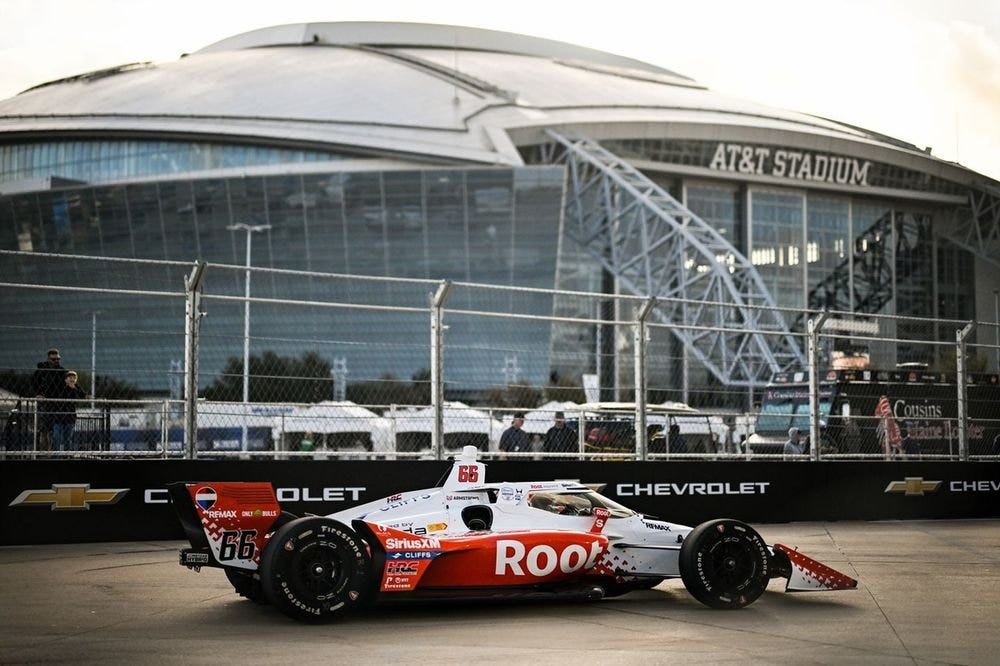
Stadium entertainment districts give him something he can replicate. A venue template. Existing infrastructure, shared costs, built-in audiences, broadcast-ready backdrops. Every NFL city in America has one. Not everyone will get to race in IndyCar. But the ones in the right media markets, with the right ownership groups willing to invest, just got a glimpse of what’s possible.
Buxton, who left F1 broadcasting to join Fox’s IndyCar coverage, sees this as an inflection point: “I see so many parallels between what Fox wanted to do with IndyCar and what Liberty did with Formula One.” He pointed out that when he was broadcasting F1 in the States on Speed Channel and NBC in the early 2010s, the series averaged around 400,000 viewers. Liberty took over in 2017, and it still took 3 to 4 years before F1 broke the million mark. IndyCar is already averaging 1.36 million in year one with Fox.
Zak Brown was at the race. His review: “Fantastic event. Drivers loved it, sponsors loved it, and it was packed.”
Pato O’Ward called it the best street course and event in IndyCar. Period.
Penske found his template. Now the question is: how many times can he stamp it?