

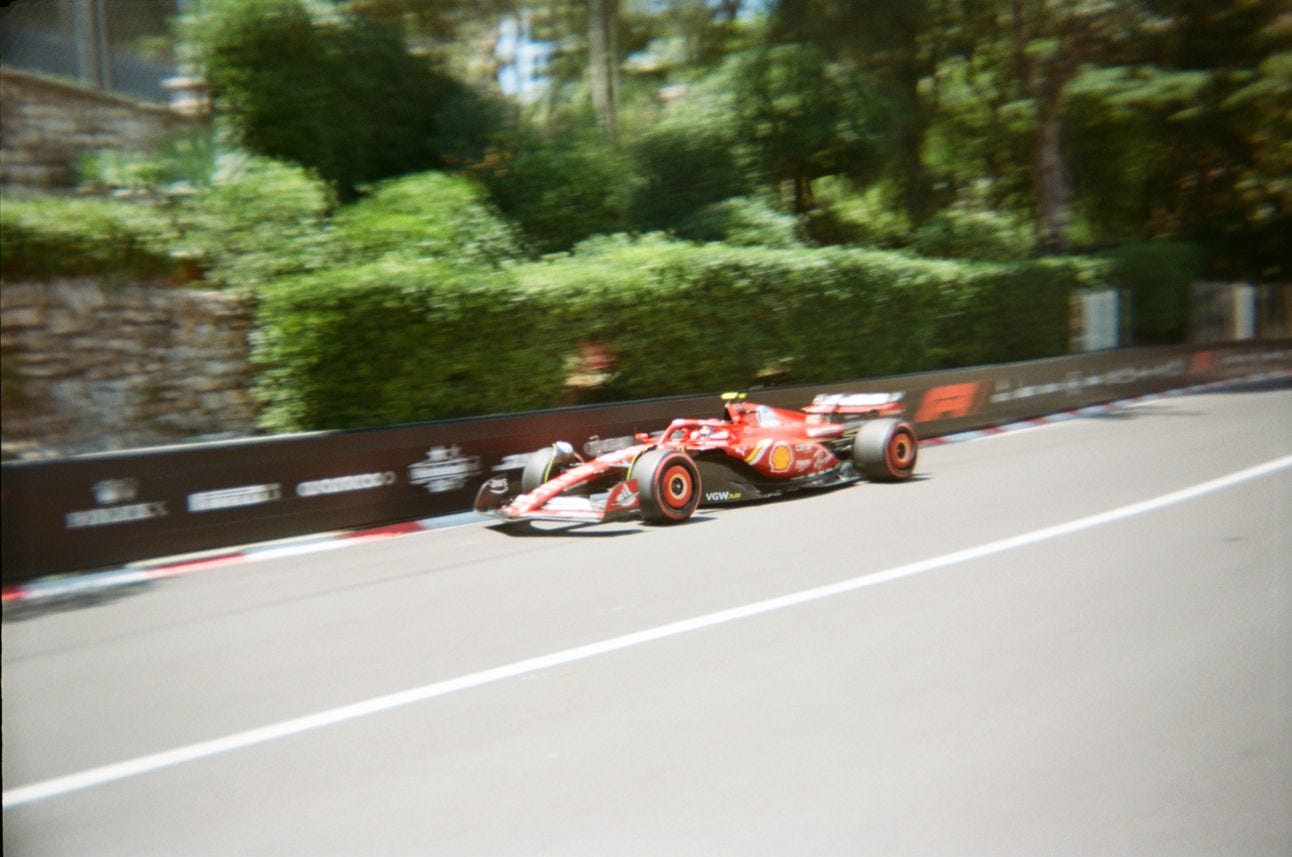
In case you missed it, Charles Leclerc won his home race in Monaco last week. It might be one of the most unanimously beloved home wins in recent memory. And while the race might be a bit of a procession these days, qualifying is always epic. An actual battle of man versus machine versus narrow street.
New sponsors are entering F1 and partnering with the teams, most recently and notably the HP x Ferrari title partnership. But McLaren continues to make moves through partnership extensions and impressive displays.
Let’s dive in.
What OKX Actually Gets From Its McLaren Deal
As Formula One continues its tremendous rise, partners like OKX are strategically positioning themselves to capitalize on this momentum and improve their brand reputation.
Ahead of the Monaco Grand Prix, OKX unveiled a special tribute to Ayrton Senna with the McLaren F1 Team, showcasing their strong partnership.
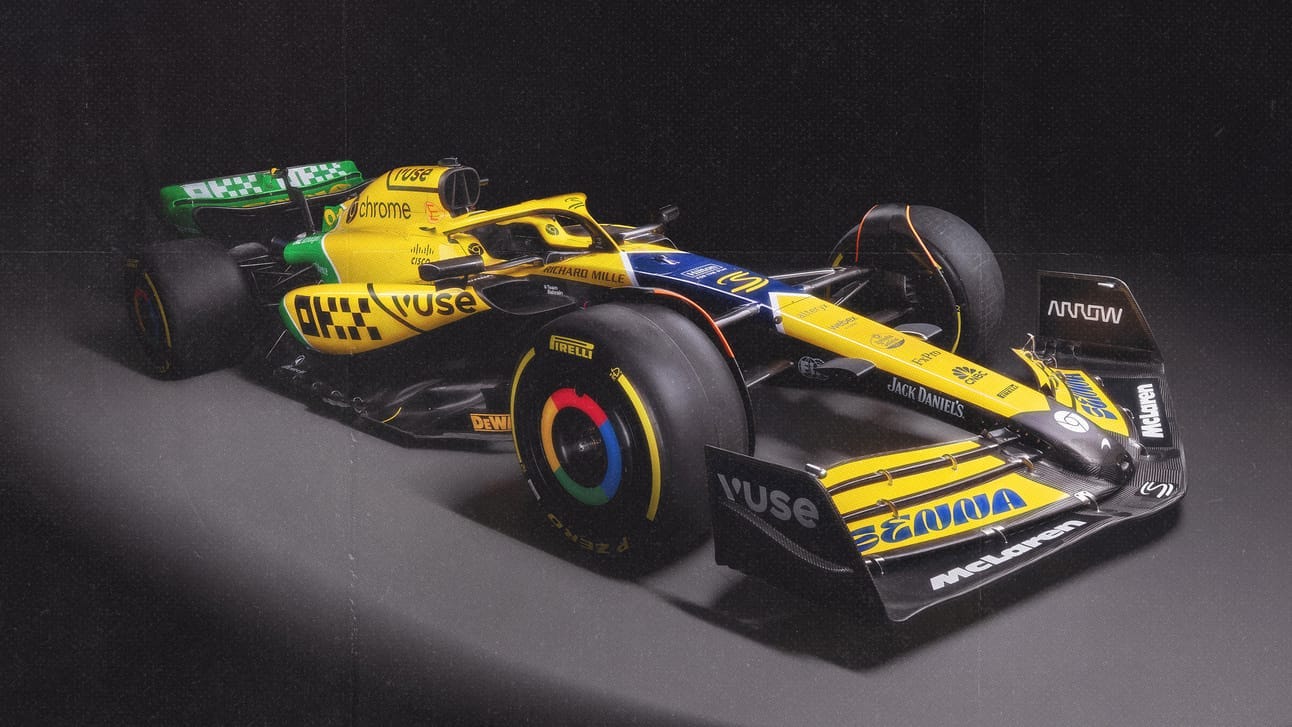
Ahead of the 2024 Monaco Grand Prix, OKX and McLaren rolled out a one-off livery honoring Ayrton Senna, painting the MCL38 in the yellow, green, and blue of his iconic helmet. Thirty years after his death, at the circuit where he won six times, the second-largest crypto exchange by trading volume turned a heritage play into a global brand-building exercise.
That livery got attention. The business logic underneath it deserves more.
The Monaco Calculation
OKX CMO Haider Rafique has been threading a specific needle since the partnership began: how does a crypto exchange borrow credibility from a sport that trades on engineering precision and generational legacy? Monaco is where that question gets answered most directly. For one weekend, the principality becomes the densest concentration of capital, media, and commercial decision-makers on any sports calendar. The paddock fills with fund managers, tech founders, and brand executives who would never attend a crypto conference but will happily take a hospitality pass at Sainte Devote.
Rafique has spoken openly about targeting the “crypto curious,” a segment that skews younger, is digitally native, and is reachable through sports culture in ways that programmatic ads and exchange banner campaigns cannot reach. OKX’s partnership with McLaren sits inside a broader portfolio that includes Manchester City (a reported $70 million sleeve deal), a LIV Golf team, and the Tribeca Film Festival. The exchange has declined to disclose the value of the McLaren deal. Given that F1 sponsorship pricing has climbed sharply in recent years, primary partner placements at a team of McLaren’s profile likely run well into eight figures annually.
Senna as Strategy
The livery choice was surgical. OKX launched its Brazilian exchange in the months before Monaco, and Senna remains the country’s most beloved sporting figure by a wide margin. A tribute campaign at Monaco lets OKX associate itself with that emotional register across every market F1 reaches, while landing hardest in the one where it just opened for business.
Both Lando Norris and Oscar Piastri wore custom Senna-inspired overalls for the weekend. Both drivers were born years after Senna’s death at Imola in 1994, and both cite him as an influence. That generational bridge is precisely what Rafique has described as OKX’s role in the partnership: connecting younger fans to McLaren’s deep history while embedding a crypto brand in that narrative.
Previous OKX livery activations followed the same playbook. The “Future Mode” redesign in 2022 and “Stealth Mode” at the 2023 Singapore Grand Prix each generated outsized social engagement relative to a standard weekend, and each gave OKX co-ownership of a visual moment that travels far beyond the broadcast window.
Why the F1 Media Model Works for Crypto
Rafique has been blunt about one thing: the McLaren sponsorship outperforms traditional media buys for OKX. The reasoning is structural.
F1 broadcasts across more than 180 countries over a calendar that spans roughly nine months. A single partnership delivers continuous global exposure without the regulatory patchwork that crypto companies face when buying media market by market. In jurisdictions where exchange advertising is restricted or outright banned, an F1 car still appears on screen. That regulatory arbitrage, available to any global series sponsor, carries particular value for an industry where advertising channels have narrowed since FTX collapsed in November 2022.
The sport’s audience composition helps too. F1 skews younger and more international than most major sports properties. For a crypto exchange chasing user acquisition in its twenties-and-thirties demographic, a 24-race season embedded in culture and content delivers compound exposure that a Super Bowl spot, for all its raw reach, cannot replicate across geographies and across months.
McLaren’s Commercial Machine
Zak Brown and Louise McEwen have built McLaren’s commercial operation into one of the most aggressive in the paddock. The team has stacked financial, tech, and consumer brands across its car, race suits, garage branding, and digital assets with a layering strategy that lets multiple sponsors coexist in the same category. McLaren was also the first F1 team to embed digital display panels on its cars, partnering with Seamless Digital in 2022 to run e-ink screens alongside the cockpit that can rotate sponsor branding in real time during a session. That kind of inventory innovation directly increases the commercial surface area available to partners like OKX.
The team’s trajectory on track has amplified the commercial story. McLaren spent years fighting in the midfield. By early 2024, Norris and Piastri were regularly challenging for podiums, and the car’s development curve looked steep. Rafique acknowledged the appeal directly, calling McLaren’s climb from the back of the grid to consistent front-running performance “incredible” and describing the decision to stay alongside the team through that arc as a deliberate bet on momentum.
What Drive to Survive Actually Changed
Netflix’s “Drive to Survive” comes up in nearly every conversation about F1’s commercial growth, and for good reason. The series, launched in 2019, pulled an entirely new audience segment into the sport, one that cared about personality, rivalry, and narrative as much as lap times. U.S. television viewership climbed 67% after the show premiered. The downstream effect on sponsorship was immediate: brands that had never considered motorsport saw a younger, engaged, content-hungry fanbase and started writing checks.
For crypto companies specifically, the timing was ideal. Drive to Survive’s audience overlapped almost perfectly with the demographic profile exchanges wanted to reach. OKX, Crypto.com (which sponsors the Miami Grand Prix and previously held Aston Martin’s title sponsorship), and others entered the grid during this window. The FTX implosion in late 2022 spooked some brands and prompted F1 to tighten its diligence process, but the exchanges that survived, including OKX, found that the reputational cleanup actually made the sport a more valuable partner. Being associated with McLaren, a team founded in 1963 with three decades of championship history, provides a kind of institutional credibility that no amount of influencer marketing can manufacture.
The Trade Show Effect
Enterprise brands use F1 sponsorship differently. HP, which joined the grid as a team sponsor, deploys its F1 assets at trade shows and partner events where a McLaren car on the booth floor signals scale, ambition, and commercial prestige to prospects and competitors alike. It draws foot traffic. It starts conversations that a product demo alone cannot.
OKX operates in a parallel register. Its activations at race weekends, including the Singapore Grand Prix fan event that Rafique cited as a standout, serve both consumer marketing and B2B credibility purposes, signaling to institutional partners and regulators that the exchange operates at a tier above the crowded field of smaller platforms.
Where This Goes
The crypto industry’s relationship with F1 is maturing. The initial land grab, when exchanges flush with bull-market capital plastered logos on anything with wheels, has given way to something more deliberate. The companies still standing are those that built genuine operational partnerships with their teams, invested in activations that went beyond logo exposure, and treated the sponsorship as a multi-year brand architecture project.
OKX appears to understand this. The Senna campaign was expensive to produce, complex to coordinate across McLaren Racing, McLaren Automotive, and Senna Global, and designed to generate emotional resonance rather than direct conversion. That is the behavior of a company playing a long game with its F1 investment.
If McLaren’s on-track performance continues to improve through 2024, OKX’s bet gets cheaper in hindsight with every podium. The exchange locked in its deal when the team was still climbing. Sponsors who arrive after the championship fight starts pay a premium. The ones who backed the team during the rebuild collect the upside.
Expect OKX to stay. Expect the activations to get bigger. And expect other crypto companies watching from the sidelines to regret waiting.