

On Super Bowl Sunday 2026, between the halftime show and the fourth quarter, something unprecedented will happen in the 75-year history of Formula 1. For thirty seconds, a racing team will introduce itself not to motorsport diehards gathered around Monaco harbor, but to 127 million Americans sprawled across living room couches, many of whom couldn’t tell you the difference between a pit stop and the paddock.
I’m glad someone finally took me up on this idea.
This moment represents the culmination of one of the most audacious marketing gambles in modern sports business. Cadillac has decided to reimagine how a racing team builds its identity from day one.
Detroit’s Gamble
The story begins with a fundamental question that most F1 teams never ask: What if you treated your racing debut like a cultural event rather than a sporting announcement?
Most F1 team launches follow a predictable playbook. Gather journalists in a room. Pull a sheet off a car. Send out press releases. Maybe get a few million views on YouTube if you’re lucky. The most creative teams might livestream the event or hire a celebrity to do the honors.
Cadillac looked at this approach and said, essentially, “What if we threw all of that out the window?”
Instead of chasing the existing US F1 audience of 52 million viewers, they’re betting $8 million on a single Super Bowl ad to reach nearly double that number in one night. But here’s the twist that makes this more than just expensive advertising: they’re targeting people who don’t yet care about Formula 1.
Think about the strategic brilliance of that positioning. While established F1 teams compete for slices of an existing fanbase, Cadillac is effectively saying, “We’ll create our own fans from scratch.”
The American Advantage
This strategy works only because of a unique market dynamic: American sports fans are particularly primed for F1 conversion right now.
Consider the numbers that tell this story. In 2018, when ESPN picked up F1 broadcasting rights for free (literally zero dollars, just to fill programming slots), average viewership was 554,000. Fast-forward to 2025: 1.32 million viewers tune in regularly, with some races hitting 2+ million. (Apple picks up the US TV broadcast rights from 2026-2031 for a massive $750 million)
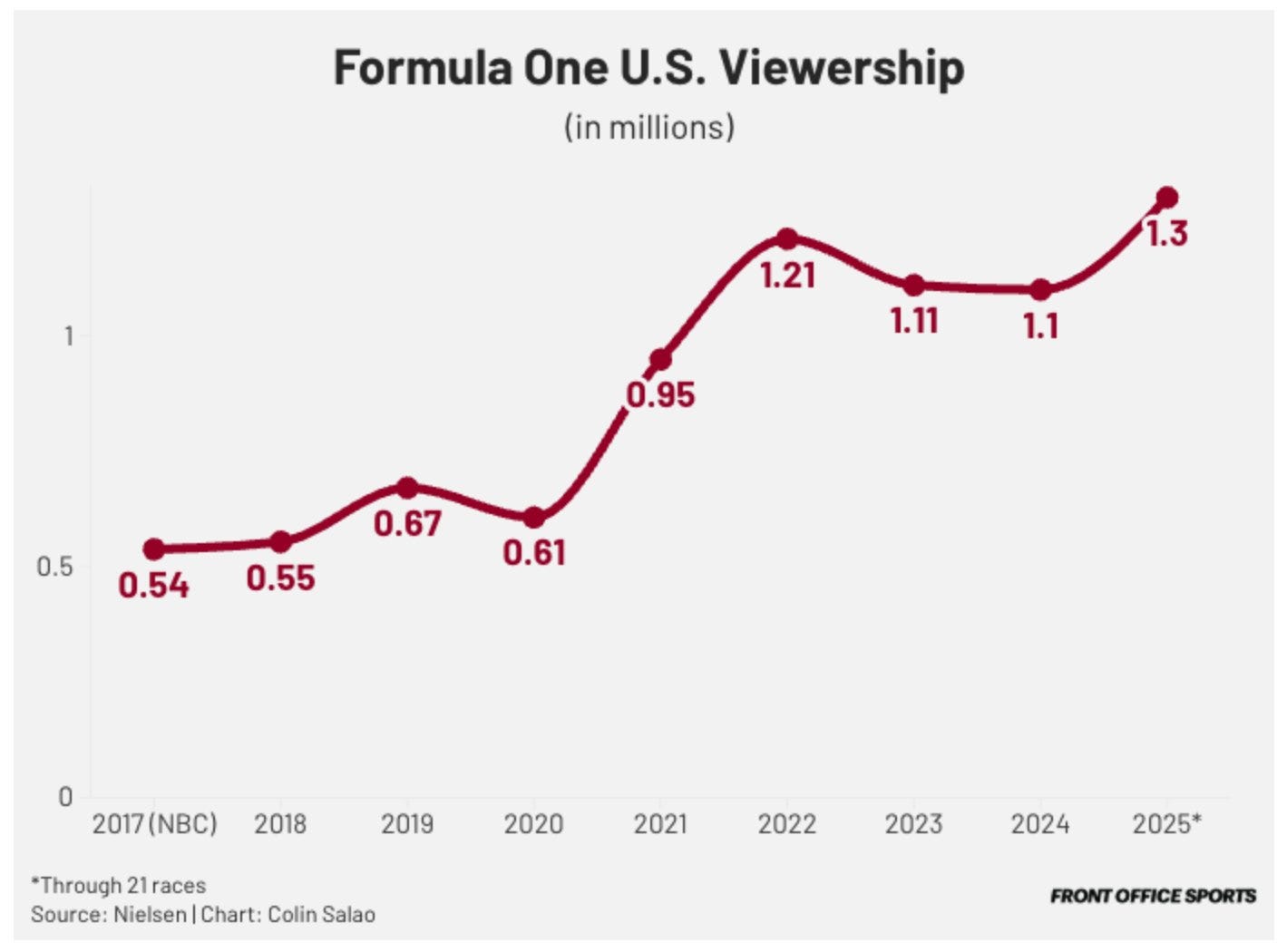
But here’s what makes Cadillac’s timing perfect: 57% of current US F1 fans started watching within the past five years. These aren’t generations-deep McLaren or Ferrari families. They’re new converts still forming their allegiances. And 74% of them are female, a demographic that luxury automotive brands spend billions trying to reach through traditional channels.
Netflix’s “Drive to Survive” created this opportunity, but Cadillac is the first team smart enough to capitalize on it at scale. While European teams have to cater to their traditional base, Cadillac doesn’t have one. Their attention isn’t split, and leveraging traditional American entertainment marketing could help capture these new fans before anyone else.
All of the Lights
Great, so you’ve got a Super Bowl ad. But there’s no need to stop there. Cadillac decided to tap into a high-traffic pedestrian hub to further activate.
Starting February 6, 2026, a chrome-clad box with a frosted-glass exterior will sit in Times Square. Through the opaque surface, visitors will see only the silhouette of an F1 car. Then, immediately after the Super Bowl ad airs on Sunday night, the glass “thaws” and reveals the full livery for the first time.
Cadillac is creating a pilgrimage destination for the very people who just watched their Super Bowl ad. The synergy is almost cinematic: a broadcast moment leads to a physical discovery, which in turn drives social amplification and deeper engagement.
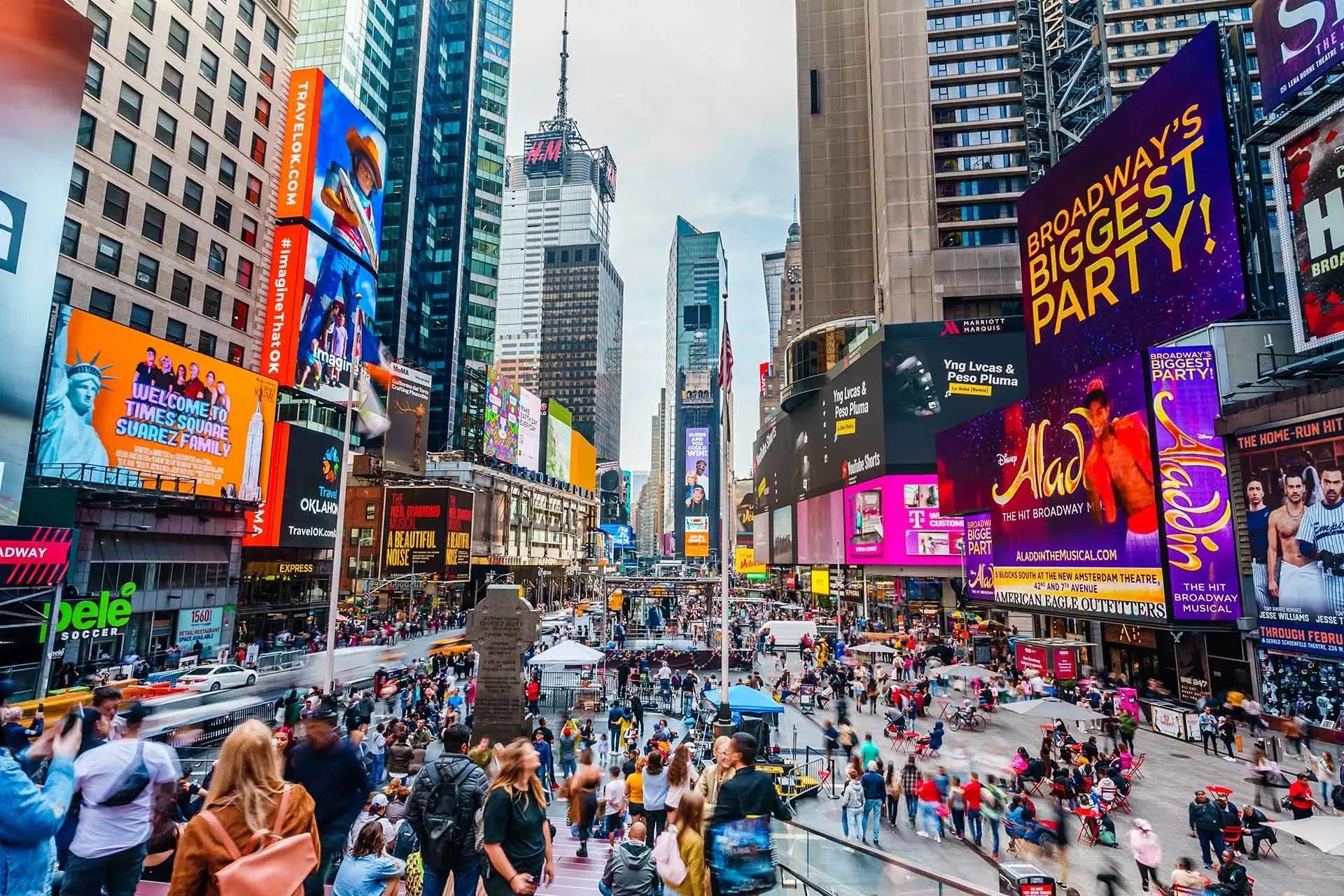
The economics here reveal sophisticated thinking about modern marketing. Times Square sees 360,000 daily pedestrians and 50 million annual visitors. Even if only 1% of those visitors during the four-day activation engage meaningfully with the installation, that’s tens of thousands of interactions. Factor in social media amplification (Times Square claims to have the “most Instagrammed billboard globally”), and the reach multiplies exponentially.
Compare this to traditional F1 launches, which typically generate 5-10 million social impressions. Cadillac is architecting a campaign designed for 50+ million impressions across multiple platforms, all coordinated around a single cultural moment.
Do the Dollars Make Sense?
One may look at Cadillac’s $1.1-1.3 billion total F1 investment and call it excessive. But that misses the strategic context entirely.
General Motors spent $3.6 billion on advertising in 2023 alone. Against that backdrop, a $20 million launch campaign for a global platform that operates year-round in 24 countries starts looking like efficient capital allocation.
More importantly, Cadillac isn’t just buying advertising. This gets the entire content engine going. Formula 1 operates under a cost cap system where teams can spend unlimited amounts on marketing while being restricted to $215 million for car development. But marketing spend isn’t part of that budget.
The smartest teams already understand this. McLaren now runs 53-55 sponsors. Red Bull founded an entire media house around their team. Mercedes generated $901 million in global media exposure for title sponsor Petronas in a single season. Cadillac is essentially buying into a marketing platform that traditional advertising could never replicate.
The European Convergence
What makes this strategy fascinating is how it reflects the broader transformation of Formula 1 under American ownership.


Liberty Media bought F1 in 2017 and immediately began fusing European motorsport tradition with American entertainment spectacle. The Las Vegas Grand Prix epitomizes this hybrid approach: a 3.8-mile street circuit through casino row, featuring celebrity DJ performances and The Sphere integration, with session times adjusted for East Coast television audiences.
Cadillac’s Super Bowl strategy represents the logical extension of this convergence. They’re also not abandoning European credibility. They maintain Silverstone UK operations, hired former F1 technical chief Pat Symonds as a consultant, and signed experienced drivers with 527 combined Grand Prix starts. And of course, Checo brings with him the high-powered backing of Mexican billionaire Carlos Slim, who has supported him since he was 11 years old.
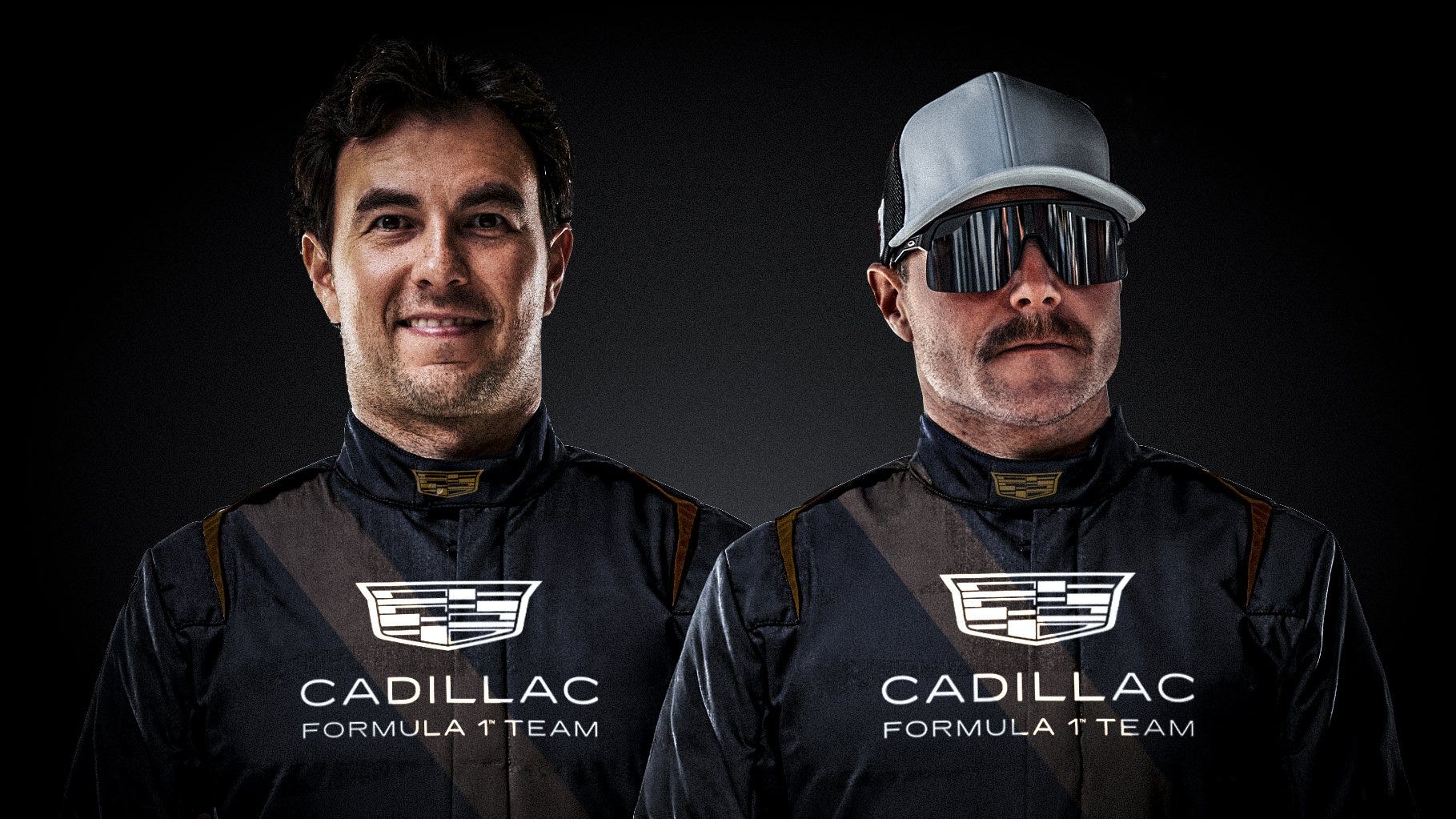
The “America’s home team” positioning becomes powerful in this context. Cadillac is building an authentic national identity that competitors can’t match.
What Goes Up
The biggest risk isn’t even financial, it’s performance-based. No amount of marketing brilliance will sustain fan engagement if Cadillac consistently finishes last. American sports fans are notoriously fickle about supporting losers, regardless of marketing budgets. (Unless you’re a Cleveland Browns fan)
But several factors suggest may not be racing for last place.
The 2026 regulation changes create a technical reset, with all teams building new cars. Could this be the rare opportunity for new entrants to be competitive from day one? Their Ferrari engine partnership through 2028 delivers proven power-unit performance. And the F1 cost cap limits how much established teams can outspend them on development.
(A side note here: Cadillac will be using customer Ferrari engines and gearboxes from 2026 for their initial entry, while simultaneously developing their own American-built engine through GM Performance Power Units LLC for a full works team debut, with the goal of supplying these engines from 2029 onwards under the new F1 regulations. GM is investing in a new facility in Charlotte, North Carolina, for this development, aiming for full works status by the end of the decade.)
The ultimate success metric isn’t any short-term ROI metric. I see it as whether Cadillac can convert Super Bowl viewers into sustained F1 fans. Industry benchmarks suggest 8.5-10% unaided brand recall for top Super Bowl ads, translating to 10+ million Americans who remember seeing Cadillac launch its F1 team. If even 5% of those viewers become casual F1 fans who follow the team’s progress, that’s 500,000+ new American supporters. Not a bad start.
The Bigger Picture
Step back from the tactical details, and Cadillac’s strategy reveals something profound about modern sports marketing. While traditional F1 teams build audiences over decades through racing success and heritage, Cadillac is attempting to compress that timeline and then sustain it through authentic American manufacturing and competitive performance.
Whether this works will determine far more than Cadillac’s F1 future. Success validates a new model for sports team launches that other franchises will inevitably copy. Failure reinforces the conventional wisdom that racing success must precede marketing success.
Either way, Super Bowl Sunday 2026 represents a pivotal moment. It will be the night American entertainment marketing goes head-to-head with European sports tradition, with $1.3 billion at stake, and I, for one, am excited.
Great work Vincenzo.
Really smart move - a Super Bowl ad is one thing, but the in person activation and tie in to the livery reveal really will take it to the next level.