

We strive to remain an independent source of motorsport business. If Business of Speed has provided you with useful insights this year, please consider subscribing.
Buying Formula One, or its parent company, Liberty Media, got a little more complicated and more expensive in the last week.
Here’s what’s going on.
Wolfe Research analyst Peter Supino modeled what a takeover of Liberty would cost and landed on $120 to $140 a share. He named TKO, the company that owns UFC and WWE, as the most logical buyer. TKO declined to comment. On November 6, Goldman Sachs raised its price target for Liberty’s Series C shares from $116 to $120, right at the bottom of that range.
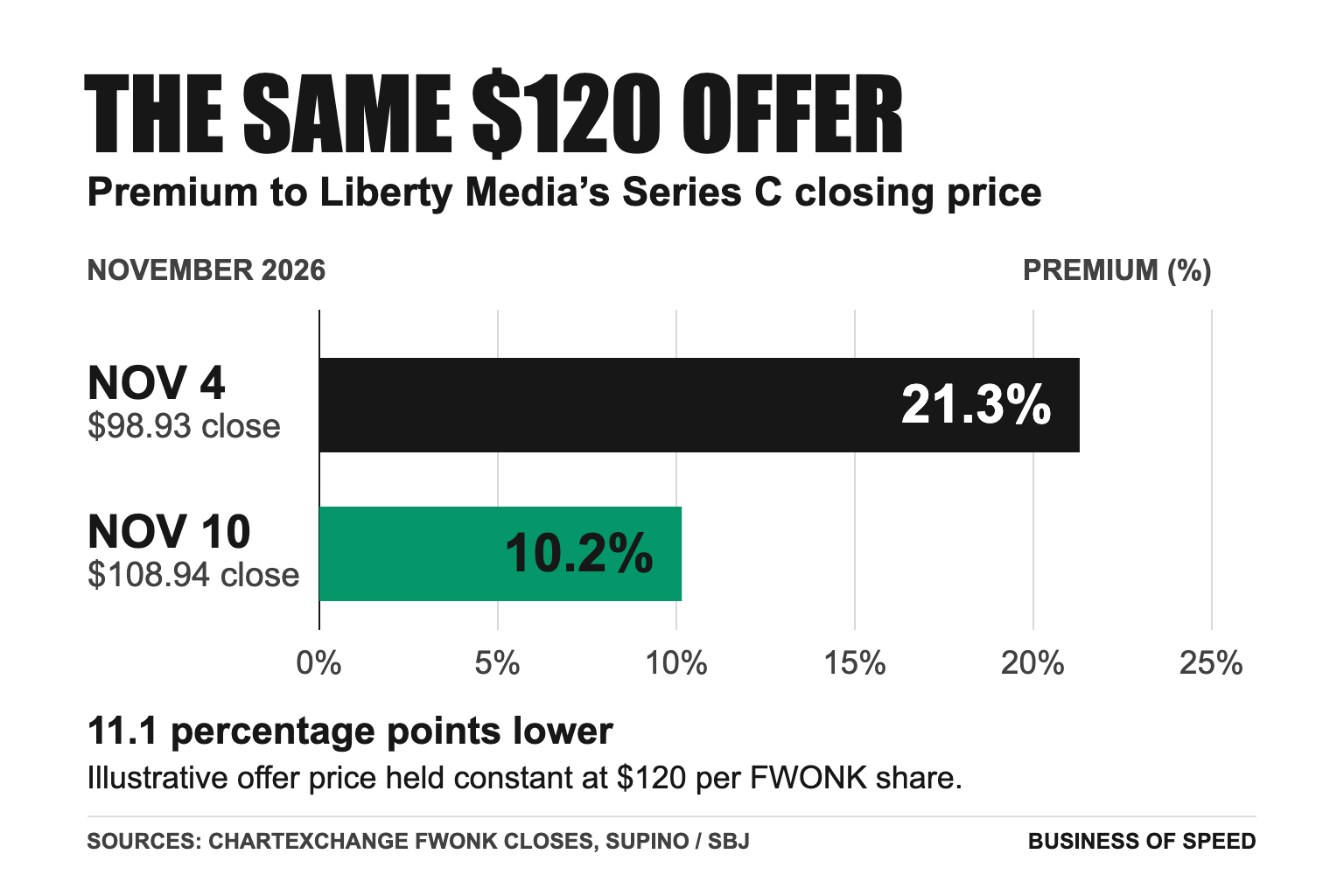
Liberty’s Series C shares closed at $98.93 on November 4. The next morning, Liberty reported third-quarter earnings and announced a share swap that took away John Malone’s voting control. By the November 10 close, the stock was at $108.94. Both pieces of news came out the same morning, so you can’t tell which one moved it.
Why does that matter to a buyer?
Because the premium a buyer would be offering shrank by 11.1 percentage points in less than a week.
Now, the actual price tag.
Liberty has roughly 254.6 million common shares after the Malone swap. At $120 to $140 a share, a buyer would owe shareholders $30.5 billion to $35.6 billion. All that is before options, convertibles, or deal costs. That buys the whole company: F1, roughly 84% of MotoGP, and Liberty's other assets.
It should be noted that the Saudi interest reported by Bloomberg in early 2023 was about F1 alone, before Liberty bought MotoGP.
Why Liberty Can Wait
Liberty doesn’t have to sell, and its numbers keep giving it reasons to wait.
Analysts keep raising their targets. Goldman raised its target even as it trimmed its profit estimates. The profit measure here is adjusted OIBDA, which is basically operating income before depreciation, amortization, and a few other costs. UBS raised its target from $110 to $116 and kept a Neutral rating. That gives Liberty’s board two outside opinions on where its stock could go. A buyer has to pay the full price at closing, even if the earnings that justify it take years to show up.
Hospitality is growing. F1 added 15% more Paddock Club capacity at both Monza and Austin by opening new space inside the Turn 1 structure. Madrid also had a bigger club than Imola did. Liberty’s Brian Wendling said most of the growth in hospitality revenue came from the Paddock Club at existing tracks, and Stefano Domenicali said 2027 capacity is already nearly sold. Liberty also reported higher hospitality costs. It reports hospitality together with licensing, freight and other businesses, so nobody outside the company can see how much profit those extra seats make.
In Las Vegas, F1 runs the race itself: it keeps the ticket money and pays the bills to put it on. Domenicali said ticket revenue, including hospitality, is pacing ahead of last year, and sponsorship has already surpassed 2025 levels. Once this year’s race is done and the profit is in, Liberty will have a better basis for deciding whether to add another hospitality deck.
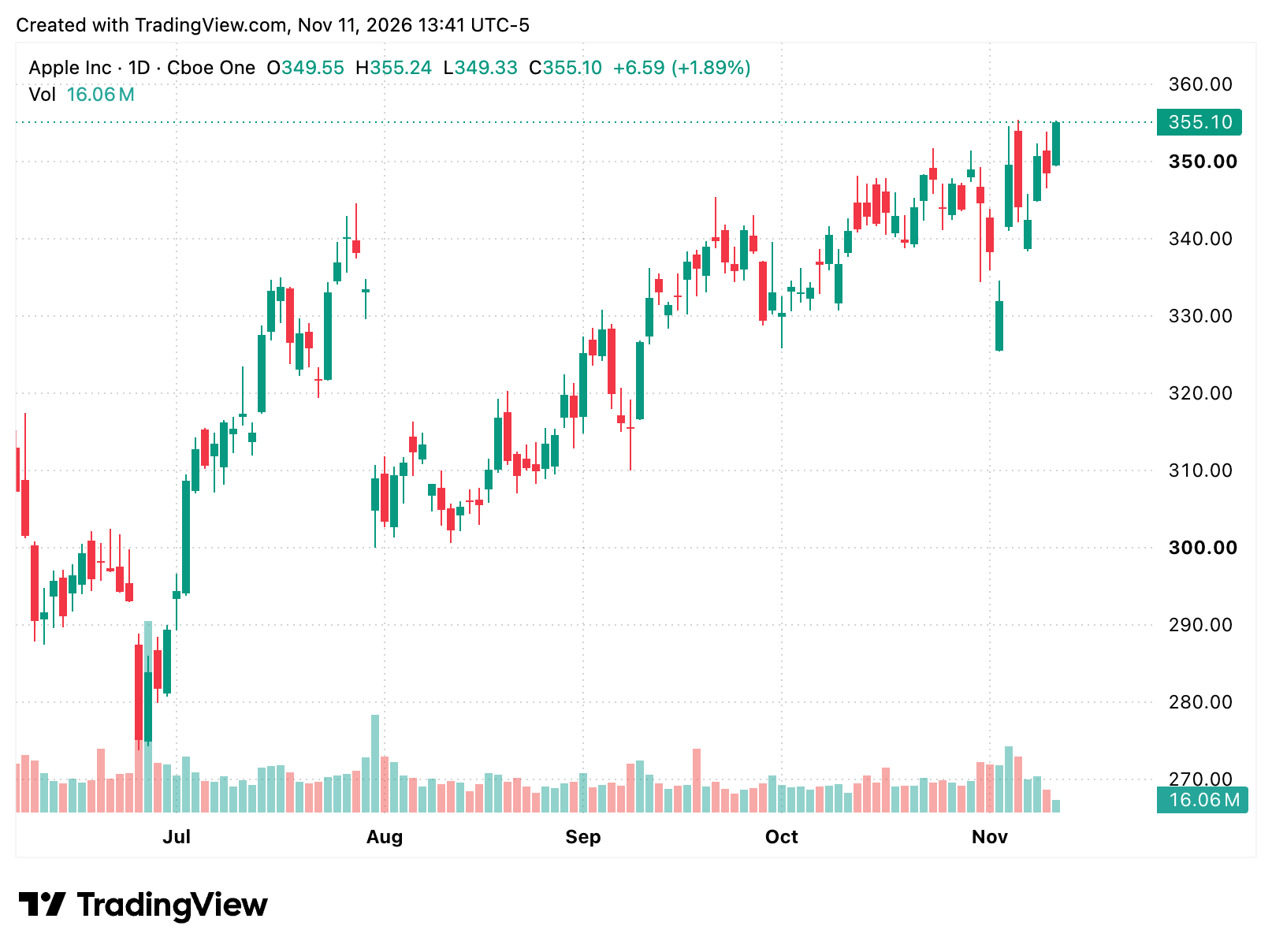
TV rights could get more competitive. Domenicali said Apple is interested in rights outside the US as those contracts come up for renewal. Liberty CEO Derek Chang says F1 wins even if Apple loses, because the current broadcaster has to pay more when there’s another bidder to beat. Apple’s US deal runs through 2030. Sky has the UK and Ireland through 2034, and its announced German deal runs through 2027. Germany is one place where Apple could make Sky pay more. Chang can ask a buyer to pay for that upside. A lender will care more about the rights money F1 has already signed.
The quarter looks better than it is. F1’s adjusted OIBDA rose 44% to $338 million in the third quarter, but that quarter had seven races, against six a year earlier. Through September, F1 had run 15 races, against 17 the year before, and the same measure was down 5% to $649 million. Sepang ran on October 4, after the quarter ended. Adding it took the season from 22 races to 23 and changed how Liberty booked season fees and costs in Q3.
There’s still some calendar risk. Qatar and Abu Dhabi are still on for November 29 and December 6, and F1 told Imola on November 10 it’s no longer needed as a backup. If a race gets canceled, that can mean Paddock Club refunds and a change to what the promoter pays, depending on the contract. TV money works differently. Liberty says its F1 contracts usually call for 14 to 16 races. Fees drop only if the season falls below that minimum for reasons other than force majeure—events outside anyone’s control.
What TKO Would Have to Raise
This is the hard part for a company like TKO. Endeavor and its subsidiaries held 64.6% of TKO’s votes at the end of September. If TKO paid for Liberty entirely in new voting stock, Endeavor’s share would shrink. At an illustrative $200 per TKO share, Endeavor would drop to about 36% of the votes at a $120 Liberty price, or 33% at $140, assuming it buys no additional shares.
To keep Endeavor above 50%, TKO could issue only about $11 billion in voting stock. That leaves $19.5 billion to $24.6 billion to come from cash, debt, or new investors.
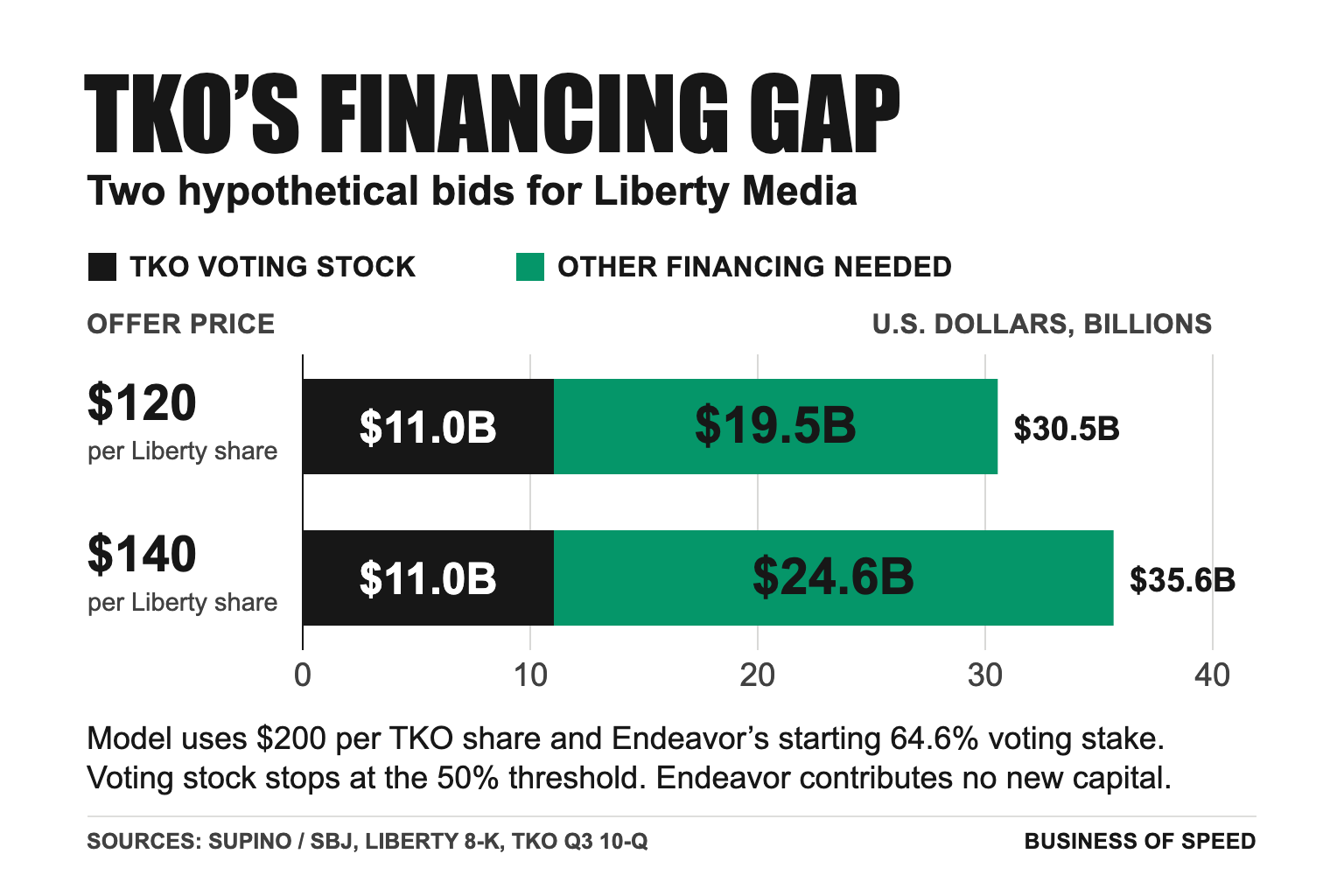
At an assumed $200 per TKO share, using September 30 share counts, about $11 billion in new voting stock brings Endeavor to the 50% line.
Say TKO borrowed all of it at 6.5%, which is the rate TKO Worldwide set on $1 billion of senior secured notes. The interest alone would run $1.3 billion to $1.6 billion a year. In reality, a lender would price the loan off the combined company and all of its debt. For comparison, Liberty generated about $980 million in operating cash flow after capital spending over the 12 months through September, including its last months owning Quint.
A lender would also want to know where the cash actually sits. At the end of September, $1.28 billion of Liberty’s $1.76 billion in cash was inside F1. F1 and MotoGP can send cash up to Liberty only if they pass tests in their own loan agreements, and neither sent any in the first nine months of the year. Ari Emanuel could bring in an equity partner or refinance debt at F1 or MotoGP. He’d still have to show lenders which company is borrowing and how the cash gets there when the interest is due.
What Malone’s Shares Could Have Bought
Until last week, Malone’s shares carried nearly half the votes at Liberty. An outsider could have cut a deal with Malone for that block before ever bidding for the whole company. That would have given them a real say in any later sale, or a way to make life hard for a rival bidder. Liberty disclosed several unsolicited offers for the block. Chang wouldn’t say who made them or on what terms.
I’ve heard from numerous sources that Ari Emanuel and Mark Shapiro were among the bidders. Hence, Liberty’s move to take Malone’s block off the table.
But now, Emanuel and Shapiro are going to try to run the same playbook Emanuel tried in 2016 when he tried to buy F1: build a group of investors to go after all of Liberty Media.
Instead, an independent committee chaired by Chase Carey agreed to a swap that retired Malone’s high-vote shares. Liberty valued the premium Malone got at about 1.5% of the company’s stock market value as of October 30. Malone’s side went from about 48% of the votes to about 3%.
Liberty also adopted a one-year poison pill. That’s a defense that lets every other shareholder buy new shares cheaply if someone crosses a set line without the board’s approval, which waters down the buyer’s stake. Here the line is generally 10% of voting power, or 15% for qualifying passive institutional investors. Roughly 90% of Liberty’s common shares carry no ordinary vote. So a buyer starting from zero could hit 10% of the votes by buying existing Series A stock worth about 1% of all common shares, based on the post-swap share counts. It doesn’t take much to trip the pill. The board can still exempt a deal it has negotiated.
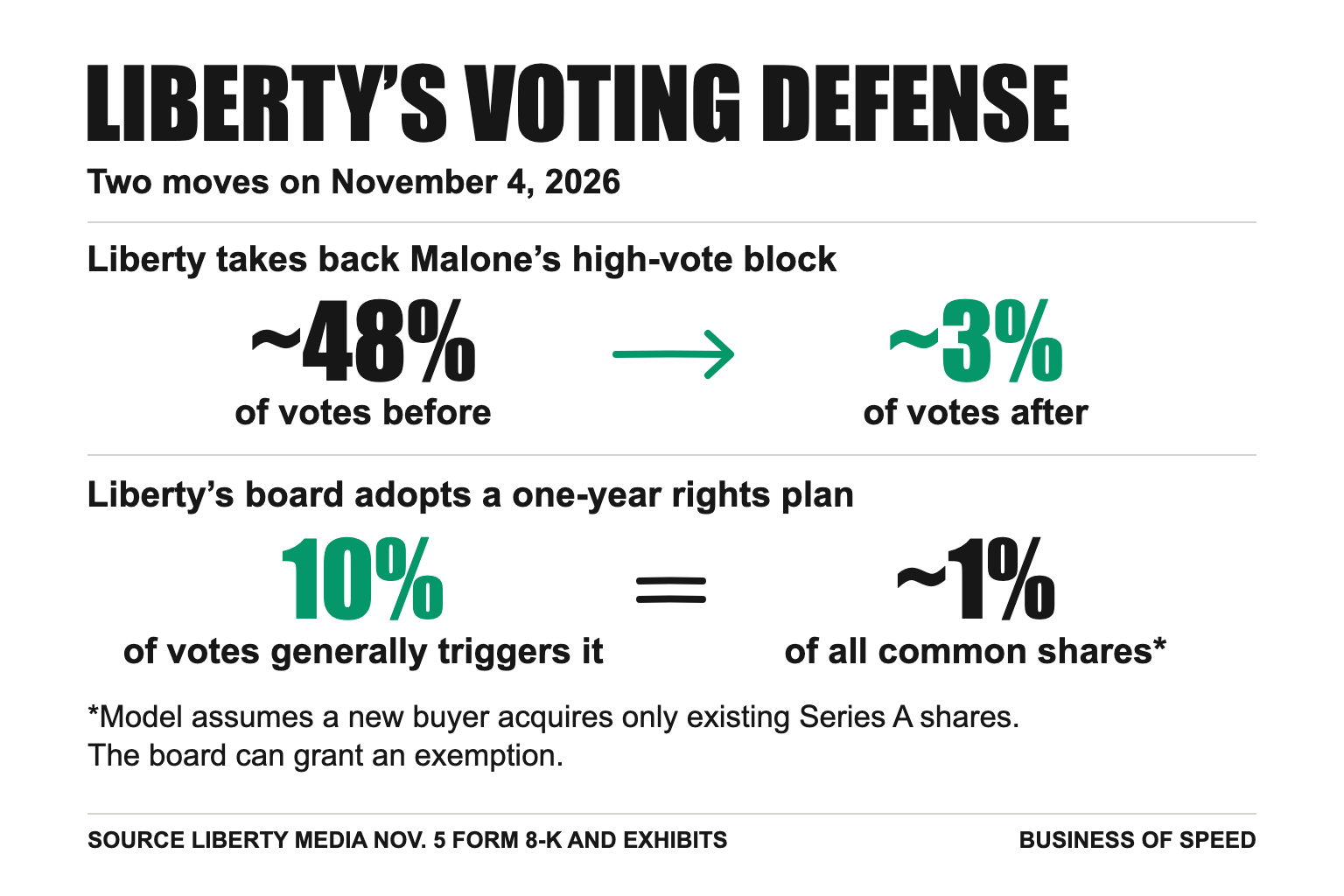
The 1% estimate assumes the buyer acquires only existing Series A shares and the post-swap share counts hold.
Malone’s old stake mattered to friendly buyers too. Some mergers need two-thirds of shareholders to approve them under Liberty’s charter, so at 48% Malone could have voted one down on his own. At about 3%, he’d need other shareholders to join him. A merger approved by at least 75% of sitting directors skips that higher bar, though any other required approvals still apply.
Former Liberty CEO Greg Maffei told Sportico he expects F1 to go private within two years. For TKO to make that happen, Emanuel needs financing that Silver Lake, Endeavor’s owner, can live with. He also needs an offer big enough for Liberty’s board to give up the next round of rights fees.
I believe we will see another international TV deal renewal before Emanuel negotiates a price for Liberty.
Business of Speed covers the business, technology, and lifestyle of racing: Formula 1, IndyCar, IMSA, WEC, NASCAR, and more. From Vincenzo Landino, entrepreneur and creator, featured in Bloomberg, TBPN, Yahoo! Finance, Forbes, Adweek, and Front Office Sports. You can find us on Instagram, Substack, and LinkedIn.