


What do you think about when you think about a sport?
Their players? Of course. Their equipment (cars, golf clubs, footballs…)? Yes. But mostly: their kit and merch.
The Global Licensed Sports Merchandise Market is valued at approximately USD 35 billion. I won’t explain here why people buy sports merch, its importance, and the potential for growth through the female demographic - I wrote a full article on that topic that you can read here. It’s a HUGE industry relevant to every sport, and often, it’s the first touchpoint where a Creative Director can make an impact.
Sports like football were never just about performance; they represent entire cultures, with subcultures specific to teams and cities, fostering a sense of belonging and pride. As social media emerged, teams began communicating beyond just scores and performance, and players started taking up more space. Fan bases grew beyond local cities, making teams attractive worldwide and effectively turning them into brands.
Every brand needs a Head of Marketing or Head of Brand that ensures storytelling alignment on all touchpoints - from sponsors to team kits, merch, and communication.
NBA: The Pioneers
The NBA was the first league to understand this shift.
In 2020, the Cleveland Cavaliers named Daniel Arsham as Creative Director, followed by the New York Knicks hiring Ronnie Fieg in 2022. Initially, these roles oversaw team kits and merchandise. However, as time passed, teams grasped the need for a holistic approach. Now, franchises like the Detroit Pistons are hiring heavy hitters like Big Sean as “Creative Director of Global Experience.”
Other sports are catching up. In 2023, British football club Crystal Palace hired Kenny Annan-Jonathan, and the WNBA is following in the NBA’s footsteps with several creative director positions already filled.
If we look at the numbers, the New York Knicks' brand valuation jumped by 60% between 2022 and 2025, and the Cleveland Cavaliers’ valuation jumped by 200% between 2020 and 2025. It’s hard to draw definitive conclusions, as many factors influence NBA valuations (viewership, trades, team results, revenue). Is it a coincidence? Or is it facilitated by these new roles hired to elevate the team’s image? It’s a topic I’d love to dig into with a finance and valuation expert (hit me up!).
The Fragmented Scene of Motorsport
In the motorsport industry, there’s a very clear separation between clothing and branding. In 2019, Ferrari Style, Ferrari’s lifestyle brand closely knit with the Scuderia Ferrari F1 team, hired Rocco Iannone as Creative Director. In 2023, A$AP Rocky was announced as Creative Director for PUMA x F1 products. Their role, just like any Creative or Artistic Director in Fashion, is primarily to oversee product design. F1 teams tend to hire experts in Apparel Design, Partnership, and Licensing. They also hire Heads of Marketing or Heads of Communication to oversee branding, logos, liveries, and sponsorships.
So far, only two teams across the motorsport world have named someone to oversee their brand.
Aston Martin F1 Team: They announced James ‘Jimmy’ Horne as Art Director in 2024. Rob Bloom, CMO of Aston Martin F1 Team, describes Horne’s role clearly: “The role of the art director is to ensure consistency across every aspect of our external marketing activation.”
Jimmy is doing an incredible job. He has managed to elevate the brand image on every social platform while staying relevant to the specific content audiences consume (memes and relatable content on TikTok; aspirational/editorial content for Instagram). Aston Martin is one of the rare F1 teams to deliver high-quality visuals with consistent branding – using green/blue hues on the color grading, using bold and luxurious typography on both on stories and their grid. As an avid social media consumer, I crave the details that make their communication so consistent and elevated.
Audi F1 Project: They might be newbies on the grid in 2026, but they are already winning the brand image war by having a Director of Marketing & Brand on board early. They are my personal favorite team in terms of social media presence, and I can’t wait to see the content they deliver during the season.
Luxury Positioning Without Luxury Execution
To say the F1 team is in desperate need of a Creative or Image Director is an understatement. With ticket prices rising, younger audiences consuming content visually, and luxury brands entering the sport, Formula 1 is at a turning point.
Average ticket prices have skyrocketed over the past few years (for example, British Grand Prix prices have increased by 123% since 2019). The sport is partnering with luxury giants like LVMH. It is clear they want to be seen as a luxury sport - an event you can attend if you have the means.
Yet their social media presence is anything but luxurious.
Notice the difference in content quality whenever there is a cross-post with Louis Vuitton or LVMH: the editing, imagery, and sound are so immersive and captivating. Compare that to the usual F1 content.
Another striking example was during the “F1 75” live event and the premiere of the F1 movie. The difference in image quality between the photo posted by the F1 Movie account versus the official F1 account was glaring. F1 even posted a carousel in which they cropped Sir Lewis Hamilton in half, a detail that would be unthinkable for any luxury brand. They posted unposed, poorly lit, and clearly unflattering photos of their drivers, with staff and fans unedited in the background. It’s one thing to capture raw moments during a fast-paced racing weekend, but the posts from a red-carpet premiere felt rushed – as if drivers were pressed for time and there wasn’t a proper photocall just meters away.


The devil is in the details. If you aspire to be a luxurious sport, these details are what differentiate a mass-market event from a premium experience.
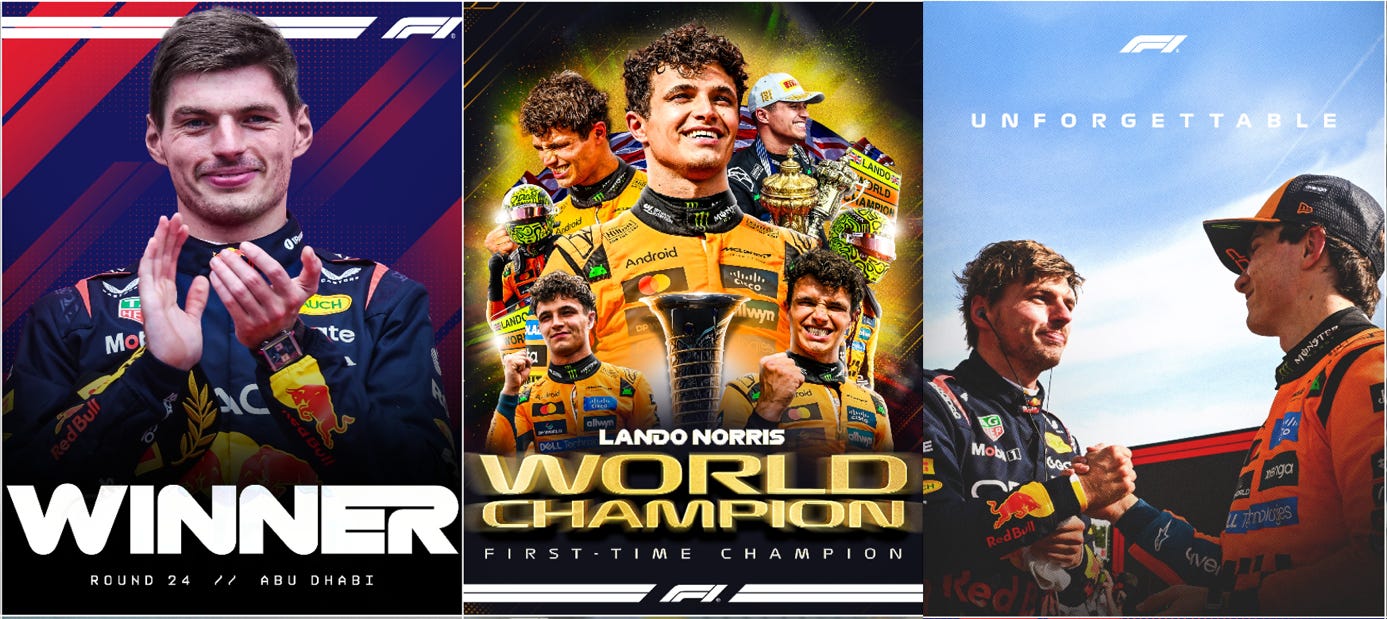
My final example concerns overall graphic design and brand identity. These three posts were posted on the same day, yet they feel like they belong to three different pages. Logo placements, typography, and typography-to-image ratios all looked different. The graphic design guidelines seem non-existent or unclear.
Don’t get me started on the F1 store’s merch, which lacks coherence. The pricing strategy is all over the place (t-shirts ranging from €17 to €87), with heavy discounts devaluing the brand. Some items lean towards streetwear, others are generic graphic tees with quotes, and we even see Christmas sweaters in the middle of February. It is an overwhelming number of conflicting messages that clash with the luxurious image F1 is aiming to project.
Finally, look at the sponsorship dissonance. While F1 signs deals with LVMH, Moët Hennessy, and TAG Heuer, they simultaneously partner with H&M, PacSun, Abercrombie & Fitch, and BAPE. These collaborations span from fast fashion and mass market to premium streetwear, creating a confusing brand narrative.
The overall touchpoints lack consistency within themselves and with each other.
The solution is quite evident: F1 needs someone to fill this gap. For this crucial role, I picture the Head of an established sportswear company, such as Alo Yoga or Salomon. For example, Lorenzo or Alessandro Boglione, who led the brilliant rebrand of K-Way, would be great fits.
After the league itself, the next most likely team to hire a Creative Director should be Scuderia Ferrari, leveraging its link to a luxury heritage. For this role, I’d focus on hiring someone young with both a creative and strategic background, like Rhuigi Villaseñor or Bruno Casanovas.
Building a Driver’s Brand
Drivers are leaning more into creative consultancy, starting with stylists. Lewis Hamilton paved the way, and now Charles Leclerc has publicly hired stylist Carlotta Constant.
The next step is for them to hire Creative Directors for their personal brand. As mentioned, Creative Directors are not just responsible for image curation, in this case, outfits, but for strategic branding and overall coherence. It’s one thing to dress like the person you want to be, but your actions should match your looks.
If you want to be seen as a fashion icon, you want to be signed as a brand ambassador of top Houses and be seen at Fashion Weeks. Lewis Hamilton is the gold standard of consistency across his wardrobe, his agenda (Paris Fashion Week, The Met Gala), his ambassadorships (Dior, Rimowa), and his socials (rare posts, high-quality visuals).
I think Charles Leclerc is following Lewis’ footsteps, but to go further, I could see him hiring his friend Doni Nahmias, founder of Nahmias, as his Creative Director.
So far, the only athlete to publicly take the plunge of hiring a personal Creative Director is American tennis player Taylor Townsend, who hired Domo Wells in late 2025. Let’s see if the next athlete to do so will be a racing driver.
Just as Daniel-Yaw Miller has written extensively on the topic, I am a strong believer in the power of Creative positions for leagues, teams, and athletes. Coming from a background in fashion and luxury, I see the immense value these roles offer. They are what take an athlete or a team, regardless of their performance, from a “person of interest” to a well-rounded tastemaker and cultural icon.

