

We strive to remain an independent source of motorsport business. If Business of Speed has provided you with useful insights this year, please consider subscribing.
I started watching Formula 1 some time around 1990. My uncle Stefano got me into cars, F1, and karting anytime my mother wasn’t around.
Senna seemed so cool to me. I loved his aggression, and something about the way he spoke drew me in. He became my favorite driver, and he still is.
His McLaren carried 27 in 1990. I used that number in my usernames (and probably half my passwords) during the early internet years. It remains my lucky number.
His first Brazilian Grand Prix victory, in 1991, might explain the attraction a bit better. With his gearbox failing, Senna completed the closing laps in sixth gear. Afterward, he needed help getting out of the car and could barely lift the trophy. The footage captures the exhaustion and emotion of finally winning at home.
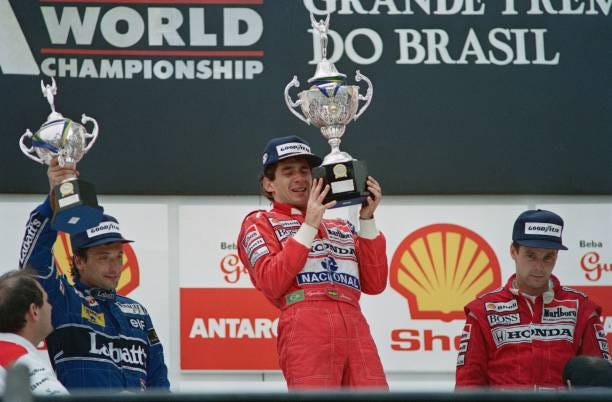
He brought so much feeling to his racing. Even now, it comes through.
The emotion. The passion. It resonated with me more than anything.
Learning about his life away from racing has given me more reasons to admire him. Ayrton built businesses, negotiated his contracts, and cared about how his name appeared on products. He also cared deeply about children whose opportunities were limited by circumstances they had never chosen.
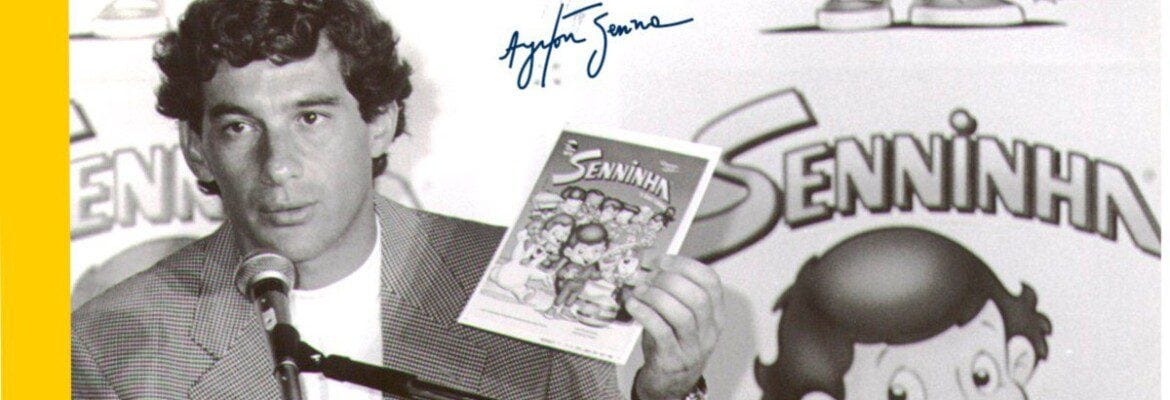
Those interests came together in January 1994, when he introduced a comic-book racing driver called Senninha.
Created by Rogério Martins and Ridaut Dias Jr., the character gave Ayrton a way to speak to children about respect, competition, and learning to live with victory and defeat. Folha de S.Paulo reported an initial $2 million investment in the project. Ayrton described it as “a channel of communication with children.”
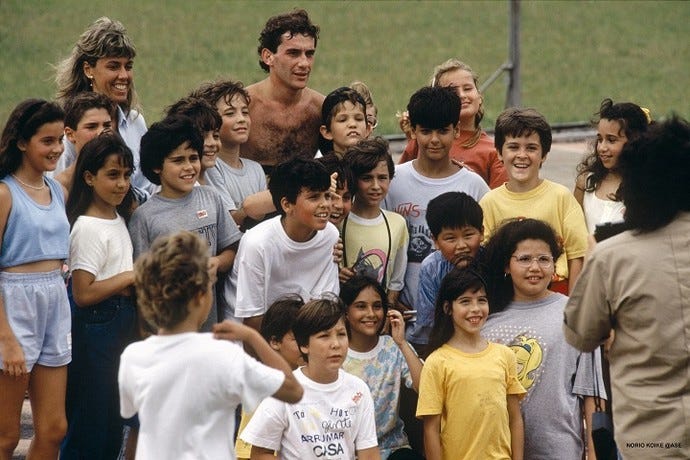
His family has spent more than three decades carrying forward both his commercial ambition and his concern for children. The business they run today helps fund the educational work he asked his sister, Viviane, to imagine.
Ayrton Senna Licensing began in 1990, while he was still winning championships. He wanted control over which products carried his name and how people encountered him outside of racing.
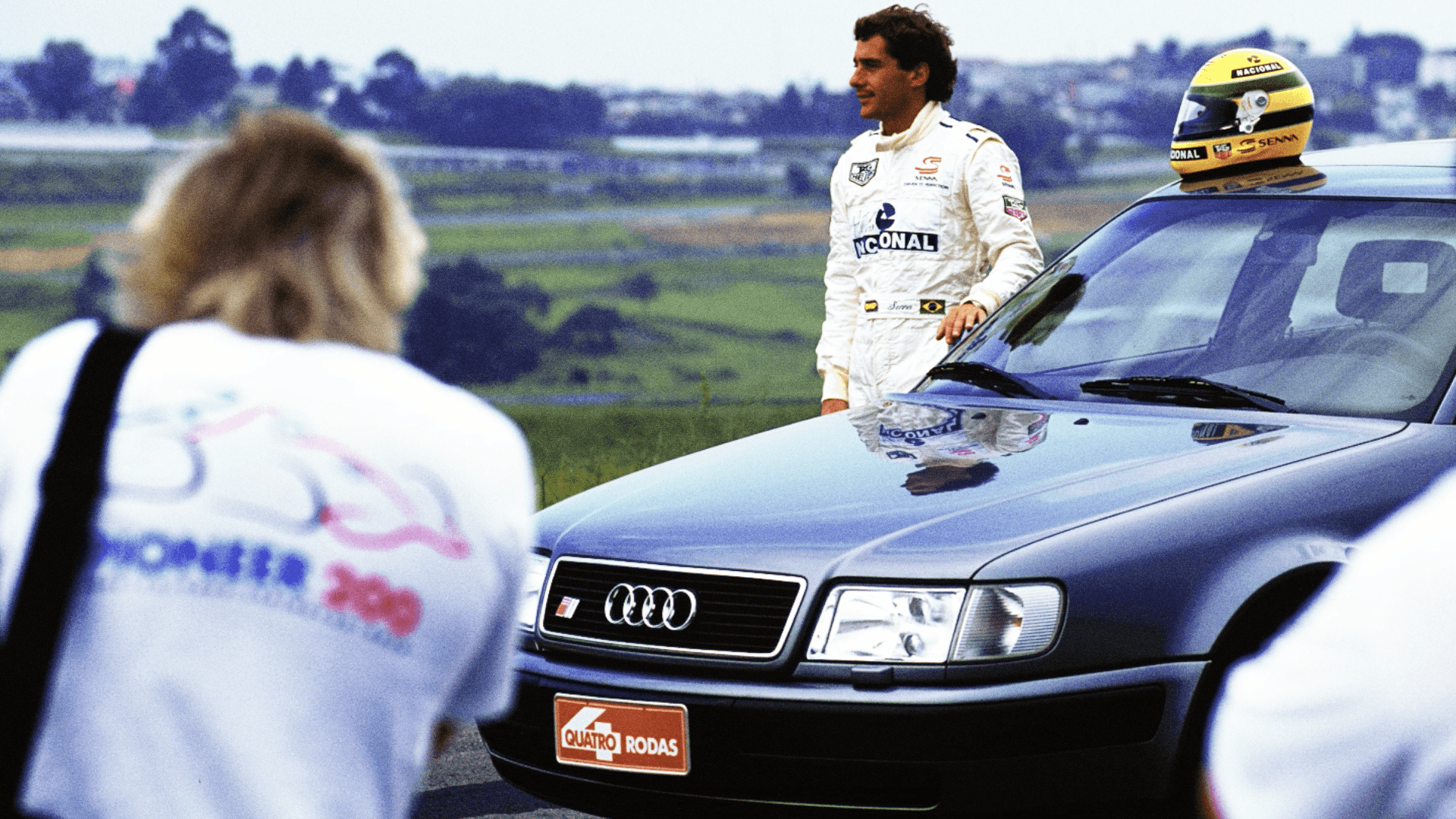
He also wasn’t afraid to operate a company himself. In November 1993, Senna Import signed an agreement with Audi in Ingolstadt to represent the German manufacturer in Brazil. Ayrton entered the venture with businessman Ubirajara Guimarães, and imports and sales began four months later.
That same sharp business judgment showed up in his own racing contracts. His manager, Julian Jakobi, recalled to Autosport that Ron Dennis said McLaren had $5 million available to pay Ayrton for 1993. Ayrton offered to race the first five Grands Prix. The arrangement became $1 million per race, payable before each weekend.
Yet the same man squeezing Ron Dennis for $1 million per race quietly gave money to people whose circumstances troubled him.
Speaking to Motor Sport’s Rob Widdows, Viviane described donations her brother made without seeking publicity. Before he died, he asked her to help develop an organized way to support Brazil.
“Children were always uppermost in his mind,” she said. “It was always the children that he spoke about.”
Ayrton knew his family’s resources had helped him develop his talent, as Senna Brands executive Thiago Fernandes noted in a 2024 interview with GP Racing. He wanted kids whose families lacked those resources to have a real shot at developing theirs.
While Senninha was one way of doing that, his conversations with Viviane sparked something much larger. She founded Instituto Ayrton Senna in November 1994, turning a sibling conversation into an institution that required dedicated people, funding, and years of sustained attention.
Viviane also made smart, practical choices about how the Institute should actually work. Fernandes explained that rather than just writing checks, the organization focused on training educators and building teaching resources so its work could scale across Brazil’s public school system. Reaching kids through the schools they already attended turned her brother’s vision into a repeatable system.
Years later, her daughter Bianca faced a different operational question. Running a global licensing brand and running an educational non-profit require completely different skill sets. To let the Institute focus purely on education, Bianca proposed spinning out a dedicated commercial company to the family council; in 2019, she established Senna Brands.
In a conversation with Bloomberg Línea, Bianca described bringing in outside specialists for categories as different as supercars and sneakers, while keeping the family closely involved in major decisions. For her, the work is still anchored by the uncle she knew away from the track.
“He was a big kid, always playful and very present,” she said, in translation. “Keeping that spirit alive is fundamental for us.”
It’s easy to forget that side of him when all we saw on TV was the intensity through a visor. His family knew his humor and personal tastes, and some of their best commercial partnerships came directly from what Ayrton actually loved.
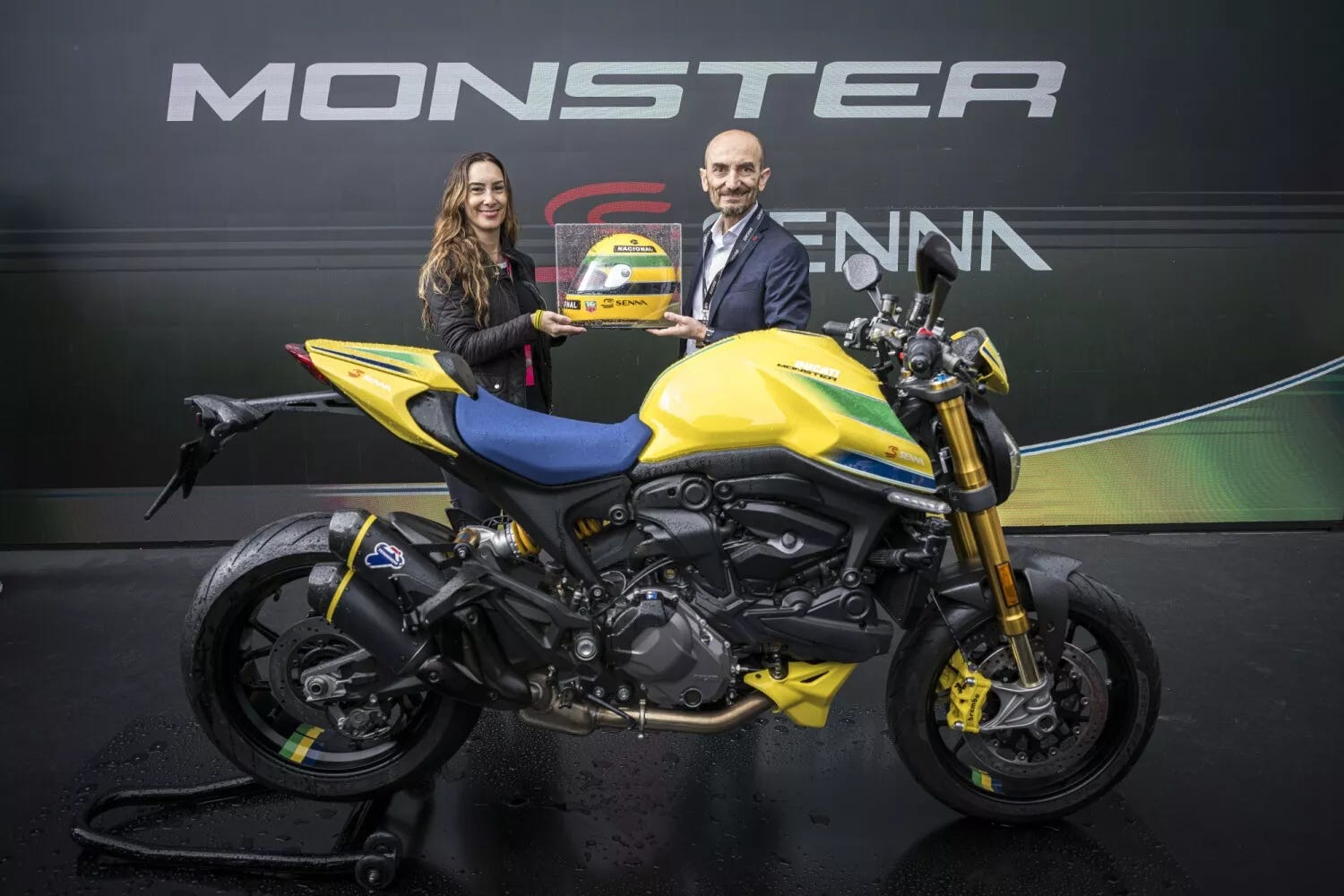
In March 1994, Ayrton visited Ducati’s factory at Borgo Panigale to sign the agreement for the 916 Senna, picking out the anthracite gray, matte black, and red color scheme himself. After his death, Ducati paused the project, spoke with the family, and agreed to finish what he started. Viviane and Ayrton’s brother Leonardo attended its presentation at the Bologna Motor Show that December, with Leonardo choosing the colors for subsequent editions. When Ducati introduced the Monster Senna in 2024, it leaned on that same history. Ayrton had owned an original Monster 900 himself.
McLaren’s road car bearing his name tapped into his driving philosophy in a similar way.
“The McLaren Senna honours my uncle because it is so utterly focused upon the driver,” Bruno Senna said. Having Bruno involved gave the project a real family stamp of approval. And in December 2017, with Viviane and Bruno in the room, McLaren auctioned the final build allocation from the 500-car production run, raising about $2.7 million directly for the Institute.
Still, carrying a sporting legacy forward means reaching people who have no memory of watching him race. A thirty-year-old today was born after Ayrton’s final lap. Their connection has to start somewhere else.
For millions of newer fans, that entry point was Netflix’s six-part drama Senna, produced by Gullane with the family’s support. Following its November 2024 release, Netflix recorded 5.8 million views between December 2 and 8, topping the platform’s non-English TV chart. Gabriel Leone’s portrayal gave people who only knew the yellow helmet a reason to go back and watch the original race footage and interviews.
For younger kids, the entry point looks more like a modern version of Senninha. Developed by Brazilian studio Floruit, Senna World in Minecraft lets players experience his early karting days, his 1988 Monaco qualifying run, and that exhausting 1991 win in Brazil, plus a virtual museum. Minecraft included it in its April 2026 Marketplace Pass selection, putting his story right where kids already spend their time.
And sometimes, the hook isn’t even racing… it’s his style.
The October 2026 Zara collection pulled directly from old photographs of Ayrton off-duty, including a famous shot of him walking away from an aircraft with a briefcase in hand and a jacket slung over his shoulder. One of the 17 pieces in the collection, which rolled out online and in 200 stores worldwide, is a leather jacket modeled on one he wore.
“A lot of people meet Ayrton today through a TV series, a photograph, a jacket,” Bianca said in the announcement. She’s right: someone might buy the jacket long before they ever hear about Suzuka or Donington.
Even the personal relationships around him are being passed down. In our May conversation with Robert Jakobi, he talked about growing up around Ayrton while his father, Julian, managed him. Now, with the family’s blessing, Robert is working to bring the Ayrton Senna Forever exhibition to Las Vegas. The manager who negotiated those $1-million-a-race McLaren deals now has a son introducing Ayrton to a new crowd.
All of this, from the exhibitions and the Netflix series to the licensing deals, feeds back into the original mission. As Fernandes told GP Racing, royalties are split between reinvesting in the brand and funding the Institute. According to the Institute’s 2025 annual report, brand and image royalties supplied 52% of its total contributions that year, with corporate and individual donations covering the rest.
That money funds programs like Se Liga, which helps kids who have fallen behind in reading by combining literacy support with teacher training and classroom materials. In 2025 alone, the Institute reported reaching 31,300 educators across 5,000 Brazilian schools.
I came to Senna through my uncle Stefano, drawn to the aggression and the way he carried himself. Understanding what his family has built has deepened that affection.
I admire the commitment Viviane and Bianca have brought to this work. They have given people who never watched Ayrton race ways to discover him, while helping sustain the educational work he wanted to support.
As someone who still chooses 27 because of him, I’m grateful for the care they have put into carrying his name forward.
Business of Speed covers the business, technology, and lifestyle of racing: Formula 1, IndyCar, IMSA, WEC, NASCAR, and more. From Vincenzo Landino, entrepreneur, creator, and proud Italian-American, featured in Bloomberg, TBPN, Yahoo! Finance, Forbes, Adweek, and Front Office Sports. Find us on Instagram, Substack, and LinkedIn.