


We strive to remain an independent source of motorsport business. If Business of Speed has provided you with useful insights this year, please consider subscribing.
Magnus Greaves took my call from the front seat of a truck. It was Monday of Grand Prix week. He was in Las Vegas, doing pickups and deliveries between sentences. Scott Dadich was in the back of a car somewhere with his camera off, because Google wouldn’t let him turn it on.
Together, they run RACEWKND. It’s a magazine. It’s coffee table books. But more than physical media, it’s a celebration of this thing we love called Formula 1.
I’ve known Magnus for the better part of a decade now. Back when RACEWKND was known as REV JOURNAL, it originally launched in 2015 at the Abu Dhabi Grand Prix to explore the intersection of F1's history and modern development.
The issues are as big as my two-year-old, and the storytelling inside is ‘like very few things in motorsport media today.’
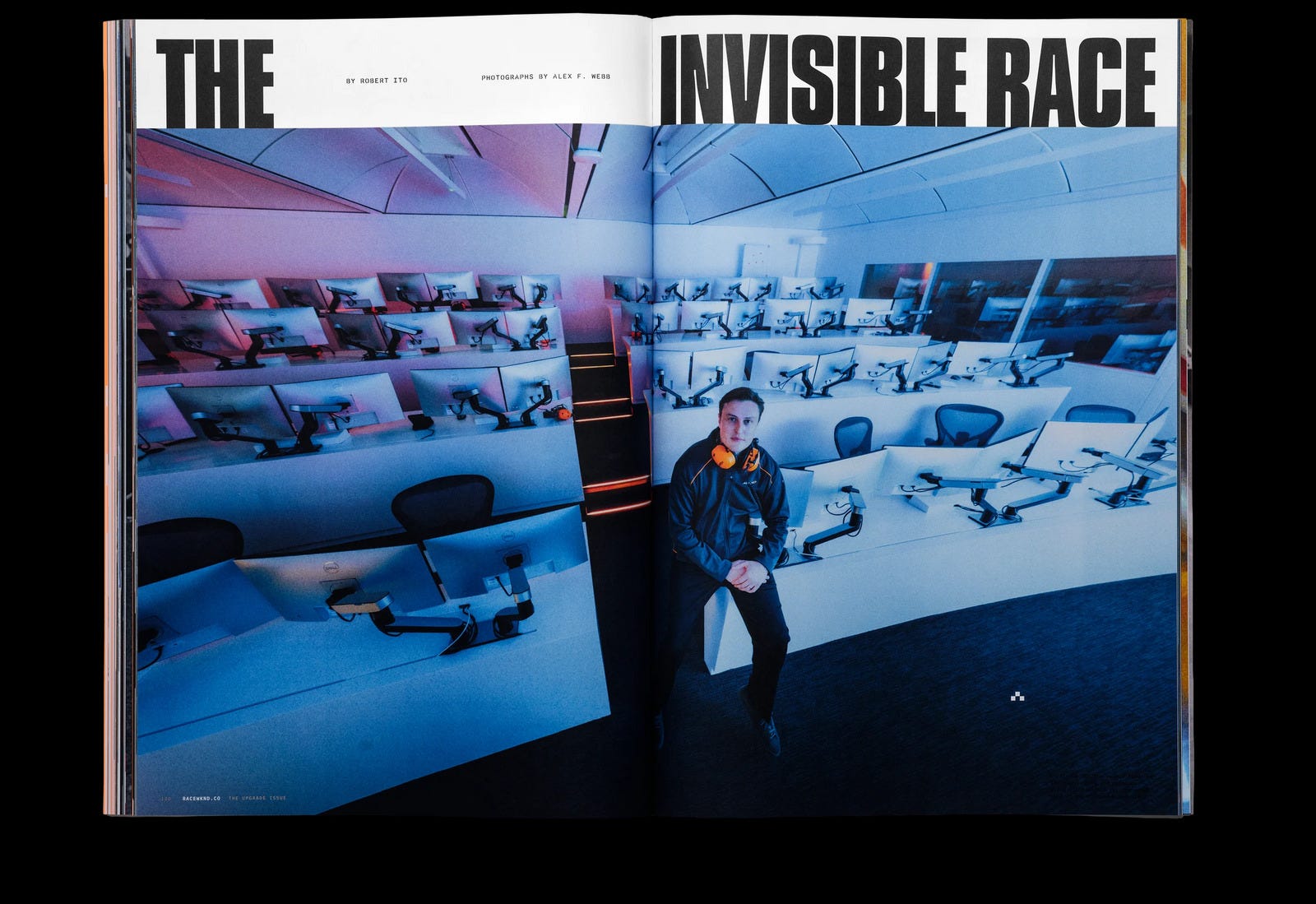
So when Magnus told me they were working on something big, I knew we had to talk. That something big is called The Upgrade Issue. A collaboration with Cisco and McLaren F1.
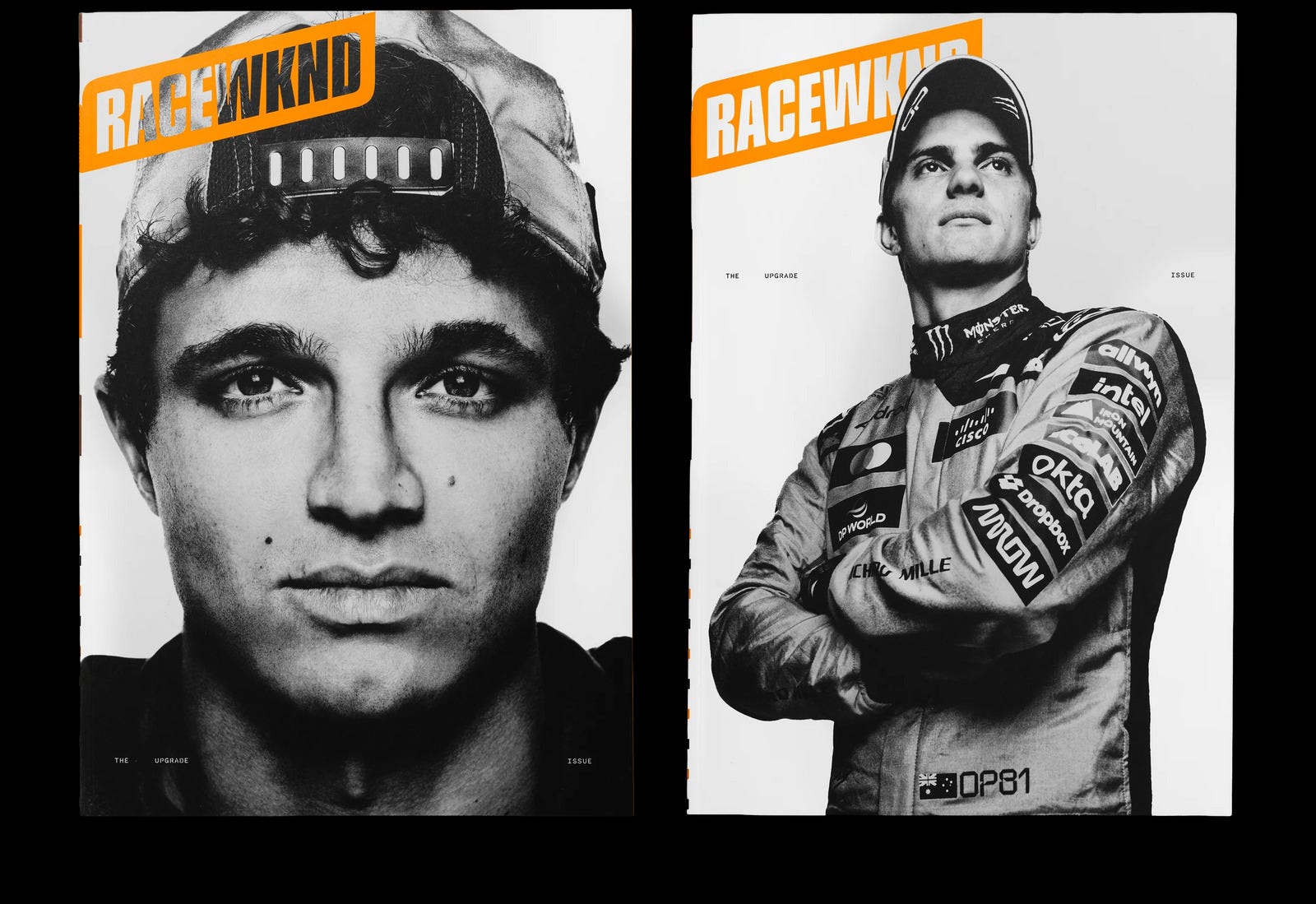
It’s a gorgeous issue. 144 pages, 15 inches by 10, printed on special paper with custom inks. Legendary British photographer Platon shot the two covers. There isn’t a single ad in it. This week it’s in the Paddock Club in Las Vegas, and on Saturday a 48-page version slides into The Wall Street Journal’s Weekend Journal.
“Wait, what?” I marveled.
That last part is new for them, too. “We built a little business here with a cool product, but no real distribution,” Magnus said.
And now they’ve got McLaren, Cisco, and the freaking Wall Street Journal.
The Word
Ask most tech sponsors in F1 what they’re about, and you get the same answer.
Speed.
Faster.
Acceleration.
“It gets a little tired,” Magnus said. “You keep hearing the same thing over and over again.”
F1 runs in sponsor waves. Tobacco had its run, then crypto had its moment, and now it’s tech. “There’s so much technology sponsorship right now,” Magnus said. “But the storytelling around it isn’t very interesting.”
So they picked a different word, and it’s one every fan already knows. An upgrade is the bag of new parts a team carries into a race weekend to find a tenth or two. Magnus and Scott stretched it to mean anything a team does to get better, which let them write about the people and culture at McLaren and Cisco, not just the hardware. “You’ve heard Lando Norris talk about stuff all the time,” Magnus said, “but now he’s talking about it in a different filter. And Andrea Stella is talking about it in the same filter.”
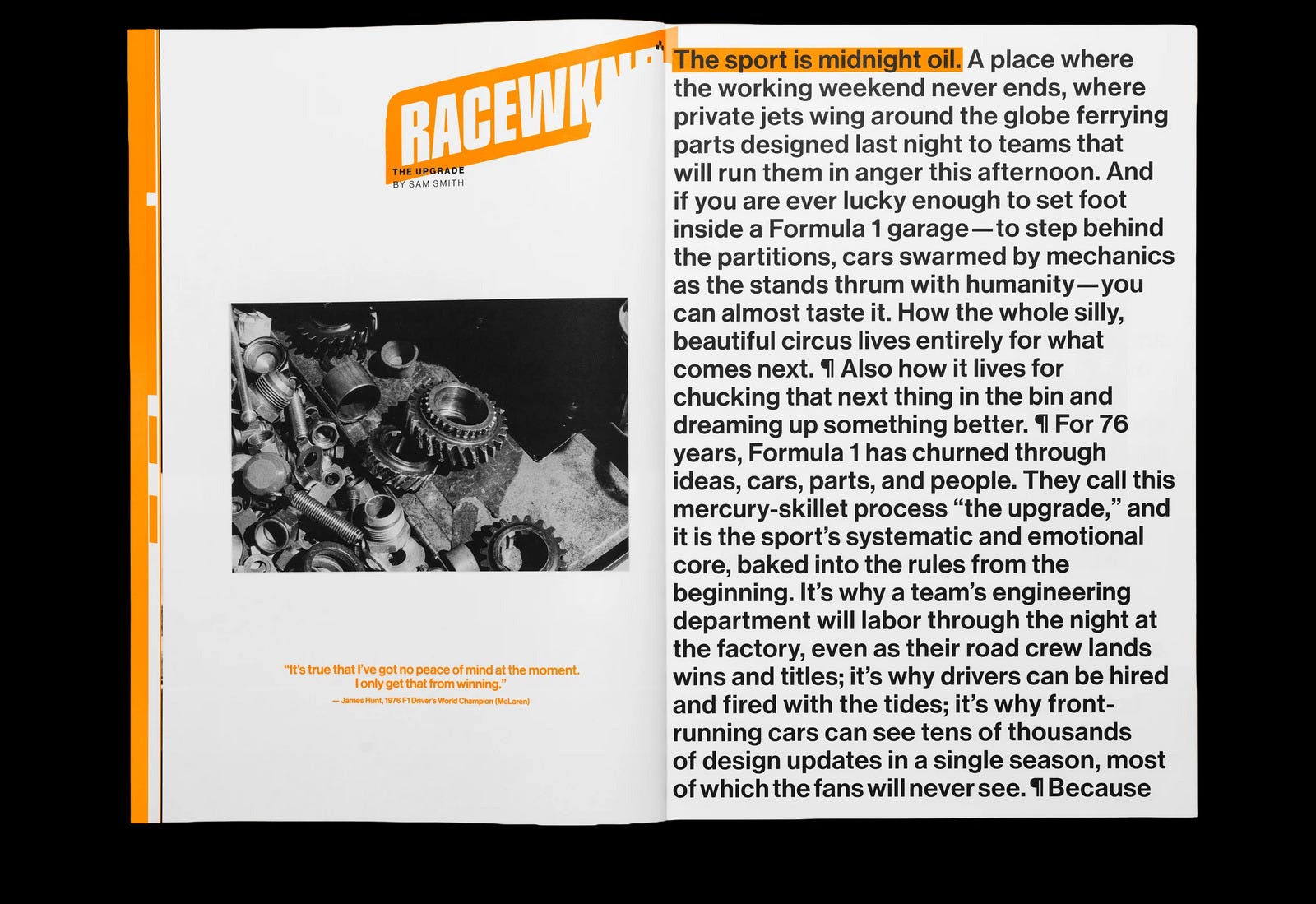
Sam Smith wrote the essay that opens the issue. It’s about 1,000 words on the upgrade mindset, and it runs across 10 oversized pages. When Scott told me that, I said nobody’s reading that on Instagram.
How it Got Made
Scott’s first magazine subscription was Road & Track. He built model cars as a kid and figured he’d move to Detroit and design the real ones. He went into magazines instead. Texas Monthly in 2000. He joined Wired in 2006 as creative director, where he and a couple of editors who loved F1 started covering the sport in a tech magazine. Later he made Abstract, the Netflix series about designers.
Magnus had been making oversized F1 magazines for years. Each issue takes on one subject: the jet set, the 1970s, F1 in America, the world champions. “It takes a long time to pull together,” he said, “leading to a slow publishing schedule.” But he knew he needed something more.


And that’s what Scott brought to the table.
The challenge with slow is that the world around us is consumed by fast, fleeting, ephemeral. So in a world literally defined by speed, how do you get someone to pay for slow?
“We can fantasize about this stuff all we want,” Magnus said. “It takes somebody like Cisco seeing that and saying, you know what? We’re gonna get behind that.”
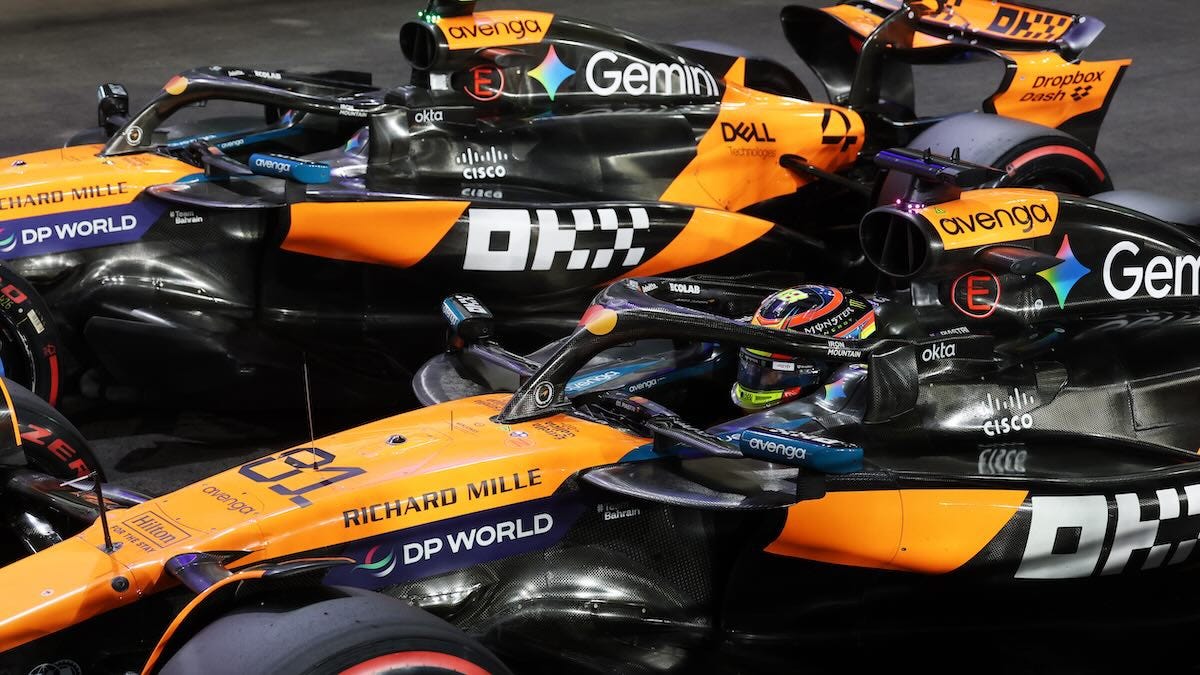
Cisco has been on the McLaren car since 2021. It started with Webex, Cisco’s video calling platform, and grew into an official technology partner, which means Cisco runs the networks at the track and back at the McLaren Technology Centre in Woking. The two extended the deal in July. Steve Clayton became Cisco’s chief communications officer in January, and Scott said that even though he’s new, “he has it all unlocked.” Cisco took the magazine to McLaren. McLaren opened the doors in Woking and handed over the drivers.
It wasn’t Magnus’s first time telling McLaren’s story. His second collection, in 2023, was four team issues on McLaren, Ferrari, Red Bull and Mercedes, shipped together in a custom box.
That put Cisco people inside rooms at the factory they’d never normally see. Walking through the factory, Scott recalled, a team lead told us, “Don’t touch anything.”
And that’s how you know you’ve gotten real access.
From Race Weekends to The Journal
This week the magazine will sit on tables in the Paddock Club and in the McLaren and Cisco hospitality suites. The CEOs of both companies are sending copies themselves to VIPs, partners and clients. After Vegas, it travels to McLaren fan events and tech conferences, with dates booked into 2027.
The Journal came at it from the other side. The paper launched WSJ Sports at an event in New York in July and picked F1 as its lead sport because, as Magnus said, F1 touches more of the business world than any other sport. Scott and Magnus both had history at the paper, and the deal came together fast. It’s a long-term partnership, and Cisco’s magazine is the first to hit the stands.
Fitting a 144-page magazine inside a newspaper meant cutting it to 48 pages and changing the size. Stories that ran eight or 10 pages became two-page spreads. Most of the big double-page photographs from the 1970s stayed in the full edition. RACEWKND kept total control. “It’s our stories. It’s our photographers. It’s our design,” Scott said.
Magnus wants one thing from this weekend. A business reader opens the WSJ Weekend Journal and comes away seeing McLaren and Cisco differently. If they go buy the $50 full edition after that, great. But it’s not the goal.
The Journal is already introducing RACEWKND to other brands, because most of the companies in that paper now have some tie to F1.
Cisco Gets It
Cisco brought Magnus and Scott to an off-site with 25 of its communications people to explain why the company was making a magazine at all. Magnus didn’t sugarcoat how it started. “Some of them were quite skeptical when we came in,” he said. “By the end, there were a hundred ideas that they had on how they wanted to use the magazine.” A lot of them walked out finally understanding why Cisco is in Formula 1.
If you’ve followed me for any length of time, you know we have these exact conversations all the time, with brands, with companies, with private equity firms looking to get in. Half the time their own people don’t get why they’re in Formula 1. They’re like, what are we doing here? We don’t get this sport. If you get ahead of that with something like this, where it actually clicks for them, that’s probably 90 to 95% of the battle with most of these sponsorships.
By Monday, both companies were emailing and calling Magnus to ask when they’d get their copies. “Rather than just a sticker showing up on their car,” he said, “there’s this shared output that they both are totally invested in.”
The Shelf
I’m a big believer in slow is smooth, smooth is fast. Speed’s great. But by Monday night, nobody remembers the video that went out on Instagram on Monday morning. This magazine is going to sit on an executive’s desk, or on somebody’s coffee table, for years.
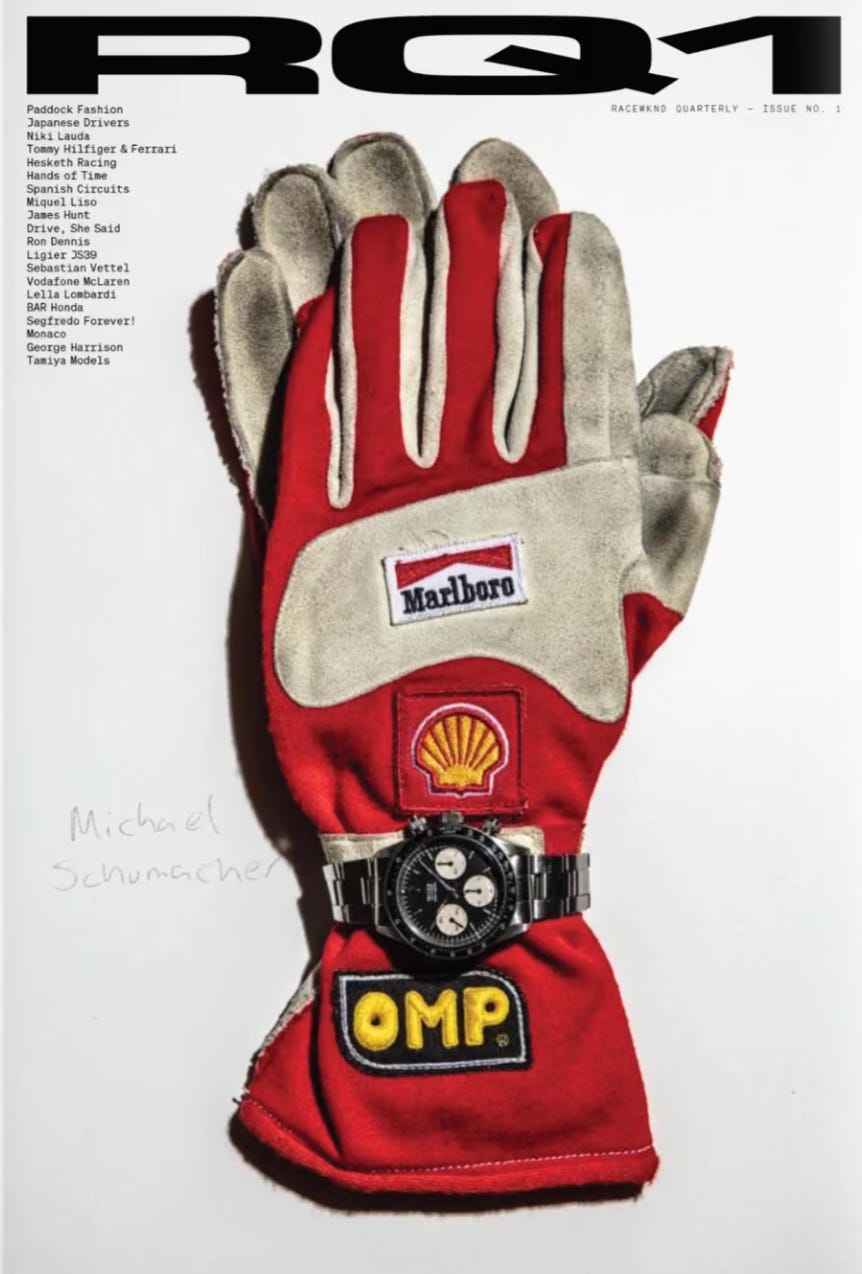
Scott explained exactly that: how the magazine is meant to be a keepsake that sits on your shelf so your collection grows, and I had RACEWKND RQ1 issue sitting right in front of me.
RQ1 is their quarterly on F1 culture, design, and fashion. The first issue has the race suit Senna wore to win Monaco in 1987 and an actual Hesketh 308 in it.
I’ve got a few others, too. We’ve moved houses three times since Magnus sent me the first one, and they’re so nice I just can’t ever throw them out.
“Case study in point,” Scott said, from behind his black square.
Money with Nothing to Show
Too many partners in this sport spend a fortune and have nothing to show for it.
Magnus told me most sponsors are completely dependent on the team to tell their story, and most of them are chasing vanity clicks. They want the fast views, and you can see it in the content.
One of the most downloaded things I’ve ever put out was a ranking of the teams on social: views, impressions, clicks. I did another one recently with a friend who runs a metrics company. Same thing. Every team downloaded it. It’s still the same game.
Before we hung up, Magnus called it a dream come true. Scott said he was lucky to be walking in Magnus’s footsteps. I told them the truth. This is exactly the type of work I’ve been talking about and have wanted to see in F1 for over a decade now.
This is how brands should be integrating with the fabric of the sport. And now, to see it come to fruition through truly good, creative humans is the best payoff one could wish for.
Business of Speed covers the business, technology, and lifestyle of racing: Formula 1, IndyCar, IMSA, WEC, NASCAR, and more. From Vincenzo Landino, entrepreneur and creator, featured in Bloomberg, TBPN, Yahoo! Finance, Forbes, Adweek, and Front Office Sports. You can find us on Instagram, Substack, and LinkedIn.
“By Monday night, nobody remembers the video that went out on Instagram on Monday morning. This magazine is going to sit on an executive’s desk, or on somebody’s coffee table, for years.”
Hell yeah! Physical memorabilia FTW.
Lovely column, Vincenzo <3
thank you for the very kind words, Vincenzo. 🙏