


We strive to remain an independent source of motorsport business. If Business of Speed has provided you with useful insights this year, please consider subscribing.
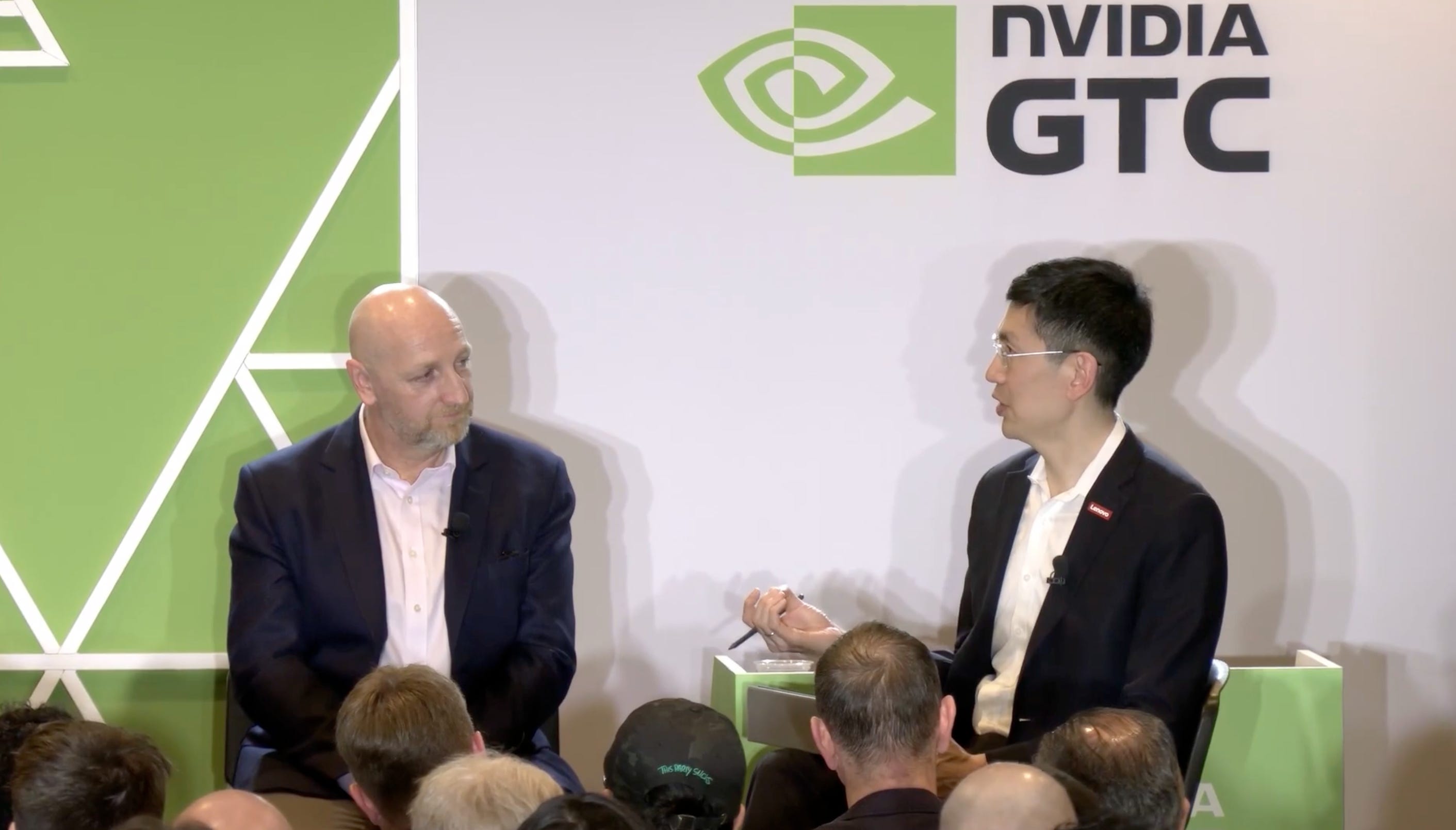
Chris Roberts told a few colleagues at Formula 1 that he had a new computer in the building. Within 24 hours, eight proposals to test it had landed in his inbox. The Lenovo ThinkStation PGX had an NVIDIA GB10 chip and was small enough to tuck under a desk. Roberts could also see taking it to the track, where he said he couldn’t always count on a connection.
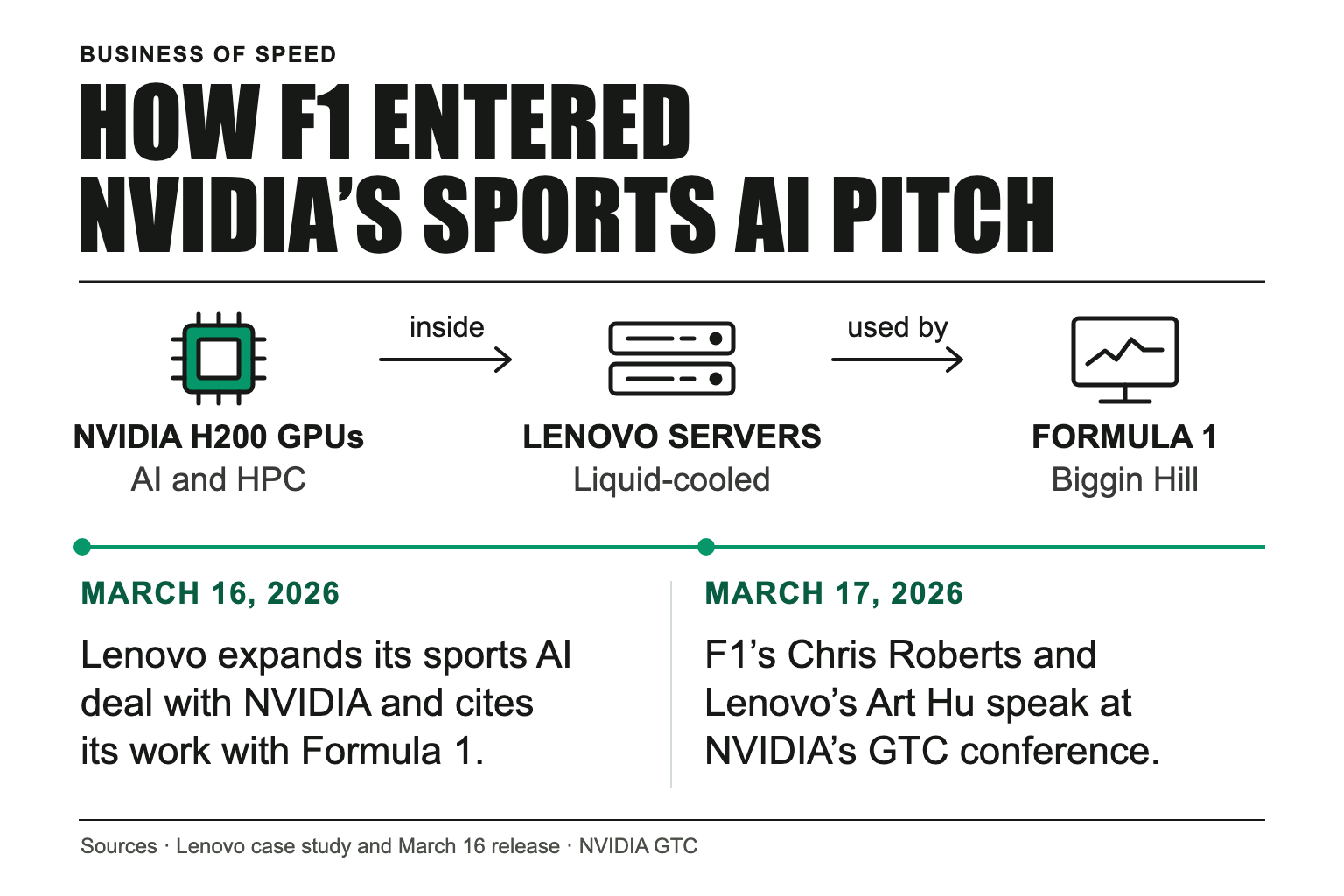
Roberts, F1’s IT director, told that story on March 17 at NVIDIA’s developer conference in San Jose. Onstage with him was Lenovo’s CIO, Art Hu. A day earlier, Lenovo had announced it was expanding a deal with NVIDIA to sell AI systems to sports organizations. It used Formula 1 to make the case.
You could see what Lenovo bought on Sunday at the Red Bull Ring. The Austrian Grand Prix carried its name, one of two race titles a season in Lenovo’s F1 deal. That agreement also keeps Lenovo supplying equipment and support at the circuit and back in Britain. NVIDIA makes chips that go inside some of that equipment. At GTC, the two companies could point prospective customers to a sport already using it.
By Thursday morning, Roberts’s crew stops making changes to the trackside systems. The FIA tests them around lunchtime, and by then F1 needs to be ready to film and time a Grand Prix. Sometimes the crew has 72 hours to move 160 tons of gear between continents. If Roberts needs engineers in São Paulo, he said he can call Lenovo and have them at the circuit within hours.
In January, F1 and Lenovo announced a server installation at Biggin Hill, where F1 produces its broadcasts. The servers use warm water to carry heat away from the processors. Lenovo says they contain NVIDIA H200 GPUs for AI and other jobs that need a lot of computing power. Lenovo also describes a proof of concept for automatically spotting and correcting poor-quality camera frames. If that works across more cameras, the production crew could handle more feeds.
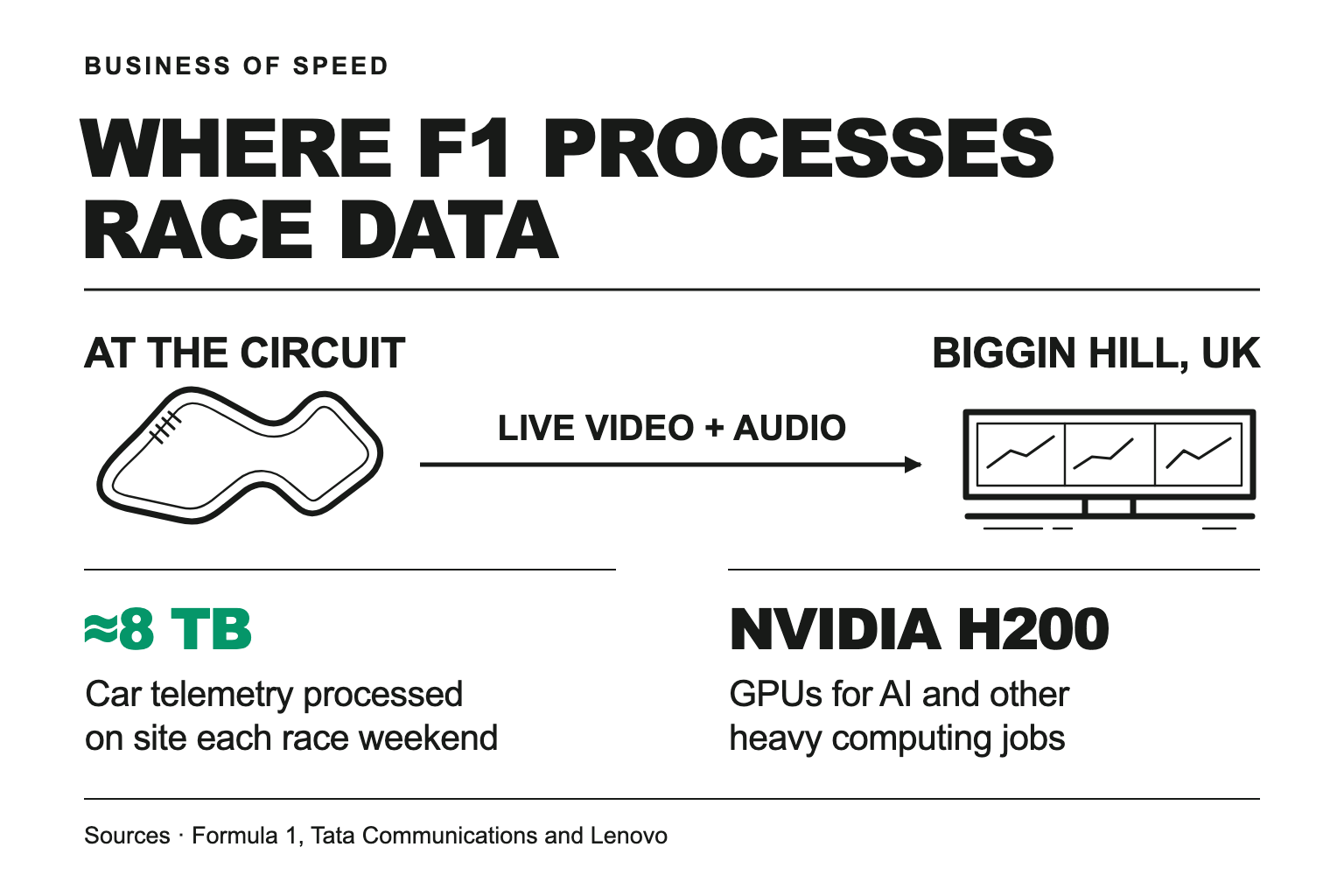
Tata Communications carries video and audio from the track to Britain. The production crew uses software built with AWS to spot developing stories in the timing data and team radio. Some jobs have moved in the other direction. In May, Lenovo said F1 had shifted the processing of roughly eight terabytes of car telemetry per weekend to servers at the track. That saves a round trip to Britain for the data people who need it at the circuit.
In Lenovo’s first F1 season in 2022, executive Emily Ketchen told Sports Business Journal that she wanted F1 to use the equipment so Lenovo could show other customers what it could do.
I saw that in action at last November’s Las Vegas Grand Prix, where I spent the week with T-Mobile for Business. The production crew needed its wireless cameras to work alongside the wired ones. Assistant Sheriff Dori Koren needed a connection his drone crews could count on when the Strip filled up.
When McLaren renewed its deal with Dell in February, the team said it uses Dell’s system to process up to 1.5 terabytes of data per race weekend for work that includes simulations and race scenarios. Dell’s name stays on the car. When Dell shows customers what McLaren uses, it calls the system Dell AI Factory with NVIDIA.
Hu told the GTC audience that Lenovo could show its systems working at the track and share what it had built with “other enterprise customers.” Lenovo had a list of things to sell them, including software to help run a venue and tools to label data for AI models.
Business of Speed covers the business, technology, and lifestyle of racing: Formula 1, IndyCar, IMSA, WEC, NASCAR, and more. From Vincenzo Landino, entrepreneur and creator, featured in Bloomberg, TBPN, Yahoo! Finance, Forbes, Adweek, and Front Office Sports. You can find us on Instagram, Substack, and LinkedIn.