

Andrea Kimi Antonelli won in Miami on Sunday to become the first driver in Formula 1 history to convert three consecutive first pole positions into victories, and the only driver ever to pair that with three straight wins from his first career result. He’s 19, in his second season, and he did it under the most genuine pressure he’s faced all year, holding off a McLaren that arrived in Florida with a real upgrade package and a reigning world champion pushing him for the entire second half of the race.
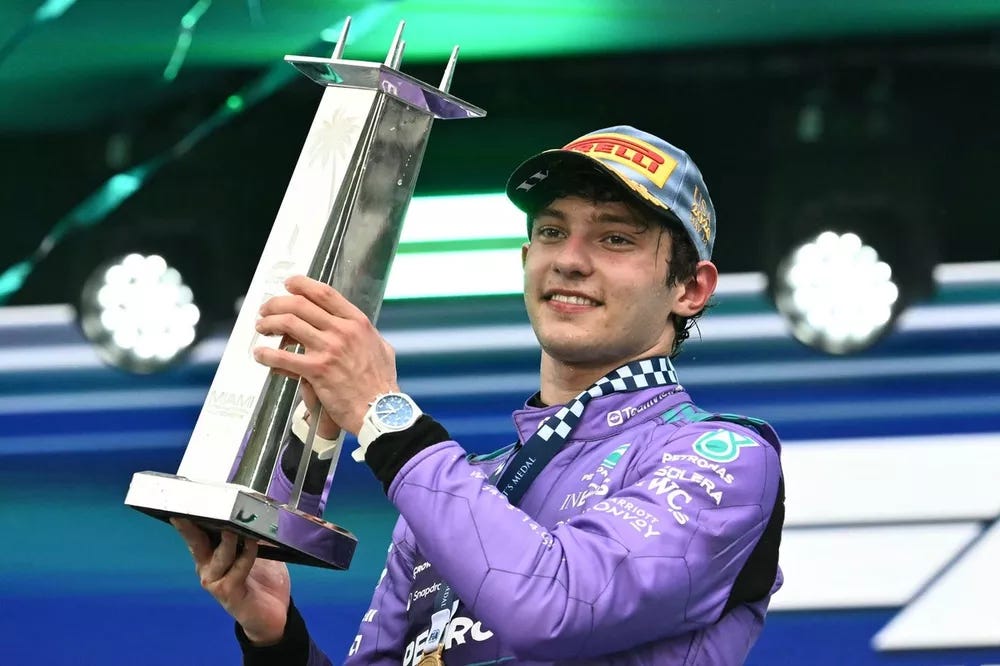
Italy hadn’t produced a repeat Grand Prix winner in over 70 years, since Alberto Ascari, and Giancarlo Fisichella’s 2006 win in Malaysia was the last time an Italian stood on the top step at all. An entire generation of Italian motorsport fans grew up rooting their national pride through Ferrari’s marque because there was nobody else to carry it.
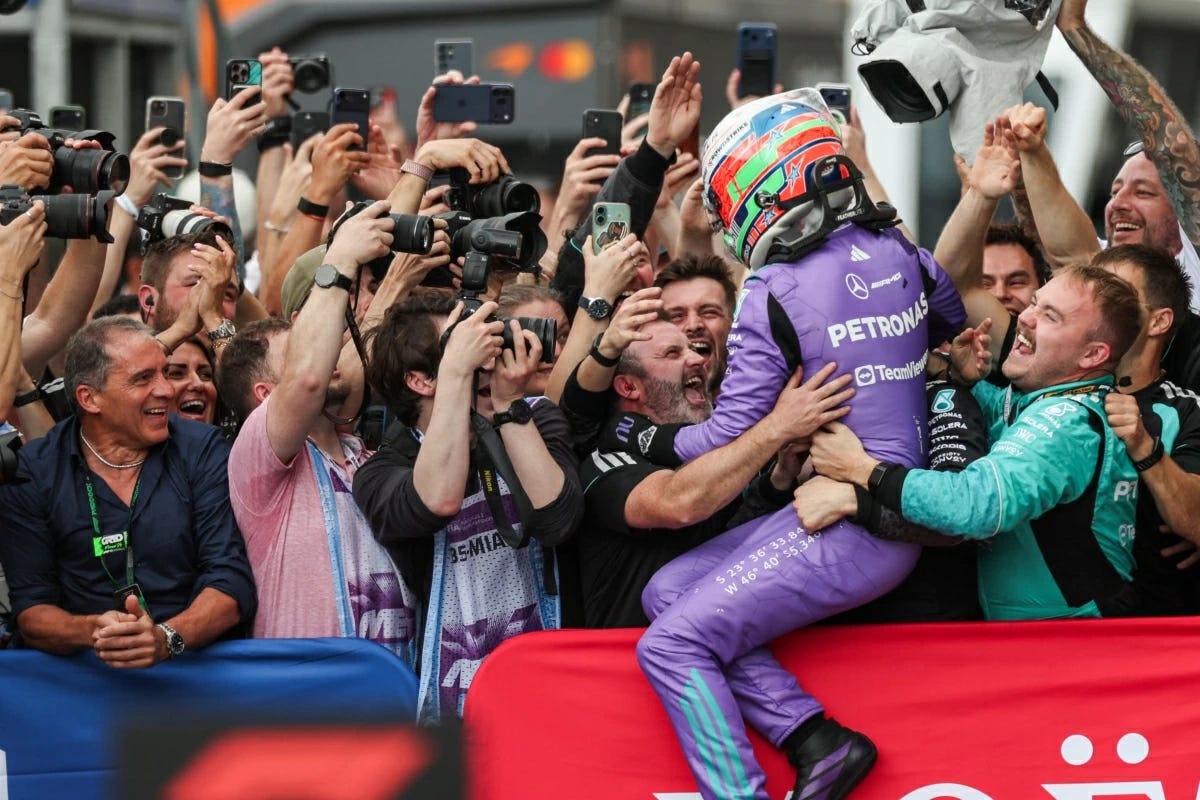
Sunday changed that, and when Antonelli cleared the barriers in parc fermé to find his parents, even the drivers who’d just finished behind him sought him out. Verstappen, both Cadillac drivers, and Franco Colapinto were all walking over with hugs. The paddock was telling you something.
Pair that with Jannik Sinner holding the world’s top tennis ranking at the same moment, and Italy has a cultural sports story it hasn’t had in a long time, two generational talents in two different sports running concurrently, neither of them appearing particularly burdened by what they’re carrying. And with the men’s Italian national soccer team missing a third straight World Cup, the time is now for both Sinner and Antonelli.
Antonelli said Thursday that he was aware of the historical pressure but wasn’t trying to focus on it. Watch the press conference footage, and you believe him.
Respect Earned
McLaren brought a meaningful upgrade to Miami, enough for Norris to beat Antonelli in Saturday’s sprint and spend the second half of Sunday with a legitimate shot at the lead. Antonelli dropped two positions at the start due to a grip problem; Toto Wolff later called it a team mistake. He fought his way back through Charles Leclerc, passed Norris on Lap 28, and then spent the closing stages defending, with a gearbox issue developing around Lap 33 and rear tire temperatures spiking four laps later. Peter Bonnington, who spent years talking Lewis Hamilton through equivalent moments from the same radio seat, brought him back lap by lap, and by Lap 40, Antonelli’s voice had settled.
The first three wins came with a car that made the driver’s job manageable. Miami had the advantage compressed, meaning the question of whether Antonelli is a product of Mercedes or a genuine championship-level driver is effectively answered.
Russell’s Discomfort
He finished fourth, admitting to Sky Sports F1 that he spent the final ten laps running Antonelli’s differential and brake bias settings after struggling all weekend with a setup that didn’t suit his style, and called the impact bigger than he expected. Russell is 20 points back, won in Canada last year, and has flagged Montreal as a circuit where he expects to recover ground. Antonelli, unprompted in the post-race press conference, said the same thing about his teammate.
Wolff is threading a needle that tightens with every Antonelli win, praising the younger driver publicly while immediately noting Russell’s competitive threat and framing the starts as a team-level problem rather than an individual one. Mercedes leads the constructors’ championship by 68 points, and the starts genuinely need fixing. Wolff called them unacceptable for a team with title ambitions, and he’s right about that.
The Viewing Data Shows Promise
The 2026 regulations have created a problem Liberty Media did not budget for. Spain’s DAZN recorded a 49% year-over-year audience drop after the Japanese Grand Prix, France’s Canal+ fell 43%, Germany lost 21%, and Austria shed 36%. These are not rounding errors in peripheral markets. France and Spain are two of the sport’s historically central territories, and the collapse in combined viewership across those four countries represents a direct threat to the broadcast rights valuations that underpin F1’s revenue model.
To understand why that matters financially, start with the top line. F1 generated $3.87 billion in revenue in 2025, with media rights fees accounting for 31.3% of that total and live viewership up 21% compared to 2024. Sponsorship alone contributed $840.4 million, up sharply from $634.5 million in 2024. The sport’s commercial model is built on audience scale, which justifies rights fees, which in turn justify sponsor pricing, reinforcing the cycle. A sustained decline in viewership in Europe puts pressure on every layer of that stack when broadcast contracts come up for renewal.
Italy is the single exception. Sky Sports Italia drew 824,000 viewers for the Japanese Grand Prix, up 36% over the same race in 2025, with Antonelli entering that weekend as the first Italian driver with a genuine shot at the championship since Michele Alboreto in 1985. That number didn’t happen because the 2026 regulations suddenly became popular in Bologna. It happened because Italy finally has a driver, and the market responded immediately and measurably.
For Liberty Media’s commercial team, Italy’s counter-trend is both a proof of concept and a product brief. Driver-market correlation is the mechanism they’ve used to grow audiences since Drive to Survive: Verstappen built the Netherlands, Norris accelerated the UK’s younger demographic, and Colapinto lit up Latin America overnight. What I’m calling the “Antonelli effect” has reignited national attention in Italy around a new protagonist in ways no marketing campaign could replicate, even as Italy was already engaged through Ferrari. The additive effect of a national title contender at a rival team is commercially distinct from Ferrari loyalty. It creates new entry points.
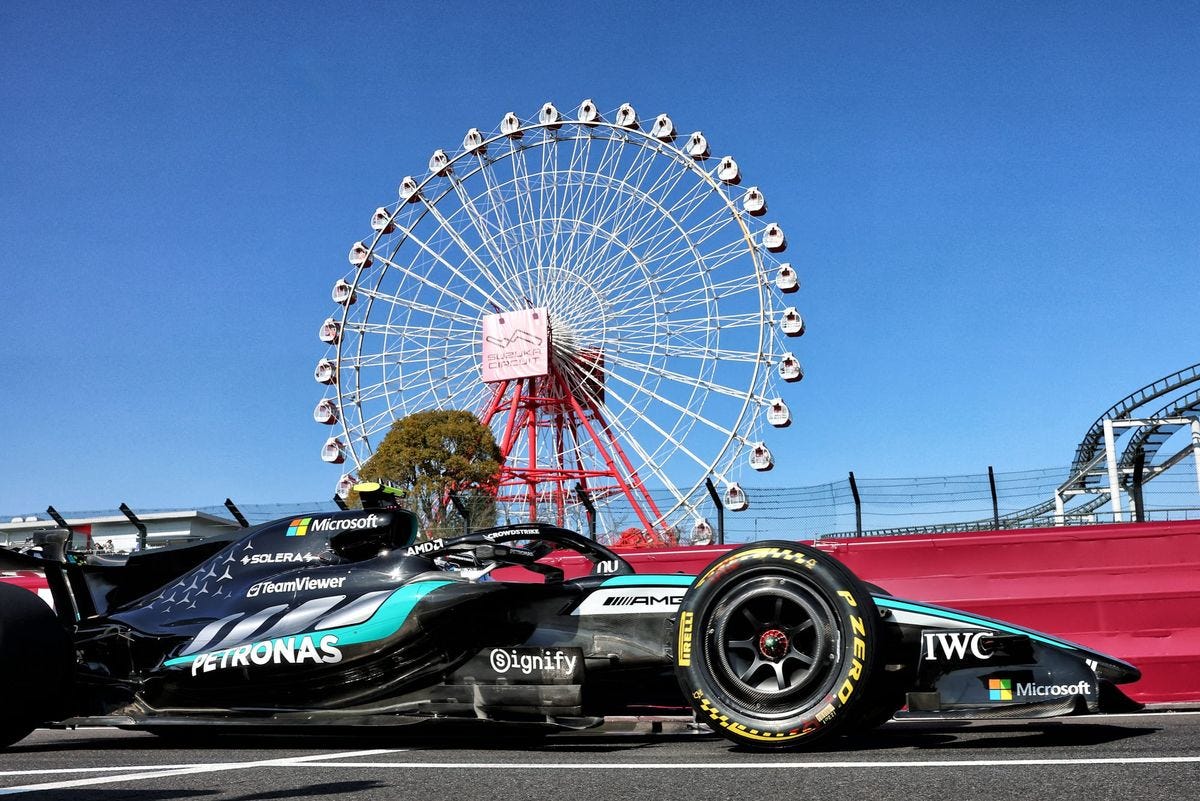
Mercedes, the direct beneficiary, is already the sport’s most commercially valuable constructor. SponsorUnited’s latest data puts Mercedes-AMG Petronas at an estimated $558 million in sponsorship revenue in 2025, leading all ten teams, with the average F1 sponsorship deal worth roughly $6 million, approximately eight times the average NFL team deal. Their Advertising Value Equivalent, which measures the media exposure delivered to commercial partners, reached $5.7 billion in 2024, up 8% year over year. Three wins into a dominant 2026 campaign, with a 19-year-old Italian leading the drivers’ championship, those AVE numbers are compounding in real time.
The contract structure underneath all of this is worth understanding. Antonelli is currently earning a reported $2 million base salary in 2026 and is under contract through 2029, so the renegotiation conversation isn’t imminent, but a market comparison already exists.
When Charles Leclerc won back-to-back in Belgium and Italy in 2019, his base salary reportedly moved from around $12 million to $30 million within two years. Antonelli is two years younger than Leclerc was at that moment, already has more wins, and is at the sport’s most commercially active team. The salary structure is management’s problem to solve in 2027. The endorsement value is a problem for every brand that didn’t sign him in 2025. [Note: salary figures above are estimates from third-party sources; neither Mercedes nor Antonelli’s camp has confirmed specific contract terms publicly.]
Across the sport, F1 team sponsorship reached $2.54 billion in 2025, a 22.1% increase that has closed the gap to the NFL, which leads at $2.66 billion, to just $120 million. F1 surpassed the English Premier League. That trajectory runs directly through narratives like this one: a young driver from a historically passionate market, winning in his second season, carrying a national story that every broadcaster on the continent can sell. The 2026 regulatory headwinds are real, and Liberty Media is under genuine pressure to fix the on-track product in several European markets. Antonelli gives them cover they didn’t plan for and leverage they’ll use, whether they acknowledge it explicitly or not.
Eighteen races remain. Russell will be competitive in Canada, McLaren will keep pushing, and the starts need fixing before a reliability or tactical error costs Antonelli points he shouldn’t be losing. None of that changes what the Italian audience data from four rounds already confirms, or what will happen to Mercedes’ $558 million commercial portfolio if this championship run extends to July.
The sport needed a story that could hold European audiences while the regulations were sorted out. One arrived on schedule, wearing number 12, and collecting the chequered flag in South Florida.
A big thanks to all of our subscribers, especially our Founding Members, for their continued support.
Founding Members: Andy Amendola, Web Smith, Alex Nunez, Hannah Elliot, Mark Boudreau, John LePore, Josh Felber, Marshall Pruett, Blake Plumley
Corporate Members: T-Mobile for Business, Electranet Inc., Bloomfield AI, HYTON
Field Notes - Miami Grand Prix
Thanks to our clients at Hyton, we had the opportunity to experience The Concours Club both at the Miami GP track and back at the club itself, located at the Opa Locka Executive Airport. We’ll write more about it in the coming weeks, but for now, here are some of the photos from the weekend.


Kimi is a beast. I hope he continues with his form. It is great to see that he is becoming a real star in Italy. It is also fun seeing Sinner talk about F1 when Grand Slams and Grand Prix have overlapping weekends.
The Italy point is really interesting because it breaks away from the broader European trend without much else materially changing. It feels less about fixing anything and more about giving people a reason to care again. That kind of pull seems stronger than we give it credit for.