


Remaining an independent source of motorsport business is what we strive for. If Business of Speed has provided you with useful insights this year, please consider subscribing.
McLaren’s new wordmark draws from the sign above the service station run by Bruce McLaren’s parents in Remuera, Auckland. You would not learn that from the text of McLaren Racing’s September 22 announcement on X. The post called it a “unique legacy,” showed the finished identity in a video and invited fans to “Learn more.” It left the family garage out of the caption.
The replies went straight to the lettering.
One fan wrote, “The current logo and swoosh are iconic.”
Another said the new typography had “no personality, no spirit”.
Two replies cannot tell us what the audience thinks, and the garage story may not change either person’s taste. They do show how quickly people judge a rebrand in the feed where they first encounter it.
Luckily, my friend Christina changed her mind after I posted about the logo's history.


I like the new wordmark. I wish McLaren had led with the story that gives it so much more meaning.
That sign is the source of the new lettering. It hung above the service station owned by Les and Ruth McLaren. Bruce spent his first nine years living in the flat upstairs, then kept learning at the garage after the family moved around the corner. The business shaped him decades before his name appeared on a Formula 1 car. McLaren has kept the familiar Speedmark alongside the wordmark.

Where McLaren’s New Wordmark Came From
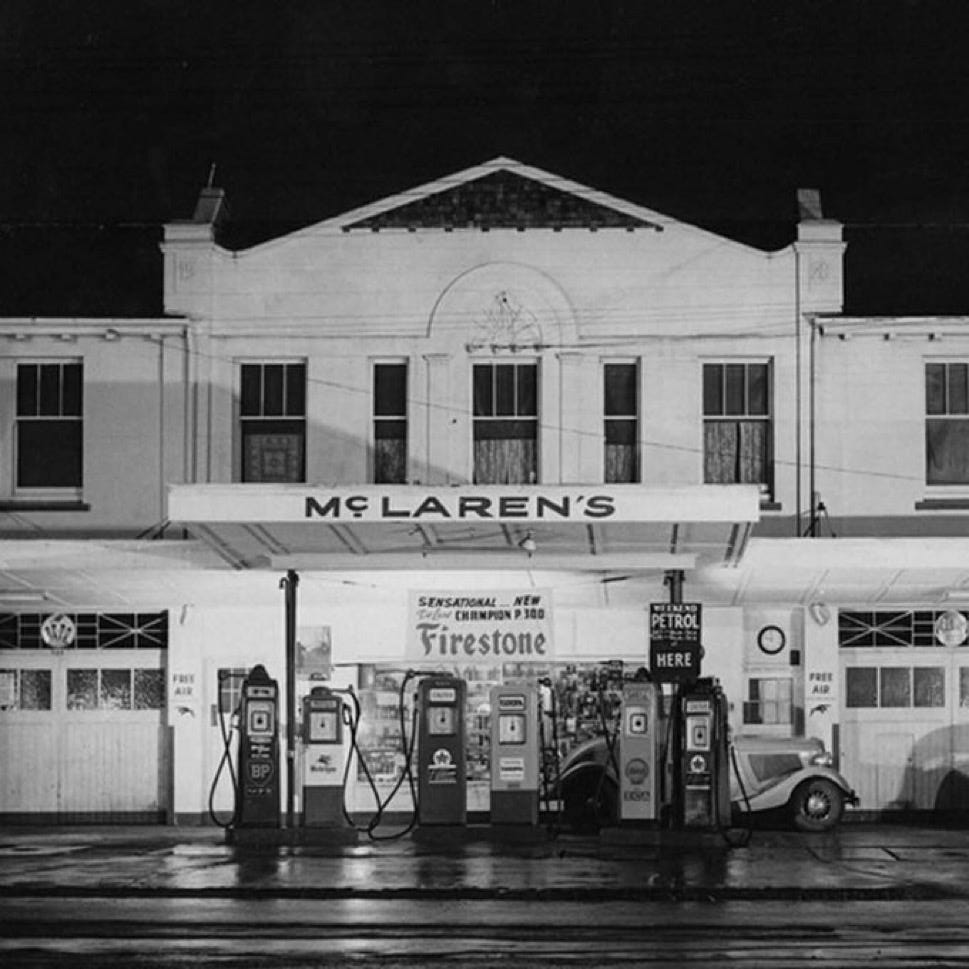
When Les McLaren bought the service-station business in 1936, he took over a decade-old building at 586-592 Remuera Road with pumps out front, a workshop at street level and flats above. Bruce was born the following year. Heritage New Zealand’s record of the property describes a boy who worked on his tricycle beside the mechanics and later learned from the garage foreman, Harold Bardsley.
The family moved around the corner to Upland Road in 1946, but the garage remained part of Bruce’s education. He and Les rebuilt an Ulster Austin Seven in the workshop behind their new home. Jack Brabham later based racing cars at the Remuera garage, where Bruce and Phil Kerr also worked on a Maserati in the 1950s. Bruce grew up among people who fixed and raced cars, and his family’s business gave them a place to meet.
McLaren’s announcement says Bruce built the car that took him to his first victory at the service station.
McLaren made the origin a second click
The X announcement had an embedded video and a link to McLaren’s fuller explanation. The caption spoke of ambition, creativity and legacy without naming Les, Ruth, Bruce’s childhood home or Remuera. That matters on a platform where people can reply without opening either asset.


I would have made this a slower reveal, opening on the sign above the pumps and the family who lived upstairs. From there, McLaren could trace the lettering from “McLAREN’S” to “McLAREN” and save the finished wordmark for the end. Fans would reach the design knowing why it looks the way it does.
I’ve written about what happens when a team leaves its story for someone else to tell.
A longer history than the Speedmark
The familiar McLaren symbols came later. Michael Turner’s first team crest placed a kiwi at its center in 1964; Doug Eyre’s Speedy Kiwi followed in 1971; and Raymond Loewy’s chevrons arrived as sponsors gained greater influence over the team in the early 1980s. Then came the Speedmark in 1997. McLaren’s own history traces those changes through shifting owners, sponsors and ambitions.
Each mark had a job. The kiwi declared Bruce’s New Zealand roots, the chevrons suited a sponsor-shaped Formula 1 team, and the Speedmark gave the company a symbol that could travel from race cars to road cars. The service-station sign reaches further back. It belongs to the family who gave the team its name.
McLaren Automotive chief creative officer David Woodhouse told Autocar that the company had spent a period “not recognizing our founder”. That is unusually candid language. The new wordmark now gives McLaren Automotive and McLaren Racing, which operate independently, a shared reference to the person behind both businesses.
That reference will have to travel farther than a launch graphic, however.
McLaren Automotive has plans for a performance SUV, and the McL 6GT concept has already brought Bruce’s road-car ambition back into view. I want to see the Remuera sign wherever McLaren explains why those vehicles belong under his name.
I expect the complaints about generic lettering to soften as more fans see the garage photograph and share it themselves.
There will always be critics.
Business of Speed covers the business, technology, and lifestyle of racing: Formula 1, IndyCar, IMSA, WEC, NASCAR, and more. From Vincenzo Landino, entrepreneur and creator, featured in Bloomberg, TBPN, Yahoo! Finance, Forbes, Adweek, and Front Office Sports. You can find us on Instagram, Substack, and LinkedIn.
