

Subscriber overload is real. Most of us are probably maxed out on the 3-4 subscriptions we can afford (me included). After reading about another Substacker’s $1 experiment, I decided to give it a shot. So here it is, for one week only: $1 subscription for life.
This edition brought to you by Spotify.

The big headline many chose to comment on last week after Liberty Media’s Q2 earnings report was that Formula 1 reported a 61% drop in operating income for the second quarter of 2026. Formula 1’s second-quarter revenue fell 38% to $764 million. Adjusted OIBDA fell 61% to $139 million. Operating income fell 75% to $73 million.
So did Formula 1’s business actually fall off a cliff, or was this just some accounting voodoo?
To start, quarterly reports are usually so skewed because they paint an incomplete picture. But the online reaction felt like a eulogy, so there I was last week, at my in-laws’ house, pouring rain outside, listening to a 56-minute earnings call while trying to keep my 4-year-old and 2-year-old occupied with the 2004 French GP.
The eulogists had plenty of material to work with. ‘Revenue fell 38 percent.’ ‘Adjusted OIBDA fell 61 percent.’ ‘Operating income fell 75 percent.’
As headlines, those look pretty worrisome. Here are the actual numbers; decide for yourself.
For the quarter ending June 30:
Formula 1 revenue: $764 million, down from $1.226 billion a year earlier
Adjusted OIBDA: $139 million, down from $361 million
Operating income: $73 million, down from $293 million
Team payments to the grid: $316 million, down from $513 million
Races held: five, against nine in the same quarter of 2025
What wasn’t in most of the headlines (but was in the articles people have to read) is that Formula 1 recognizes revenue by race—in fractions of the full season—timed to when races actually happen rather than spread evenly across the calendar. Five races occurred in Q2, compared with nine in 2025. Bahrain and Saudi Arabia never raced in April, casualties of the war in the Middle East. Japan moved to Q1. Imola dropped off the schedule completely. Fewer races run, less season to recognize, less revenue booked.
I don’t think Formula 1’s business took any real damage this quarter. Its books did. And that’s why I don’t give quarterly reports much space in my mind.

Let’s take a step back, and we’ll see that things aren’t looking too bad at all.
Liberty’s own calendar puts three races in the first quarter, five in the second, seven in the third, and eight crammed into the final nine weeks of the year, from early October through the first weekend of December.
In full-year 2025, all 24 races produced $3.873 billion in F1 revenue and $946 million in Adjusted OIBDA at a 24 percent margin. Nothing about the underlying contracts changed between June and August. Media rights fees escalate on schedule. Sponsors pay out the term they signed. Teams collect a fixed share of full-season profit once the books close.
What’s genuinely uncertain is the calendar itself. Liberty told the SEC that Bahrain and Saudi Arabia’s races didn’t happen in April “as a result of the ongoing conflict in the Middle East,” and that “additional calendar changes may be necessary” if it continues. Bahrain has already been rerouted to Malaysia for October. Qatar and Abu Dhabi are still on the books for late November and early December. It’s looking increasingly likely those two hold, if only because Formula 1 has now shown twice that it would rather relocate a race than cancel one. If they don’t, Stefano Domenicali has said the season finishes in Europe instead, probably at Imola.
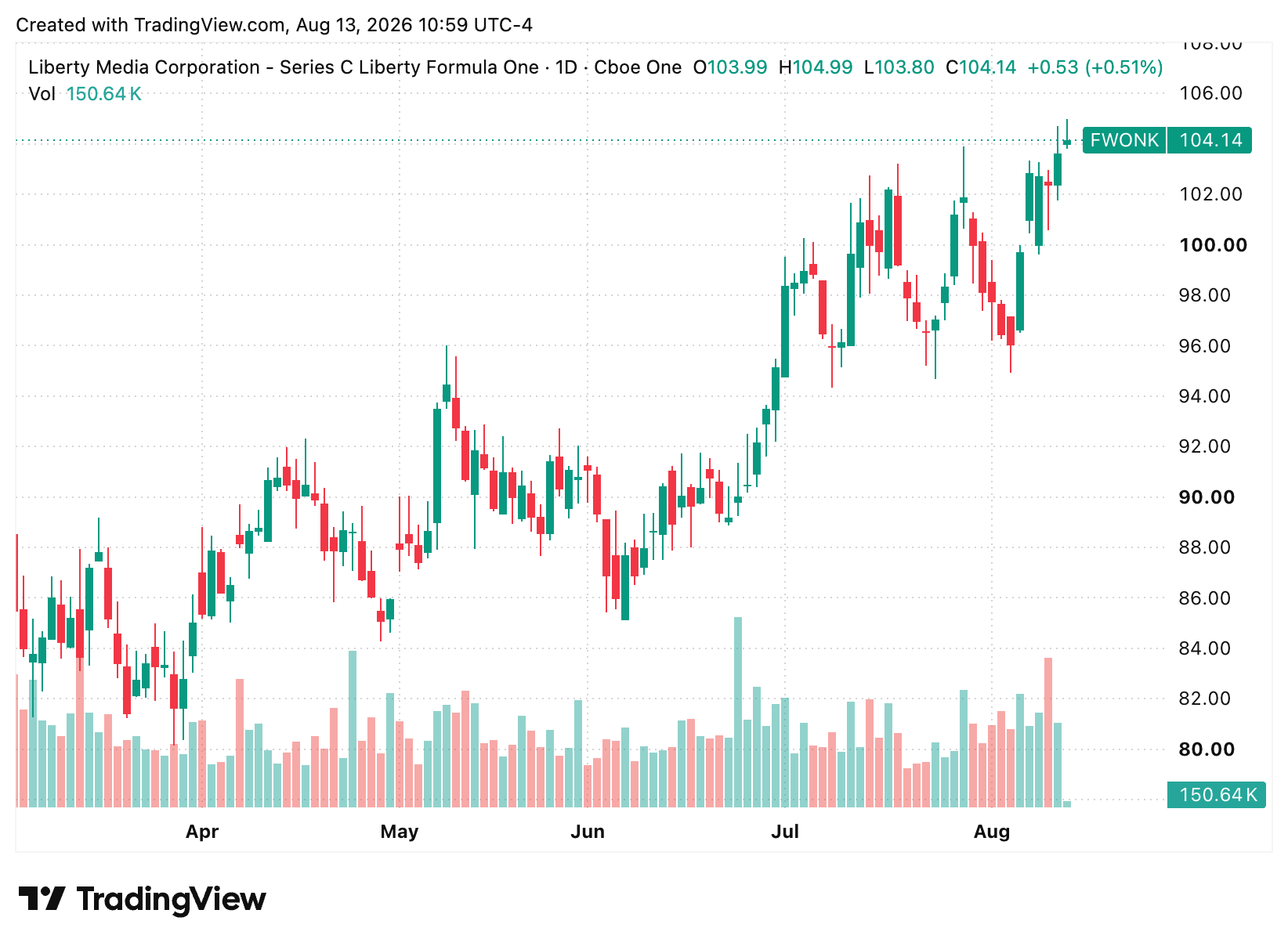
The market didn’t need convincing either. Liberty’s stock opened the morning of the earnings call at $96.05 and closed up 3.08 percent at $99.01. It has since continued to climb.
The questions on the call read the same way. Six analysts got time with management. None asked about the drop:
Evercore’s Kutgun Maral asked about media rights trajectory and Las Vegas profitability
Goldman Sachs asked management to strip out the calendar noise and describe underlying performance
Context helps too. Liberty paid $4.4 billion for Formula One Group in 2017. It paid a disclosed enterprise value of €4.2 billion, worth roughly $4.5 billion at the time, for MotoGP’s commercial rights in 2024, a series with a fraction of F1’s audience. The buyer who knows this asset class best keeps paying more for it.
And the demand seems to be in line with that story. Paddock Club, F1’s hospitality product, sold out for 2026 with team allocations for 2027 already locked in. Total hours watched on Apple’s broadcast are up 13 percent season to date. The Las Vegas Grand Prix just got a ten-year extension through 2037. Sponsorship revenue grew 32 percent in 2025, to $840 million, the fastest-growing line in the business.
The online reaction will always skew toward disaster, because that’s how clicks and headlines work. While a lot of it is just the headlines doing what they do, a lot of it is also the internet doing what it does best: complaining.
The critics aren’t wrong about everything. A global calendar comes with global risk attached, and Liberty just watched that risk cost it a Grand Prix and force it to use new language in a federal filing over a war it doesn’t control.
While the risks are real, the health of the sport has never been better.
Business of Speed covers the business, technology, and lifestyle of racing: Formula 1, IndyCar, IMSA, WEC, NASCAR, and more. From Vincenzo Landino, entrepreneur and creator featured in Bloomberg, TBPN, Yahoo! Finance, Forbes, Adweek, and Front Office Sports. You can find us on Instagram, Substack, and LinkedIn.
Brilliant!